AFTERSHOCK PROBABILISTIC FORECASTING AND TESTING OF OPERABILITY IN EARTHQUAKE FIELD INVESTIGATION ON-SITE: A CASE OF THE 2025 DINGRI MS6.8 EARTHQUAKE IN XIZANG
ZHANG Sheng-feng(), ZHANG Yong-xian
Institute of Earthquake Forecasting, China Earthquake Administration, Beijing 100036, China
ZHANG Sheng-feng, ZHANG Yong-xian. AFTERSHOCK PROBABILISTIC FORECASTING AND TESTING OF OPERABILITY IN EARTHQUAKE FIELD INVESTIGATION ON-SITE: A CASE OF THE 2025 DINGRI MS6.8 EARTHQUAKE IN XIZANG[J]. SEISMOLOGY AND GEOLOGY, 2025, 47(3): 835-849.
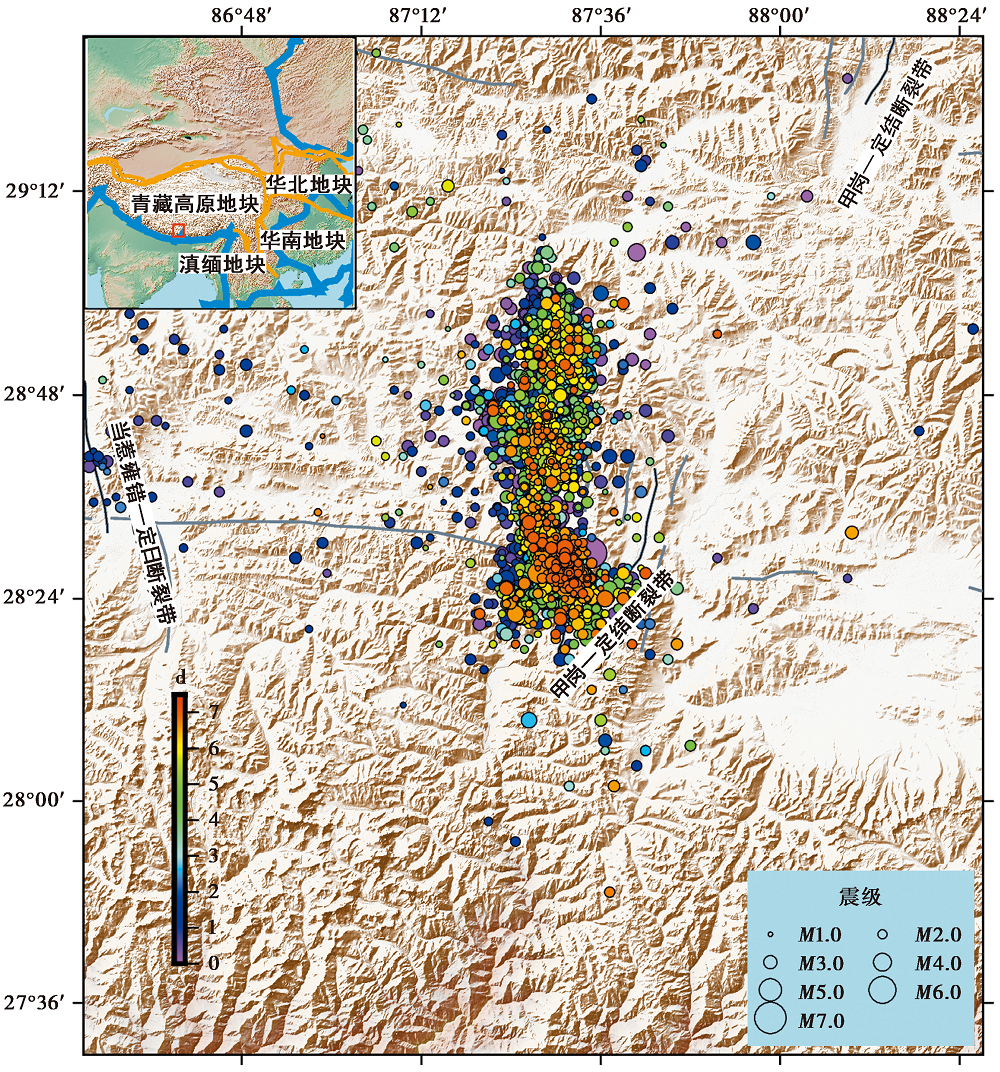
Fig. 1 Epicenter distribution of aftershock sequence of MS6.8 earthquake in Dingri, Xizang.
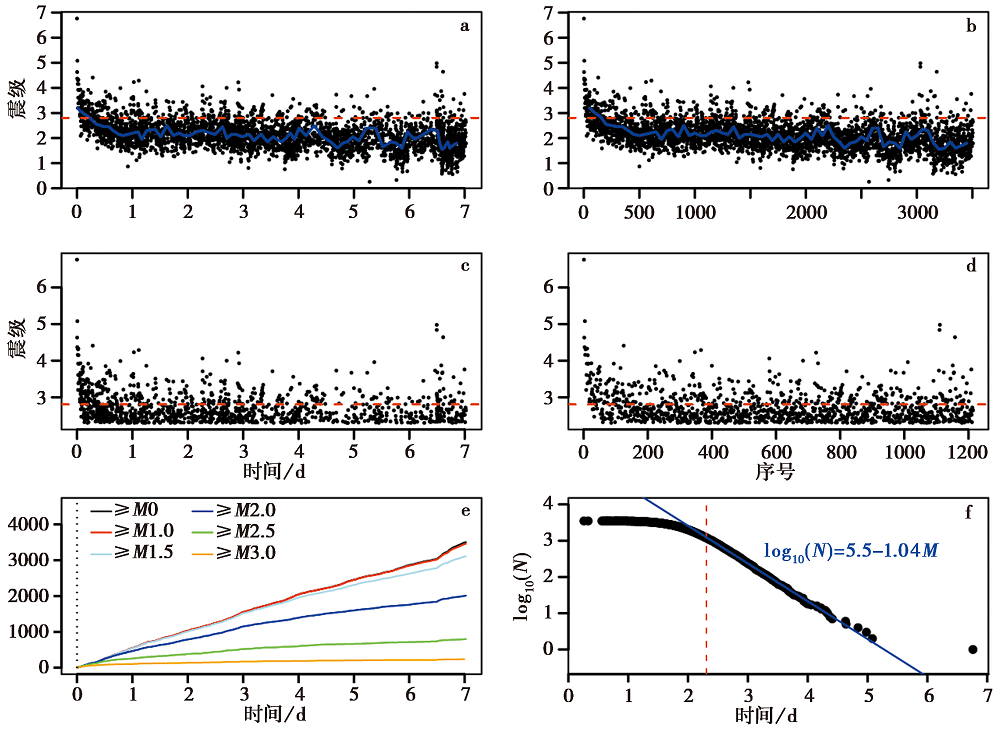
Fig. 2 Different analysis perspectives on the MS6.8 earthquake sequence in Dingri, Xizang, carried out during this research work.
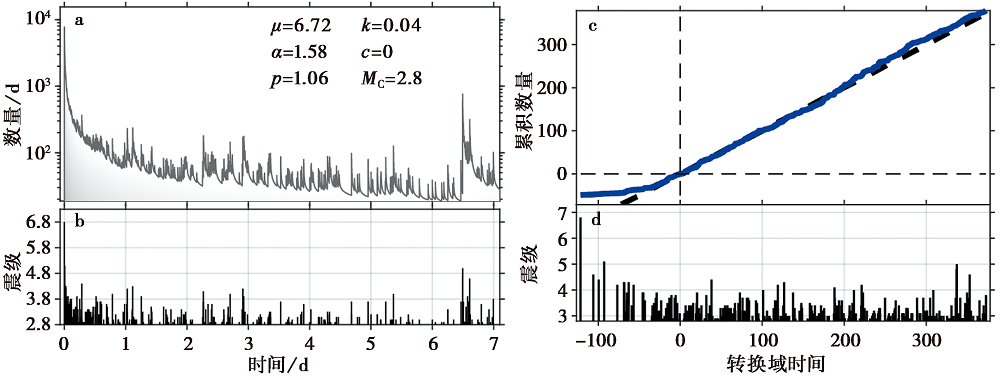
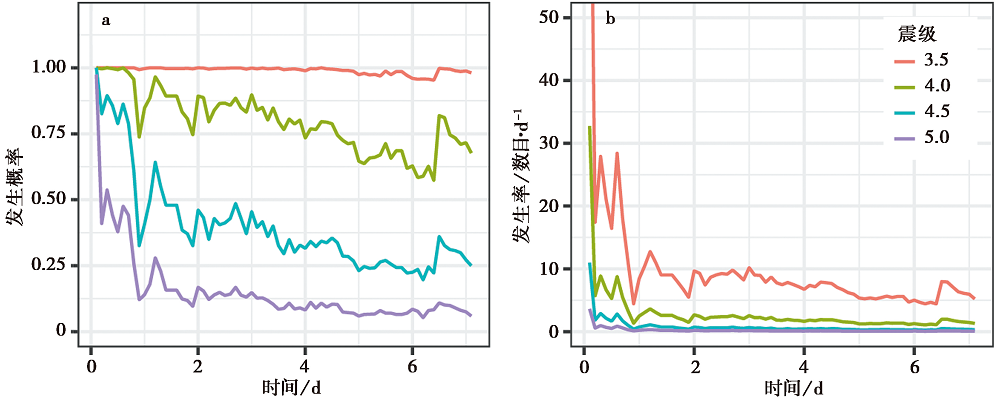
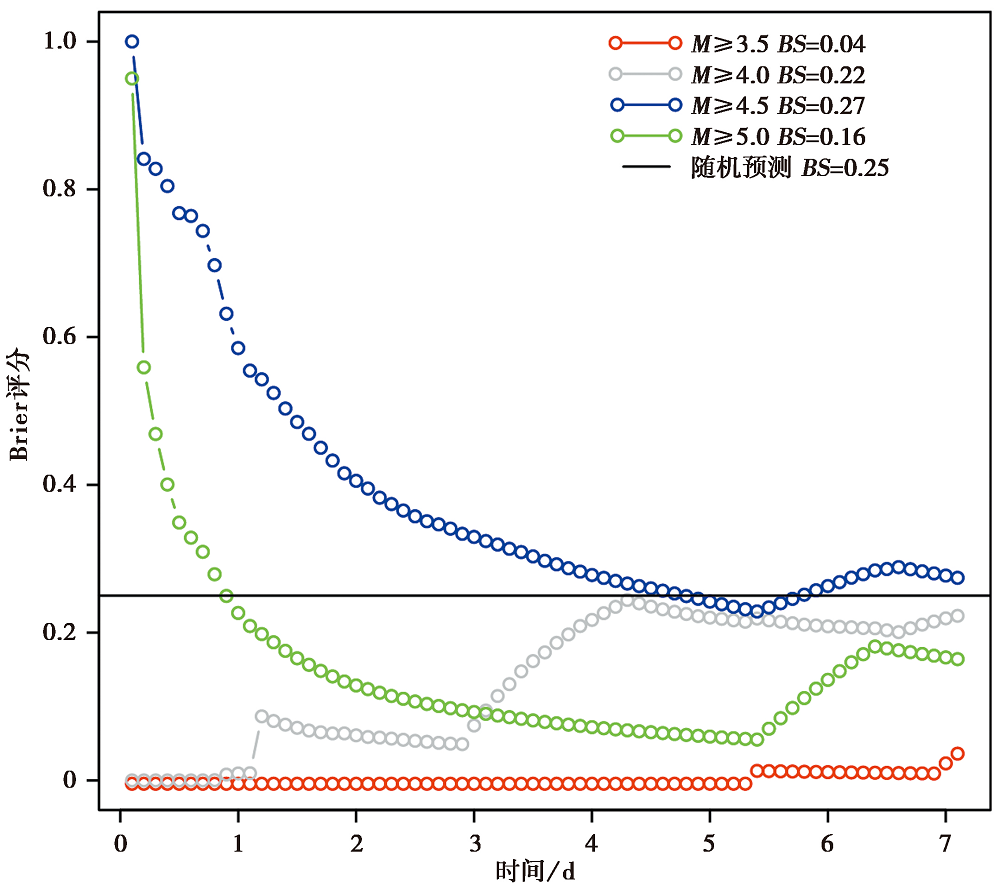
Fig. 3 The results of model fitting and residual analysis of the aftershock sequence of the Dingri MS6.8 earthquake in Xizang using the temporal ETAS model.
Table 1 Parameters used in the short-term probabilistic forecasting model of the temporal ETAS model
JIANGChang-sheng, HANLi-bo, GUOLu-jie. 2014. Parameter characteristics in the early period of three earthquake sequences in the Yutian, Xinjiang since 2008[J]. Acta Seismologica Sinica, 36(2): 165-174 (in Chinese).
JIANGChang-sheng, WUZhong-liang, HANLi-bo, et al. 2013. Effect of cutoff magnitude MC of earthquake catalogues on the early estimation of earthquake sequence parameters with implication for the probabilistic forecast of aftershocks: The 2013 Minxian-Zhangxian, Gansu, MS6.6 earthquake sequence[J]. Chinese Journal of Geophysics, 56(12): 4048-4057 (in Chinese).
[3]
AkaikeH. 1974. A new look at the statistical model identification[J]. IEEE Transactions on Automatic Control, 19(6): 716-723.
[4]
AkaikeH. 1998. Information theory and an extension of the maximum likelihood principle[G]// Parzen E, Tanabe K, Kitagawa G(Eds.), Selected Papers of Hirotugu Akaike. Springer New York, NY: 199-213.
[5]
BrierG W. 1950. Verification of forecasts expressed in terms of probability[J]. Monthly Weather Review, 78(1): 1-3.
[6]
DaleyD J, Vere-JonesD. 2003. An Introduction to Theory of Point Processes-Volume 1: Elementary Theory and Methods(2nd Edition)[M]. Springer-Verlag New York, NY.
[7]
GerstenbergerM C, WiemerS, JonesL M, et al. 2005. Real-time forecasts of tomorrow’s earthquakes in California[J]. Nature, 435(7040): 328-331.
[8]
GutenbergB, RichterC F. 1944. Frequency of earthquakes in California[J]. Bulletin of the Seismological Society of America, 34(4): 185-188.
[9]
IwataT. 2008. Low detection capability of global earthquakes after the occurrence of large earthquakes: Investigation of the Harvard CMT catalogue[J]. Geophysical Journal International, 174(3): 849-856.
[10]
JordanT H. 2013. Lessons of L'Aquila for operational earthquake forecasting[J]. Seismological Research Letters, 84(1): 4-7.
[11]
JordanT H, JonesL M. 2010. Operational earthquake forecasting: Some thoughts on why and how[J]. Seismological Research Letters, 81(4): 571-574.
[12]
JordanT H, MarzocchiW, MichaelA J, et al. 2014. Operational earthquake forecasting can enhance earthquake preparedness[J]. Seismological Research Letters, 85(5): 955-959.
[13]
KawamuraM, ChenC C. 2013. Precursory change in seismicity revealed by the Epidemic-Type Aftershock-Sequences model: A case study of the 1999 Chi-Chi, Taiwan earthquake[J]. Tectonophysics, 592: 141-149.
[14]
LewisP A W, ShedlerG S. 1979. Simulation of nonhomogeneous poisson processes by thinning[J]. Naval Research Logistics Quarterly, 26(3): 403-413.
[15]
MizrahiL, DalloI, van der ElstN J, et al. 2024. Developing, testing, and communicating earthquake forecasts: Current practices and future directions[J]. Reviews of Geophysics, 62(3): e2023RG000823.
[16]
MolchanG M, DmitrievaO E, RotwainI M, et al. 1990. Statistical analysis of the results of earthquake prediction, based on bursts of aftershocks[J]. Physics of the Earth and Planetary Interiors, 61(1-2): 128-139.
[17]
OgataY. 1978. The asymptotic behaviour of maximum likelihood estimators for stationary point processes[J]. Annals of the Institute of Statistical Mathematics, 30(2): 243-261.
[18]
OgataY. 1981. On Lewis’ simulation method for point processes[J]. IEEE Transactions on Information Theory, 27(1): 23-31.
[19]
OgataY. 1988. Statistical models for earthquake occurrences and residual analysis for point processes[J]. Journal of the American Statistical Association, 83(401): 9-27.
[20]
OgataY. 1989. Statistical model for standard seismicity and detection of anomalies by residual analysis[J]. Tectonophysics, 169(1): 159-174.
[21]
OgataY. 1992. Detection of precursory relative quiescence before great earthquakes through a statistical model[J]. Journal of Geophysical Research: Solid Earth, 97(B13): 19845-19871.
[22]
OgataY. 2001. Increased probability of large earthquakes near aftershock regions with relative quiescence[J]. Journal of Geophysical Research: Solid Earth, 106(B5): 8729-8744.
[23]
OgataY. 2006. Monitoring of anomaly in the aftershock sequence of the 2005 earthquake of M7.0 off coast of the western Fukuoka, Japan, by the ETAS model[J]. Geophysical Research Letters, 33(1): L01303.
[24]
OgataY, TsuruokaH. 2016. Statistical monitoring of aftershock sequences: A case study of the 2015 MW7.8 Gorkha, Nepal, earthquake[J]. Earth, Planet and Space, 68(1): 44.
[25]
OmiT, OgataY, HirataY, et al. 2014. Estimating the ETAS model from an early aftershock sequence[J]. Geophysical Research Letters, 41(3): 850-857.
[26]
OmoriF. 1894. On the aftershocks of earthquakes[J]. Journal of the College of Science, Imperial University of Tokyo, 7: 111-200.
[27]
PapangelouF. 1972. Integrability of expected increments of point processes and a related random change of scale[J]. Transactions of the American Mathematical Society, 165: 483-506.
[28]
ReasenbergP A, JonesL M. 1989. Earthquake hazard after a mainshock in California[J]. Science, 243(4895): 1173-1176.
[29]
ReasenbergP A, JonesL M. 1990. California aftershock hazard forecasts[J]. Science, 247(4940): 345-346.
RhoadesD A. 2013. Mixture models for improved earthquake forecasting with short-to-medium time horizons[J]. Bulletin of the Seismological Society of America, 103(4): 2203-2215.
[31]
RhoadesD A, LiukisM, ChristophersenA, et al. 2015. Retrospective tests of hybrid operational earthquake forecasting models for Canterbury[J]. Geophysical Journal International, 204(1): 440-456.
[32]
ShebalinP, NarteauC, HolschneiderM, et al. 2011. Short-term earthquake forecasting using early aftershock statistics[J]. Bulletin of the Seismological Society of America, 101(1): 297-312.
[33]
ShebalinP, NarteauC, ZecharJ D, et al. 2014. Combinning earthquake forecasts using different probability gains[J]. Earth, Planet and Space, 66:37.
[34]
UtsuT. 1961. A statistical study of on the occurrence of aftershocks[J]. The Geophysical Magazine, 30: 521-605.
[35]
WilksD S. 2010. Sampling distributions of the Brier score and Brier skill score under serial dependence[J]. Quarterly Journal of the Royal Meteorological Society, 136(653): 2109-2118.
[36]
WoessnerJ, WiemerS. 2005. Assessing the quality of earthquake catalogues: Estimating the magnitude of completeness and its uncertainty[J]. Bulletin of the Seismological Society of America, 95(2): 684-698.
[37]
ZaliapinI, Ben-ZionY. 2013. Earthquake clusters in southern California I: Identification and stability[J]. Journal of Geophysical Research: Solid Earth, 118(6): 2847-2864.
[38]
ZhangS F, ZhangY X, LiS. 2024. Time-dependent aftershock probabilistic forecasting and ensemble model implementation: Insights from the 2021 MS7.4 Maduo earthquake[J]. Seismological Research Letters, 95(6): 3517-3531.
[39]
ZhuangJ C, OgataY, WangT. 2017. Data completeness of the Kumamoto earthquake sequence in the JMA catalog and its influence on the estimation of the ETAS parameters[J]. Earth, Planets and Space, 69(1): 36.