
SEISMOLOGY AND GEOLOGY ›› 2026, Vol. 48 ›› Issue (4): 981-994.DOI: 10.3969/j.issn.0253-4967.20250058
• Research paper • Previous Articles Next Articles
EXPERIMENTAL STUDY ON THE EFFECT OF STRESS PERTURBATION ON ACOUSTIC EMISSION ACTIVITY DURING FAULT SLIP
HUANG Yuan-min1,2)( ), GUO Yan-shuang2), MA Sheng-li2), LI Xiao-hui1), ZHANG Hui3)
- 1)
Guangdong Earthquake Agency
2)State Key Laboratory of Earthquake Dynamics and Forecasting ,Institute of Geology, China Earthquake Administration
3)Hainan Earthquake Agency
-
Received:2025-02-25Revised:2025-05-26Online:2026-08-20Published:2026-09-09
应力扰动对断层滑动声发射活动影响的实验
黄元敏1,2)(), 郭彦双2), 马胜利2), 李晓慧1), 张慧3)
- 1)
广东省地震局
2)地震动力学与强震预测全国重点实验室(中国地震局地质研究所)
3)海南省地震局
-
作者简介:黄元敏, 男, 1982年生, 博士, 高级工程师, 主要从事构造物理实验与模拟、 注水诱发地震、 地震预测等方面研究工作, E-mail: eq_hym@aliyun.com。
-
基金资助:地震动力学与强震预测全国重点实验室(LED2024B08); 国家重点研发计划项目(2023YFC3008605-4); 海南省自然科学基金(422QN430)

Cite this article
HUANG Yuan-min, GUO Yan-shuang, MA Sheng-li, LI Xiao-hui, ZHANG Hui. EXPERIMENTAL STUDY ON THE EFFECT OF STRESS PERTURBATION ON ACOUSTIC EMISSION ACTIVITY DURING FAULT SLIP[J]. SEISMOLOGY AND GEOLOGY, 2026, 48(4): 981-994.
黄元敏, 郭彦双, 马胜利, 李晓慧, 张慧. 应力扰动对断层滑动声发射活动影响的实验[J]. 地震地质, 2026, 48(4): 981-994.
share this article
Add to citation manager EndNote|Ris|BibTeX
URL: https://www.dzdz.ac.cn/EN/10.3969/j.issn.0253-4967.20250058
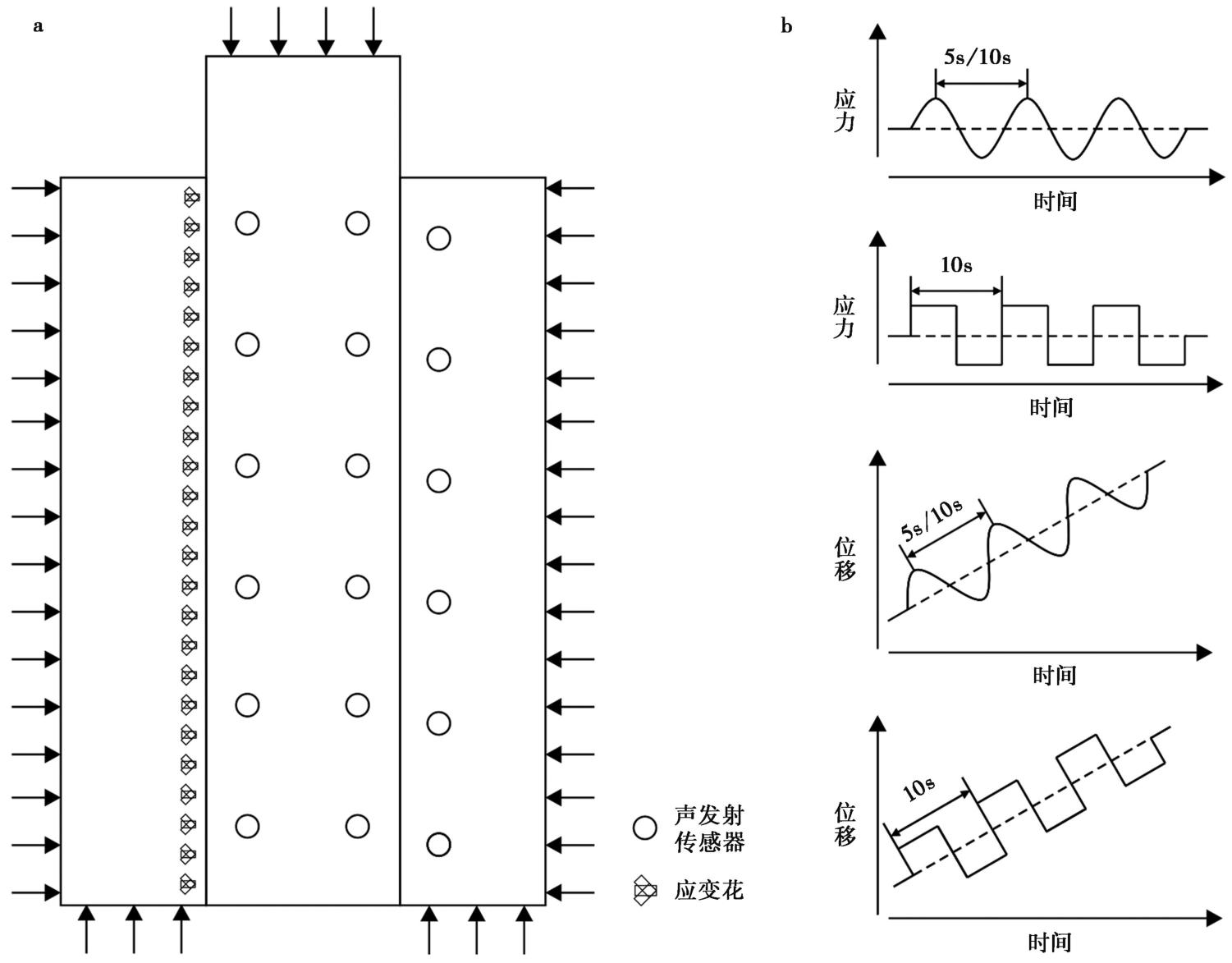
Fig. 1 Schematic drawing of the sample showing AE sensors and strain gauges(a) and modes of stress perturbation(b).
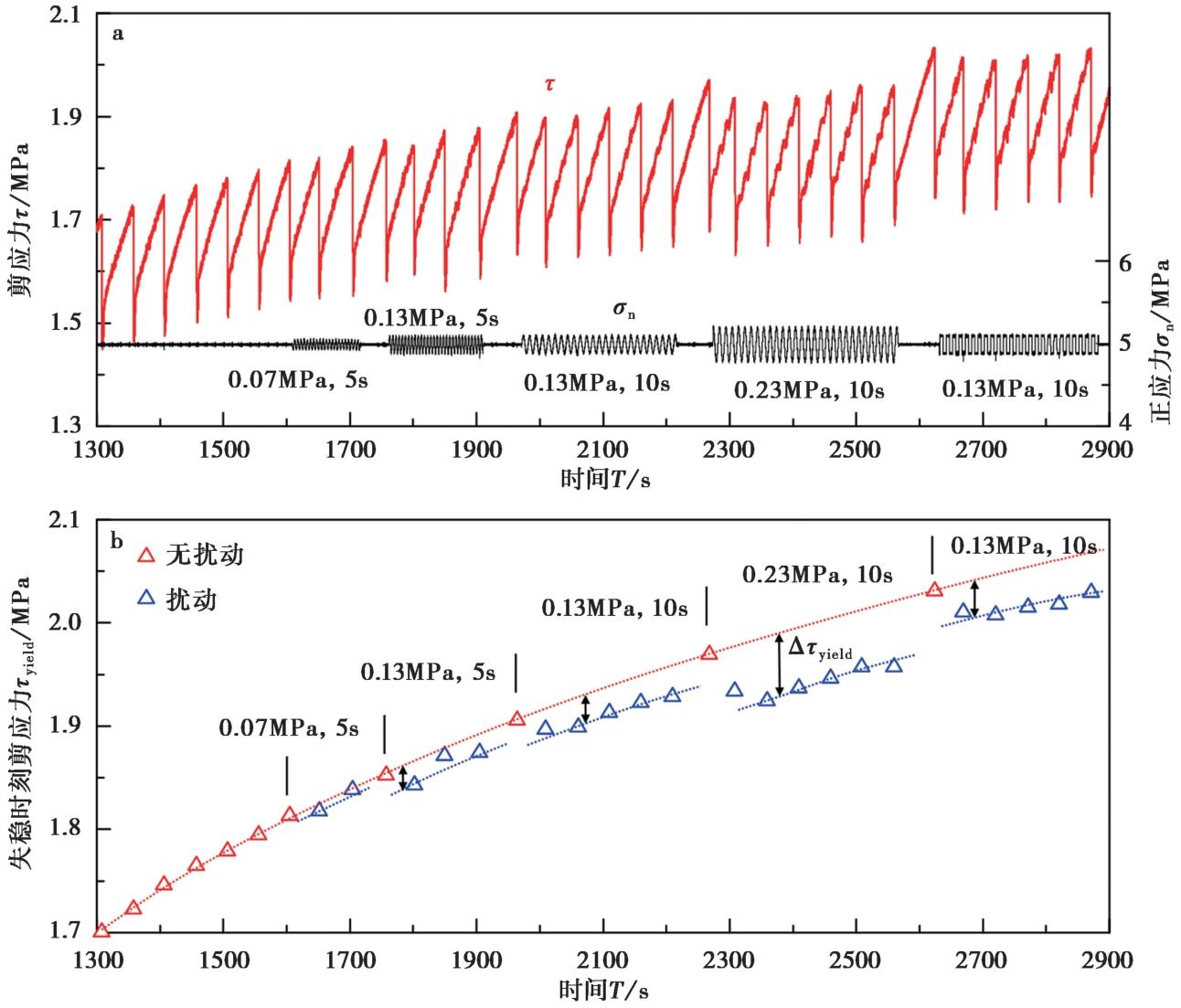
Fig. 2 Stress curve(a) and failure stress at stick-slip(b) for normal stress perturbations applied on the fault at 5MPa average normal stress.
| 扰动方式 | 正弦波状扰动 | 方波状扰动 | ||||||||
|---|---|---|---|---|---|---|---|---|---|---|
| 振幅和周期 | 0.07MPa,5s | 0.13MPa,5s | 0.13MPa,10s | 0.23MPa,10s | 0.13MPa,10s | |||||
| 扰动前后失稳应力差Δτyield/MPa | 0.007 | 0.025 | 0.028 | 0.061 | 0.037 | |||||
Table1 Difference of shear stress at stick-slip for different normal stress perturbations applied on the fault.
| 扰动方式 | 正弦波状扰动 | 方波状扰动 | ||||||||
|---|---|---|---|---|---|---|---|---|---|---|
| 振幅和周期 | 0.07MPa,5s | 0.13MPa,5s | 0.13MPa,10s | 0.23MPa,10s | 0.13MPa,10s | |||||
| 扰动前后失稳应力差Δτyield/MPa | 0.007 | 0.025 | 0.028 | 0.061 | 0.037 | |||||
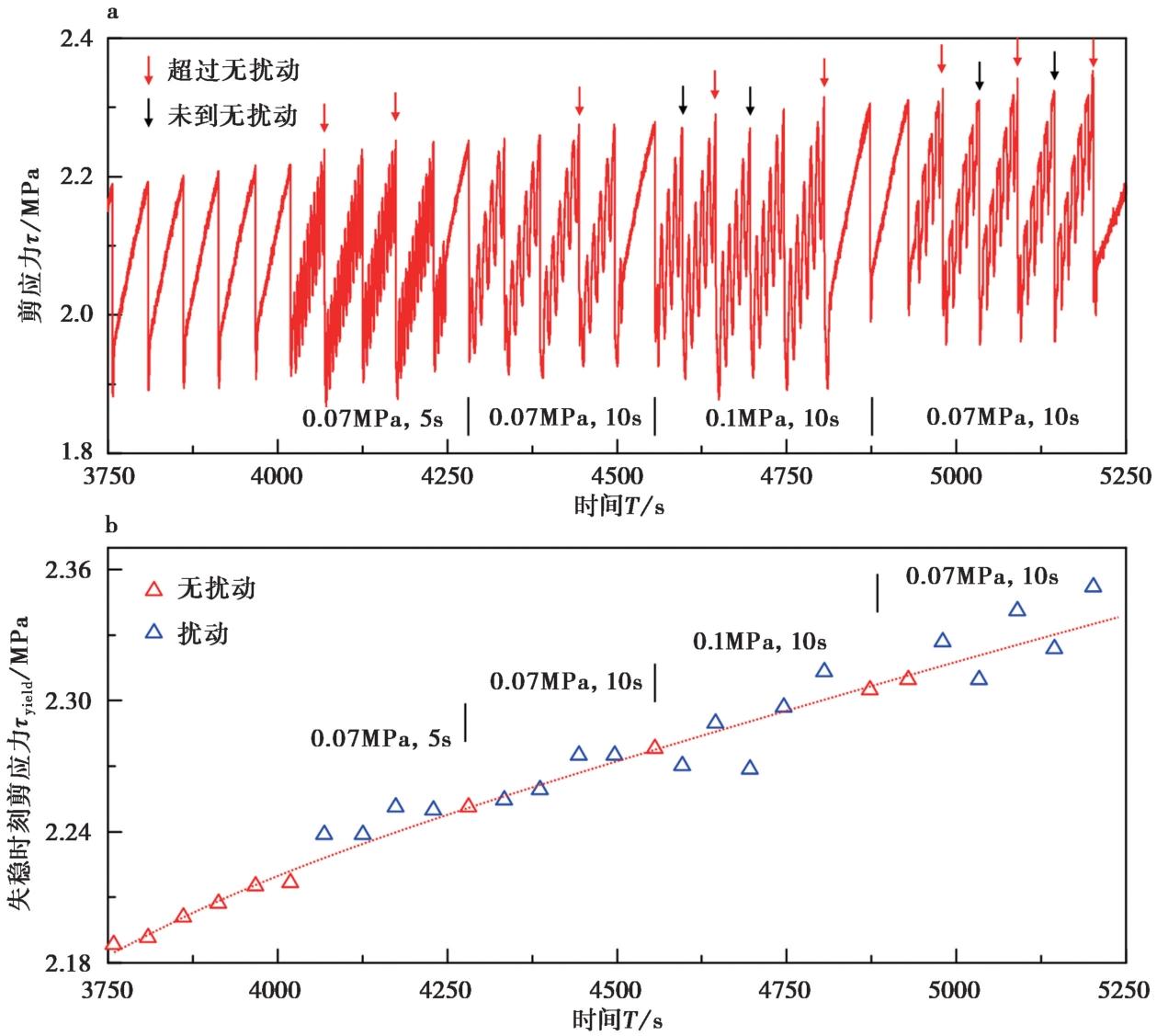
Fig. 3 Stress curve(a) and failure stress at stick-slip(b) for shear stress perturbations applied on the fault at 5MPa average normal stress.
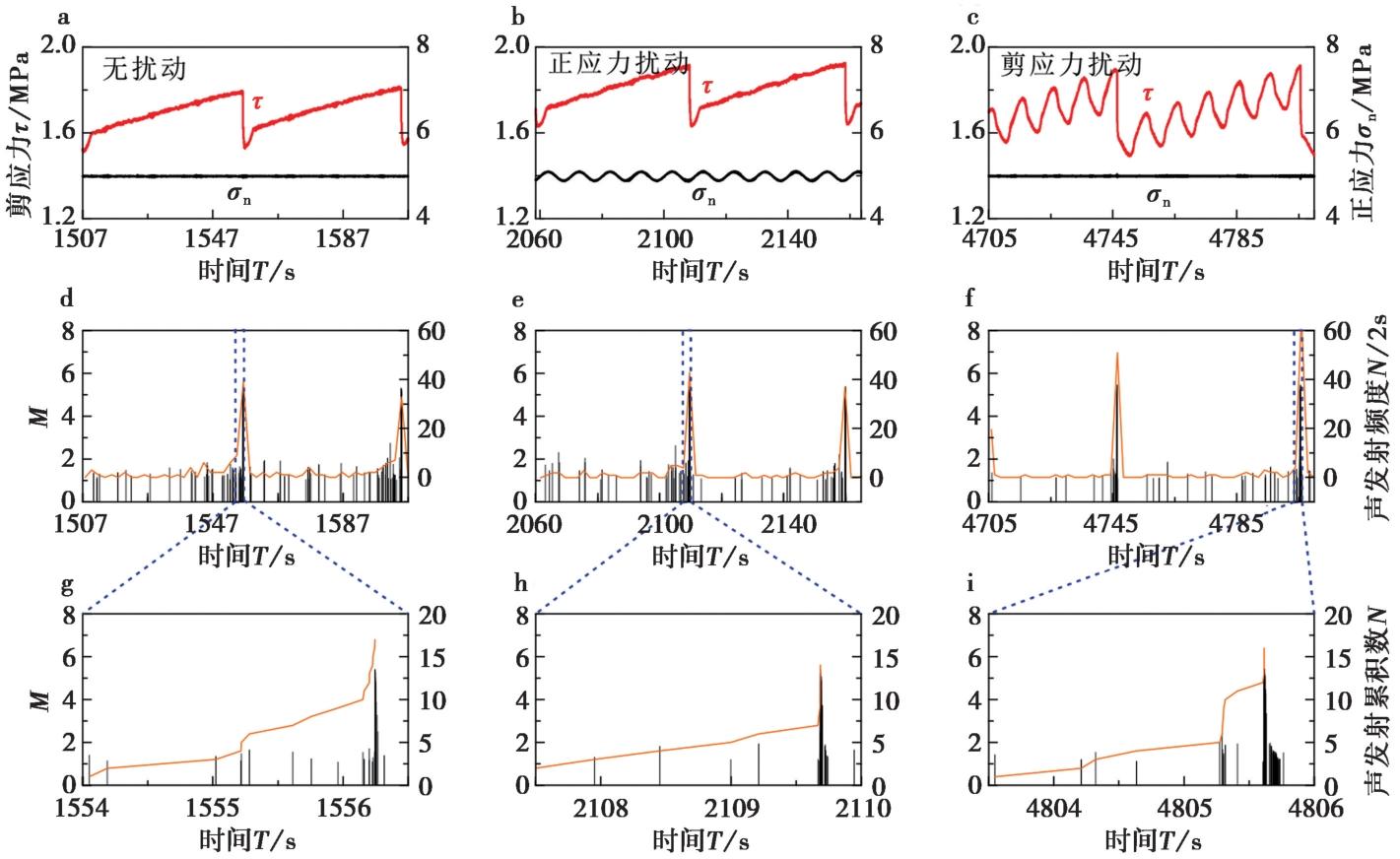
Fig. 4 Stress curve and AE activities for different stress perturbations applied on the fault at 5MPa average normal stress.
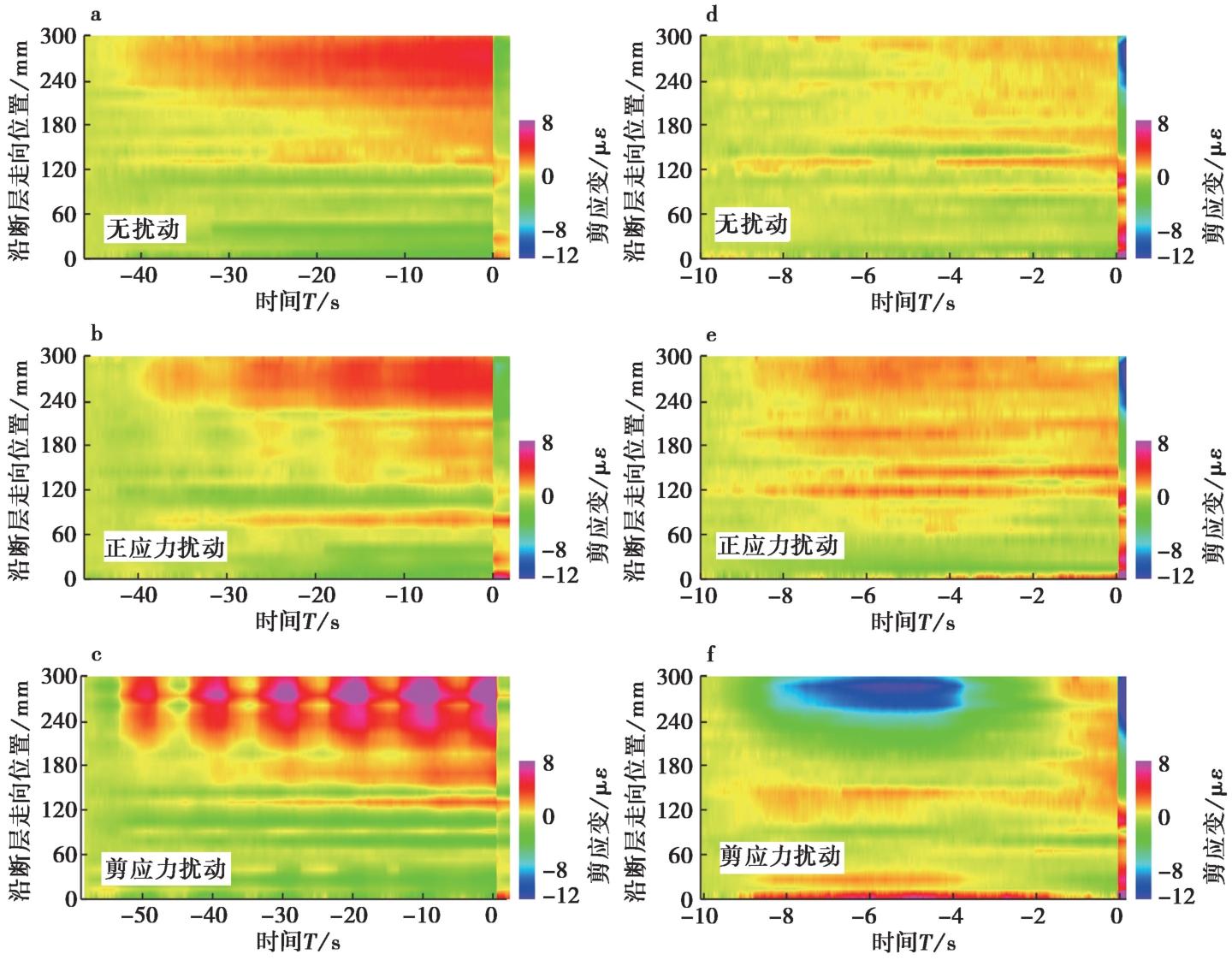
Fig. 5 Shear strain along the fault in the cycle of fault failure for the loading(a) without stress perturbation, (b)0.13MPa normal stress perturbation, and(c)0.1MPa shear stress perturbation.
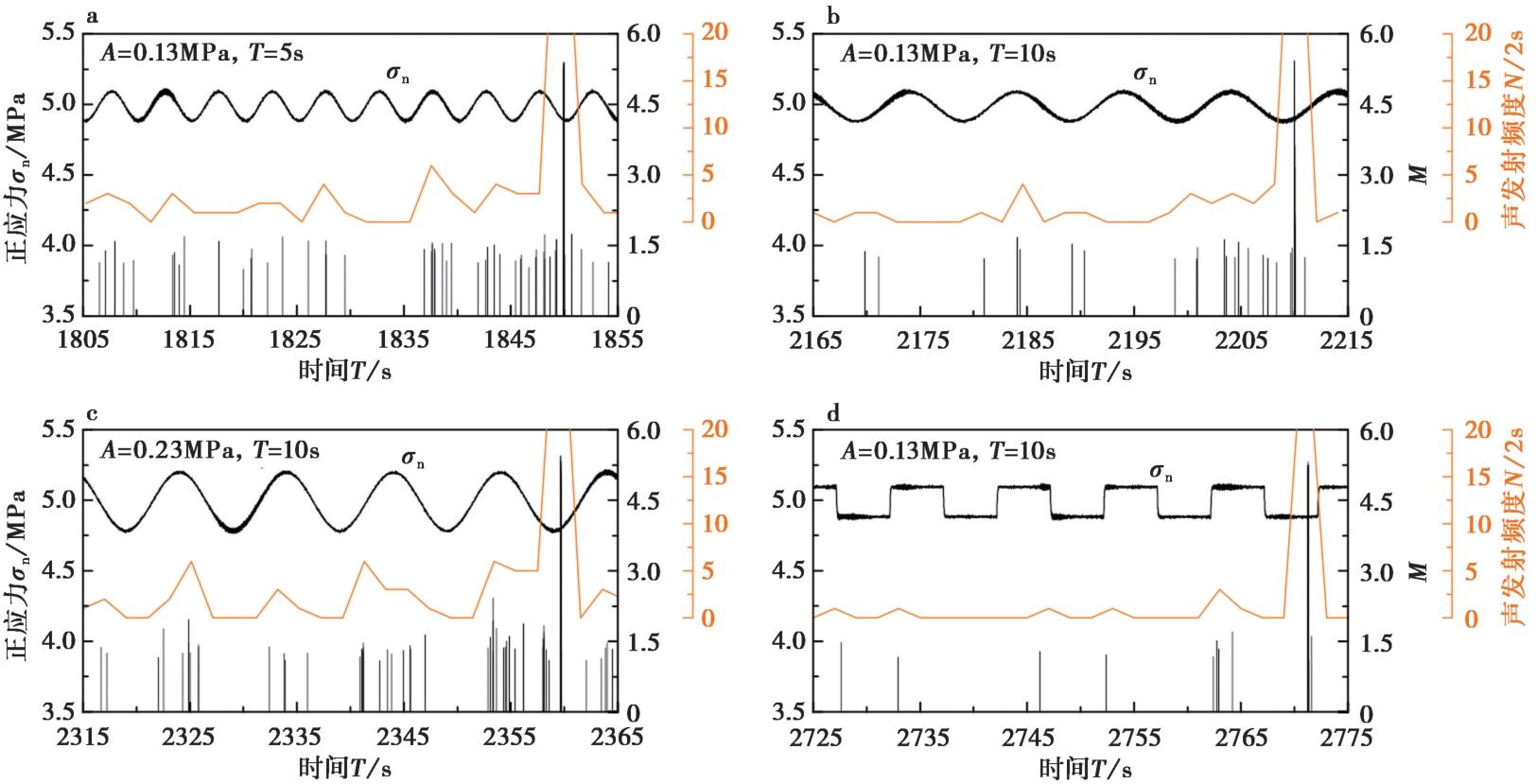
Fig. 6 Stress curve, the magnitude and number of AE activities in the stick-slip cycle when normal stress perturbations are applied on the fault at 5MPa average normal stress.
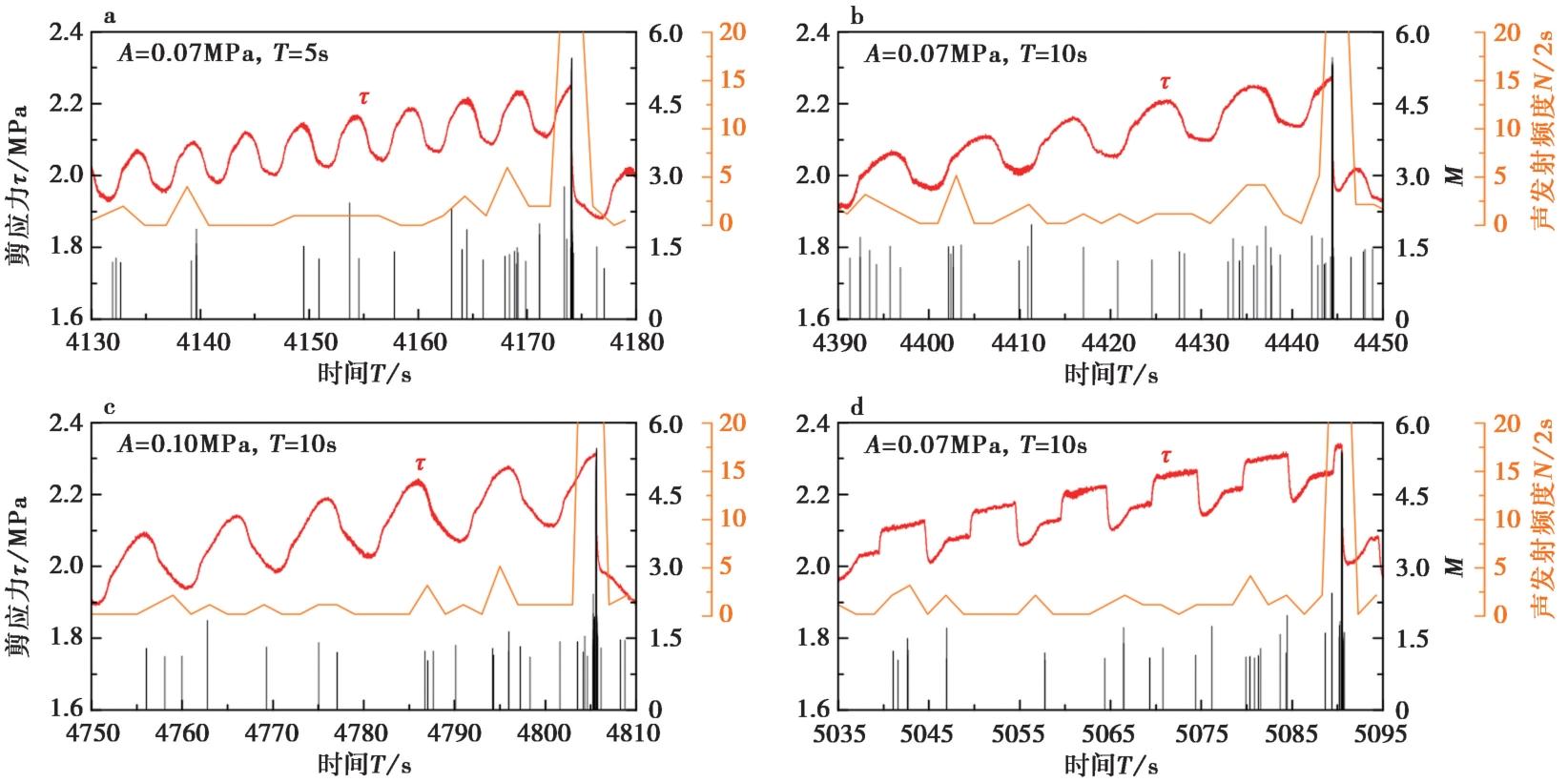
Fig. 7 Shear stress, the magnitude and number of AE activities in the stick-slip cycle when the shear stress perturbations are applied on the fault at 5MPa average normal stress.
| [1] |
崔永权, 马胜利, 刘力强. 2005. 侧向应力扰动对断层摩擦影响的实验研究[J]. 地震地质, 27(4): 645-652.
|
|
|
|
| [2] | |
|
DOI |
|
| [3] |
黄元敏, 马胜利, 缪阿丽, 等. 2009. 剪切载荷扰动对断层摩擦影响的实验研究[J]. 地震地质, 31(2): 276-286.
DOI |
|
DOI |
|
| [4] |
黄元敏, 马胜利, 缪阿丽, 等. 2016. 正应力扰动对断层滑动失稳影响的实验研究[J]. 地球物理学报, 59(3): 931-940.
DOI |
|
|
|
| [5] |
刘力强, 马胜利, 马瑾, 等. 2001. 不同结构岩石标本声发射b值和频谱的时间扫描及其物理意义[J]. 地震地质, 23(4): 481-492.
|
|
|
|
| [6] |
马胜利, 雷兴林, 刘力强. 2004. 标本非均匀性对岩石变形声发射时空分布的影响及其地震学意义[J]. 地球物理学报, 47(1): 127-131.
|
|
|
|
| [7] |
马胜利, 缪阿丽, 黄元敏. 2011. 应力扰动对断层摩擦声发射活动影响的实验研究[J]. 西北地震学报, 33(1): 1-8.
|
|
|
|
| [8] |
云龙, 郭彦双, 马瑾. 2011. 5° 拐折断层在黏滑过程中物理场演化与交替活动的实验研究[J]. 地震地质, 33(2): 356-368. doi: 10.3969/j.issn.0253-4967.2011.02.009.
|
|
DOI |
|
| [9] |
赵扬锋, 樊艺, 荆刚, 等. 2022. 断层黏滑失稳过程声发射特征试验研究[J]. 岩石力学与工程学报, 41(S2): 3101-3113.
|
|
|
|
| [10] |
DOI URL |
| [11] |
PMID |
| [12] |
|
| [13] |
|
| [14] |
DOI URL |
| [15] |
DOI URL |
| [16] |
DOI URL |
| [17] |
PMID |
| [18] |
|
| [19] |
DOI URL |
| [20] |
DOI URL |
| [21] |
DOI |
| [22] |
DOI PMID |
| [23] |
DOI URL |
| [24] |
DOI URL |
| [25] |
|
| [26] |
|
| [27] |
|
| [28] |
DOI URL |
| [29] |
|
| [30] |
DOI URL |
| [31] |
DOI URL |
| [32] |
|
| [33] |
|
| [34] |
|
| [35] |
DOI URL |
| [36] |
DOI URL |
| [37] |
DOI URL |
| [38] |
|
| [39] |
|
| [40] |
|
| [41] |
DOI URL |
| [42] |
|
| [43] |
PMID |
| [44] |
DOI URL |
| [45] |
DOI URL |
| [1] | LI Zi-hong, ZHUO Yan-qun, CHEN Shun-yun, CHEN Hao, LU Li-li. EXPERIMENTAL STUDY ON THE EFFECTS OF FAULT CONTACT HETEROGENEITY ON SEISMIC ACTIVITY [J]. SEISMOLOGY AND GEOLOGY, 2026, 48(2): 329-350. |
| [2] | HUANG Jian-hua, ZHANG Bo, DANG Jia-xiang, ZOU Jun-jie, HE Hong-lin, ZHANG Jin-jiang. THE WEAKENING, STRENGTHENING AND TRANSFORMATION MECHANISM OF BINARY MINERAL MIXTURES DURING COSEISMIC SLIP [J]. SEISMOLOGY AND GEOLOGY, 2025, 47(4): 1262-1291. |
| [3] | SHAO Kang, LIU Jin-feng, XIE Bin, ZHU Min-jie. FRICTIONAL PROPERTIES ASSOCIATED WITH ACOUSTIC EMISSION CHARACTERISTICS OF SIMULATED GRANITE FAULT GOUGES: EFFECTS OF NORMAL STRESS AND WATER CONTENT [J]. SEISMOLOGY AND GEOLOGY, 2024, 46(6): 1332-1356. |
| [4] | ZHAO Qian-bai, ZHAO Yong, YANG Tian-hong, TENG Long, WANG Shu-hong, LIU Yi-long. DISCRETE ELEMENT SIMULATION STUDY OF FAULT STICK-SLIP INSTABILITY PATTERNS AT DIFFERENT MICROCRACK DENSITIES [J]. SEISMOLOGY AND GEOLOGY, 2024, 46(6): 1357-1373. |
| [5] | SONG Dong-mei, WANG Hui, SHAN Xin-jian, WANG Bin, CUI Jian-yong. A NOVEL EXTRACTION METHOD OF PRE-EARTHQUAKE GRACE GRAVITY ANOMALY INFORMATION BASED ON MAXIMUM SHEAR STRAIN [J]. SEISMOLOGY AND GEOLOGY, 2022, 44(6): 1539-1556. |
| [6] | YANG Hai-ming, CHEN Shun-yun, LIU Pei-xun, GUO Yan-shuang, ZHUO Yan-qun, QI Wen-bo. EXPERIMENTAL STUDY ON THE CHANGES OF ULTRASONIC CODA WAVE AND ACOUSTIC EMISSION DURING ROCK LOADING AND DEFORMATION [J]. SEISMOLOGY AND GEOLOGY, 2020, 42(3): 715-731. |
| [7] | CHEN Fu-chao, GUO Liang-qian, ZHENG Zhi-jiang. RESEARCH ON ACTIVITY OF ZHANGJIAKOU-BOHAI FAULT ZONE BASED ON GPS OBSERVATIONS [J]. SEISMOLOGY AND GEOLOGY, 2020, 42(1): 95-108. |
| [8] | LI Shi-nian, QI Wen-bo, LIU Li-qiang. A SUPER-DYNAMIC DEFORMATION MEASUREMENT SYSTEM WITH LONG-TIME PARALLEL CONTINUOUS ACQUISITION [J]. SEISMOLOGY AND GEOLOGY, 2019, 41(6): 1529-1538. |
| [9] | ZHAO Yang-feng, LIU Li-qiang, PAN Yi-shan. EXPERIMENT STUDY ON ACOUSTIC EMISSION, MICROSEISM AND CHARGE INDUCTION DURING FRACTURE PROCESS OF GRANITE WITH FAULT ZONE UNDER UNIAXIAL COMPRESSION [J]. SEISMOLOGY AND GEOLOGY, 2017, 39(5): 964-980. |
| [10] | LEI Xing-lin, LI Xia-ying, LI Qi, MA Sheng-li, FU Bi-hong, CUI Yin-xiang. ROLE OF IMMATURE FAULTS IN INJECTION-INDUCED SEISMICITY IN OIL/GAS RESERVOIRS—A CASE STUDY OF THE SICHUAN BASIN, CHINA [J]. SEISMOLOGY AND GEOLOGY, 2014, 36(3): 625-643. |
| [11] | WANG Xue-bin, MA Bing, LV Jia-qing. NUMERICAL SIMULATION OF FAILURES, PRECURSORS AND STICK-SLIP PROCESSES FOR TYPICAL FAULT STRUCTURES AT A LABORATORY SCALE [J]. SEISMOLOGY AND GEOLOGY, 2014, 36(3): 845-861. |
| [12] | CAO Feng-juan, WANG Liang, JIAO Ming-ruo, ZHAI Li-na, WANG Yan. DISCUSSION ON THE CHARACTERISTICS AND SEISMO-TECTONICS OF THE GAIZHOU ML 4.7 EARTHQUAKE SWARM SEQUENCE ON FEBRUARY 2, 2012 [J]. SEISMOLOGY AND GEOLOGY, 2013, 35(4): 842-852. |
| [13] | LI Pu-chun, LIU Li-qiang, GUO ling-li, LIU Pei-xun. MULTI-POINT DISLOCATION IN STICK-SLIP PROCESS [J]. SEISMOLOGY AND GEOLOGY, 2013, 35(1): 125-137. |
| [14] | MIAO A-li, MA Sheng-li. EXPERIMENTAL STUDY ON THE INFLUENCE OF MUSCOVITE ON VELOCITY-DEPENDENCE TRANSITION [J]. SEISMOLOGY AND GEOLOGY, 2012, 34(1): 63-75. |
| [15] | YUN Long, GUO Yan-shuang, MA Jin. AN EXPERIMENTAL STUDY OF EVOLUTION OF PHYSICAL FIELD AND THE ALTERNATIVE ACTIVITIES DURING STICK-SLIP OF 5°|BEND FAULT [J]. SEISMOLOGY AND GEOLOGY, 2011, 33(2): 356-368. |
| Viewed | ||||||
|
Full text |
|
|||||
|
Abstract |
|
|||||
Copyright © SEISMOLOGY AND GEOLOGY, All Rights Reserved.
Tel: 010-62009049/9063 E-mail: dzdz@ies.ac.cn
Powered by Beijing Magtech Co., Ltd.