
SEISMOLOGY AND GEOLOGY ›› 2026, Vol. 48 ›› Issue (2): 279-313.DOI: 10.3969/j.issn.0253-4967.20240135
• Review • Previous Articles Next Articles
RESEARCH ADVANCES OF THE LATE QUATERNARY ACTIVITY OF XIAOJIANG FAULT ZONE IN THE SOUTHEASTERN MARGIN OF QINGHAI-XIZANG PLATEAU
CHANG Yu-qiao1,2,3)( ), ZHANG Hui-ping1), ZHAO Xu-dong1)
- 1)
State Key Laboratory of Earthquake Dynamics and Forecasting ,Institute of Geology, China Earthquake Administration
2)Yunnan Earthquake Agency ,China Earthquake Administration
3)Kunming Institute of Earthquake Prediction ,China Earthquake Administration
-
Received:2025-01-10Revised:2025-03-11Online:2026-04-20Published:2026-05-14
青藏高原东南缘小江断裂带晚第四纪活动性研究进展
常玉巧1,2,3)(), 张会平1), 赵旭东1)
- 1)
地震动力学与强震预测全国重点实验室(中国地震局地质研究所)
2)云南省地震局
3)中国地震局昆明地震预报研究所
-
作者简介:常玉巧, 女, 1988年生, 中国地震局地质研究所博士研究生, 高级工程师, 主要从事活动构造、 构造地貌与古地震研究, E-mail: 349797655@qq.com。
-
基金资助:地球深部探测与矿产资源勘查国家科技重大专项(2024ZD1000703); 中国地震局地震科技星火计划项目(XH25032YB)

Cite this article
CHANG Yu-qiao, ZHANG Hui-ping, ZHAO Xu-dong. RESEARCH ADVANCES OF THE LATE QUATERNARY ACTIVITY OF XIAOJIANG FAULT ZONE IN THE SOUTHEASTERN MARGIN OF QINGHAI-XIZANG PLATEAU[J]. SEISMOLOGY AND GEOLOGY, 2026, 48(2): 279-313.
常玉巧, 张会平, 赵旭东. 青藏高原东南缘小江断裂带晚第四纪活动性研究进展[J]. 地震地质, 2026, 48(2): 279-313.
share this article
Add to citation manager EndNote|Ris|BibTeX
URL: https://www.dzdz.ac.cn/EN/10.3969/j.issn.0253-4967.20240135
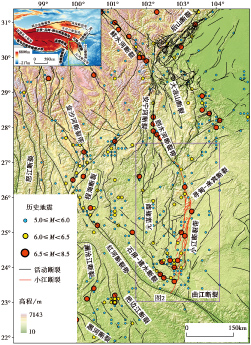
Fig. 1 Tectonic setting and distribution of the Xiaojiang fault zone.
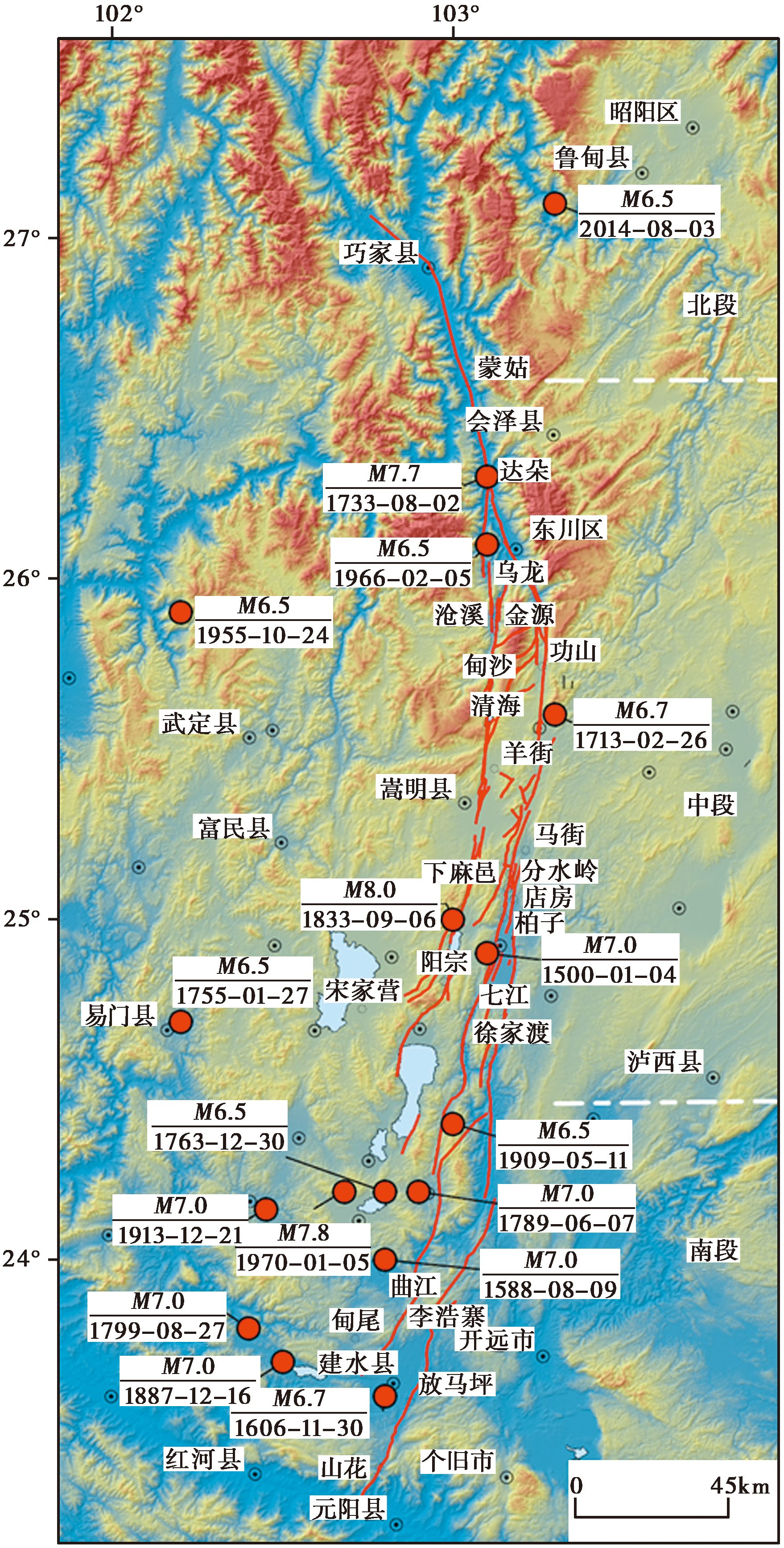
Fig. 2 The geometry and epicentral distribution of earthquakes of M≥6.5 around the Xiaojiang fault zone.

Fig. 3 Relief and slope of the Xiaojiang fault zone.
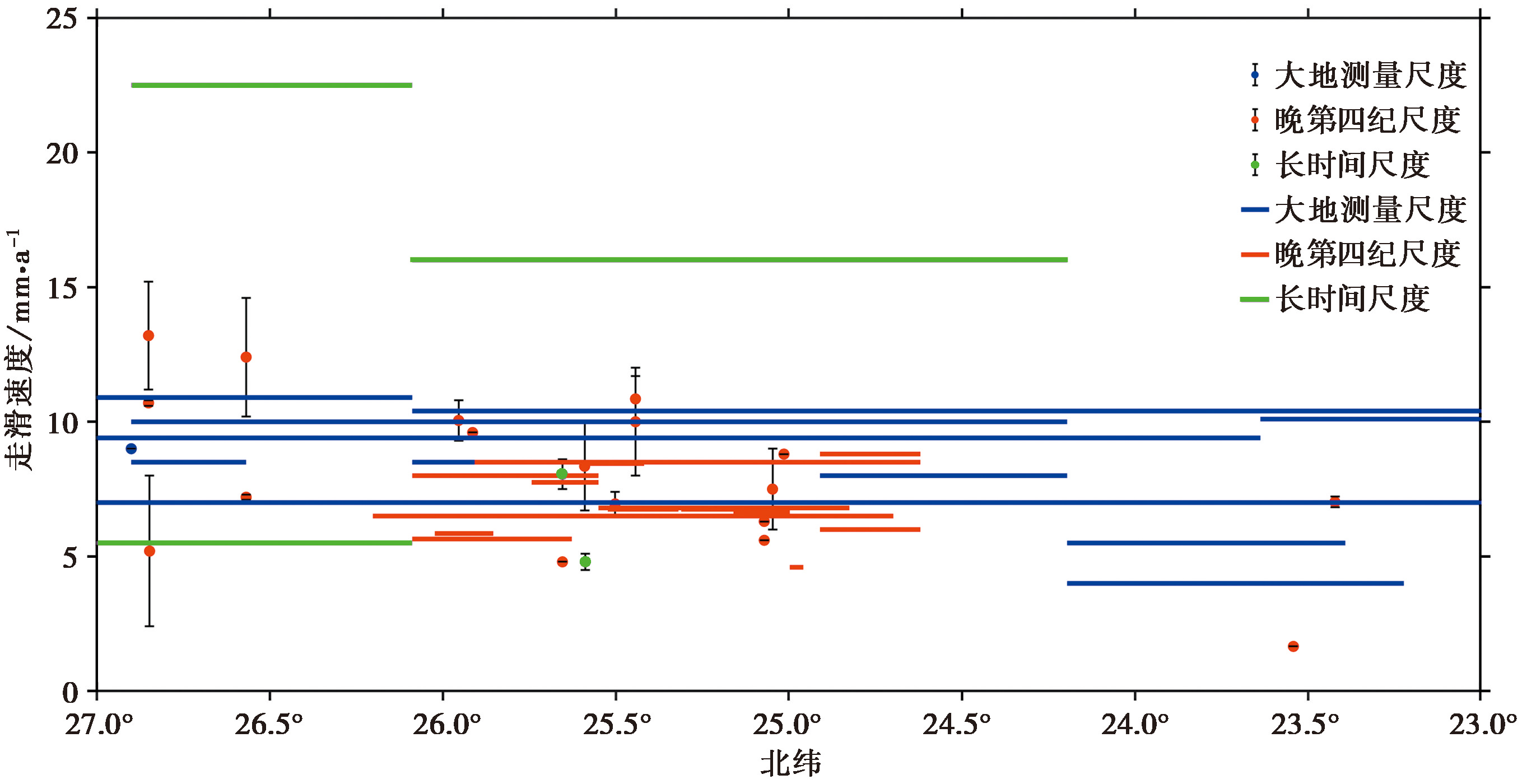
Fig. 4 Slip rate of three timescales of the Xiaojiang fault zone.
| 序号 | 断裂 分段 | 探槽位置 (各段分别自北向南排序) | 揭露事件 (自上而下由新到老) | 文献 |
|---|---|---|---|---|
| 1 | 东支 | 白沙井 | ③1733年东川$7 \frac{3}{4} $级地震 ②3065aBP ①5296aBP | 国家地震局地质研究所等, |
| 2 | 东支 | 玉碑地 | ③1733年东川$7 \frac{3}{4} $级地震 ②(2450±80)aBP ①约5000aBP | 国家地震局地质研究所等, |
| 3 | 东支 | 板河口 | ④(2 450±800)aBP ③无年龄数据 ②无年龄数据 ①无年龄数据 | 国家地震局地质研究所等, |
| 4 | 东支 | 小团山 | ③1733年东川$7 \frac{3}{4} $级地震 ②(2 035±85)aBP ①(2 905±95)aBP | 朱向军, (源自宋方敏等, |
| 5 | 东支 | 石膏塘 | ⑥1733东川$7 \frac{3}{4} $级地震 ⑤无年龄数据 ④(2 500±80)aBP ③无年龄数据 ②无年龄数据 ①无年龄数据 | 国家地震局地质研究所等, |
| 6 | 东支 | 大营盘 | ③1733年东川$7 \frac{3}{4} $级地震 ②(5 200±1050)aBP ①(7 200±155)aBP | 朱向军, (源自宋方敏等, |
| 7 | 东支 | 大脑包 | ④1733年东川$7 \frac{3}{4} $级地震 ③推测5 000aBP ②推测7 000aBP ①推测9 000aBP | 宋方敏等, |
| 8 | 东支 | 双龙潭 | ②7 000a BP之后 ①无年龄数据 | 宋方敏等, |
| 9 | 东支 | 双龙潭 | ⑤1713寻甸6.7级地震 ④7 000aBP之后 ③7 000aBP之前 ②12 000aBP之后 ①12 000aBP之前 | 宋方敏等, |
| 10 | 东支 | 清水沟 | 无 | 宋方敏等, |
| 11 | 东支 | 下米户 | ⑤1500年宜良7级地震 ④推测8 000aBP ③14 310aBP ②(19 850±1100)aBP之前 (20 280±1200)aBP之后1次 ①(20 280±1200)aBP之前1次 | 宋方敏等, |
| 12 | 东支 | 下麻邑 | ③1500年宜良7级地震 ②14 310aBP ①(19 850±1 100)aBP | 宋方敏等, |
| 13 | 东支 | 店房 | ④无年龄数据 ③(13 260±50)aBP之前 ②无年龄数据 ①<30 000aBP | 常玉巧等, |
| 14 | 东支 | 店房 | 晚更新世晚期9次: 38 000~17 000aBP | 国家地震局地质研究所等, |
| 15 | 东支 | 店房 | 晚更新世晚期8次: 38 000~17 000aBP | 国家地震局地质研究所等, |
| 16 | 东支 | 龚家营 | ②(9 720±190)~(13 860±260)aBP ①(13 860±260)aBP之前2次 | 宋方敏等, |
| 17 | 东支 | 打挂村 | ②1500年宜良7级地震 ①(14410±40)aBP之后 | 常玉巧等, |
| 18 | 东支 | 七江村 | ④1500年宜良7级地震 ③4 515aBP ②推测8 000aBP ①推测12 000aBP | 宋方敏等, |
| 19 | 东支 | 凹子地 | ②1500年宜良7级地震 ①19 000aBP | 宋方敏等, |
| 20 | 西支 | 干海子 | ③490aBP ②1 180~830aBP ①5 250~1 550aBP | 李西等, |
| 21 | 西支 | 草海子 | ⑥1833年嵩明8级地震 ⑤830~330aBP ④1 560~1 230aBP ③11 450~1 450aBP ②37 350~26 750aBP ①41 950~38 250aBP | 李西等, |
| 22 | 西支 | 甸沙 | ④1833年嵩明8级地震 ③4 700aBP ②推测8 000aBP ①推测15 000aBP | 俞维贤等, |
| 23 | 西支 | 甸沙 | ⑥1833年8级地震 ⑤2 000aBP ④(4 670±380)aBP ③推测8 000aBP ②推测12 000aBP ①推测15 000aBP | 俞维贤等, |
| 24 | 西支 | 海尾村 | ②1833年8级地震 ①(5 010±400)aBP | 俞维贤等, |
| 25 | 西支 | 水马田 | ⑨1833年8级地震 ⑧15 000aBP ⑦无年龄数据 ⑥(19 200±380)aBP ⑤(30 030±1 070)aBP ④无年龄数据 ③无年龄数据 ②(38 260±3430)aBP ①无年龄数据 | 陈睿等, |
| 26 | 西支 | 大坟地 | ③20 200aBP ②20 770~20 350aBP ①24 250~21 550aBP | 李西等, |
| 27 | 西支 | 龙家村西南 | ⑥1833年8级地震 ⑤2 000aBP ④4 000aBP ③8 000aBP ②12 000aBP ①15 000aBP | 宋方敏等, 俞维贤等, |
| 28 | 西支 | 冬瓜营 | ③1833年8级地震 ②2 000aBP ①3 210aBP | 陈睿等, |
| 29 | 西支 | 冬瓜营 | ⑤1833年嵩明8级地震 ④1500年宜良M>7地震 ③(1 347±213)aBP ②(1 930±135)aBP ①(2 359±213)aBP | Hu et al., |
| 30 | 西支 | 七孔坡 | ④1833年8级地震 ③4 000aBP ②8 000aBP ①12 000aBP | 俞维贤等, |
| 31 | 南段 | 落水洞 | ②12 490~5 655aBP ①3 845~505aBP | Guo et al., |
| 32 | 南段 | 东村 | ③15 365~12 725aBP ②10 840~6 890aBP ①1 685~185aBP | Guo et al., |
| 33 | 南段 | 放马坪 | ③1 640aBP之前 ②1 475~675aBP ①625~495aBP之后 | Guo et al., |
| 34 | 南段 | 两岔河1 | 3次,无年龄数据 | 韩竹军等, |
| 35 | 南段 | 两岔河2 | 无 | 韩竹军等, |
Table 2 Statistical table of the trench sites in previous studies of the Xiaojiang fault zone
| 序号 | 断裂 分段 | 探槽位置 (各段分别自北向南排序) | 揭露事件 (自上而下由新到老) | 文献 |
|---|---|---|---|---|
| 1 | 东支 | 白沙井 | ③1733年东川$7 \frac{3}{4} $级地震 ②3065aBP ①5296aBP | 国家地震局地质研究所等, |
| 2 | 东支 | 玉碑地 | ③1733年东川$7 \frac{3}{4} $级地震 ②(2450±80)aBP ①约5000aBP | 国家地震局地质研究所等, |
| 3 | 东支 | 板河口 | ④(2 450±800)aBP ③无年龄数据 ②无年龄数据 ①无年龄数据 | 国家地震局地质研究所等, |
| 4 | 东支 | 小团山 | ③1733年东川$7 \frac{3}{4} $级地震 ②(2 035±85)aBP ①(2 905±95)aBP | 朱向军, (源自宋方敏等, |
| 5 | 东支 | 石膏塘 | ⑥1733东川$7 \frac{3}{4} $级地震 ⑤无年龄数据 ④(2 500±80)aBP ③无年龄数据 ②无年龄数据 ①无年龄数据 | 国家地震局地质研究所等, |
| 6 | 东支 | 大营盘 | ③1733年东川$7 \frac{3}{4} $级地震 ②(5 200±1050)aBP ①(7 200±155)aBP | 朱向军, (源自宋方敏等, |
| 7 | 东支 | 大脑包 | ④1733年东川$7 \frac{3}{4} $级地震 ③推测5 000aBP ②推测7 000aBP ①推测9 000aBP | 宋方敏等, |
| 8 | 东支 | 双龙潭 | ②7 000a BP之后 ①无年龄数据 | 宋方敏等, |
| 9 | 东支 | 双龙潭 | ⑤1713寻甸6.7级地震 ④7 000aBP之后 ③7 000aBP之前 ②12 000aBP之后 ①12 000aBP之前 | 宋方敏等, |
| 10 | 东支 | 清水沟 | 无 | 宋方敏等, |
| 11 | 东支 | 下米户 | ⑤1500年宜良7级地震 ④推测8 000aBP ③14 310aBP ②(19 850±1100)aBP之前 (20 280±1200)aBP之后1次 ①(20 280±1200)aBP之前1次 | 宋方敏等, |
| 12 | 东支 | 下麻邑 | ③1500年宜良7级地震 ②14 310aBP ①(19 850±1 100)aBP | 宋方敏等, |
| 13 | 东支 | 店房 | ④无年龄数据 ③(13 260±50)aBP之前 ②无年龄数据 ①<30 000aBP | 常玉巧等, |
| 14 | 东支 | 店房 | 晚更新世晚期9次: 38 000~17 000aBP | 国家地震局地质研究所等, |
| 15 | 东支 | 店房 | 晚更新世晚期8次: 38 000~17 000aBP | 国家地震局地质研究所等, |
| 16 | 东支 | 龚家营 | ②(9 720±190)~(13 860±260)aBP ①(13 860±260)aBP之前2次 | 宋方敏等, |
| 17 | 东支 | 打挂村 | ②1500年宜良7级地震 ①(14410±40)aBP之后 | 常玉巧等, |
| 18 | 东支 | 七江村 | ④1500年宜良7级地震 ③4 515aBP ②推测8 000aBP ①推测12 000aBP | 宋方敏等, |
| 19 | 东支 | 凹子地 | ②1500年宜良7级地震 ①19 000aBP | 宋方敏等, |
| 20 | 西支 | 干海子 | ③490aBP ②1 180~830aBP ①5 250~1 550aBP | 李西等, |
| 21 | 西支 | 草海子 | ⑥1833年嵩明8级地震 ⑤830~330aBP ④1 560~1 230aBP ③11 450~1 450aBP ②37 350~26 750aBP ①41 950~38 250aBP | 李西等, |
| 22 | 西支 | 甸沙 | ④1833年嵩明8级地震 ③4 700aBP ②推测8 000aBP ①推测15 000aBP | 俞维贤等, |
| 23 | 西支 | 甸沙 | ⑥1833年8级地震 ⑤2 000aBP ④(4 670±380)aBP ③推测8 000aBP ②推测12 000aBP ①推测15 000aBP | 俞维贤等, |
| 24 | 西支 | 海尾村 | ②1833年8级地震 ①(5 010±400)aBP | 俞维贤等, |
| 25 | 西支 | 水马田 | ⑨1833年8级地震 ⑧15 000aBP ⑦无年龄数据 ⑥(19 200±380)aBP ⑤(30 030±1 070)aBP ④无年龄数据 ③无年龄数据 ②(38 260±3430)aBP ①无年龄数据 | 陈睿等, |
| 26 | 西支 | 大坟地 | ③20 200aBP ②20 770~20 350aBP ①24 250~21 550aBP | 李西等, |
| 27 | 西支 | 龙家村西南 | ⑥1833年8级地震 ⑤2 000aBP ④4 000aBP ③8 000aBP ②12 000aBP ①15 000aBP | 宋方敏等, 俞维贤等, |
| 28 | 西支 | 冬瓜营 | ③1833年8级地震 ②2 000aBP ①3 210aBP | 陈睿等, |
| 29 | 西支 | 冬瓜营 | ⑤1833年嵩明8级地震 ④1500年宜良M>7地震 ③(1 347±213)aBP ②(1 930±135)aBP ①(2 359±213)aBP | Hu et al., |
| 30 | 西支 | 七孔坡 | ④1833年8级地震 ③4 000aBP ②8 000aBP ①12 000aBP | 俞维贤等, |
| 31 | 南段 | 落水洞 | ②12 490~5 655aBP ①3 845~505aBP | Guo et al., |
| 32 | 南段 | 东村 | ③15 365~12 725aBP ②10 840~6 890aBP ①1 685~185aBP | Guo et al., |
| 33 | 南段 | 放马坪 | ③1 640aBP之前 ②1 475~675aBP ①625~495aBP之后 | Guo et al., |
| 34 | 南段 | 两岔河1 | 3次,无年龄数据 | 韩竹军等, |
| 35 | 南段 | 两岔河2 | 无 | 韩竹军等, |
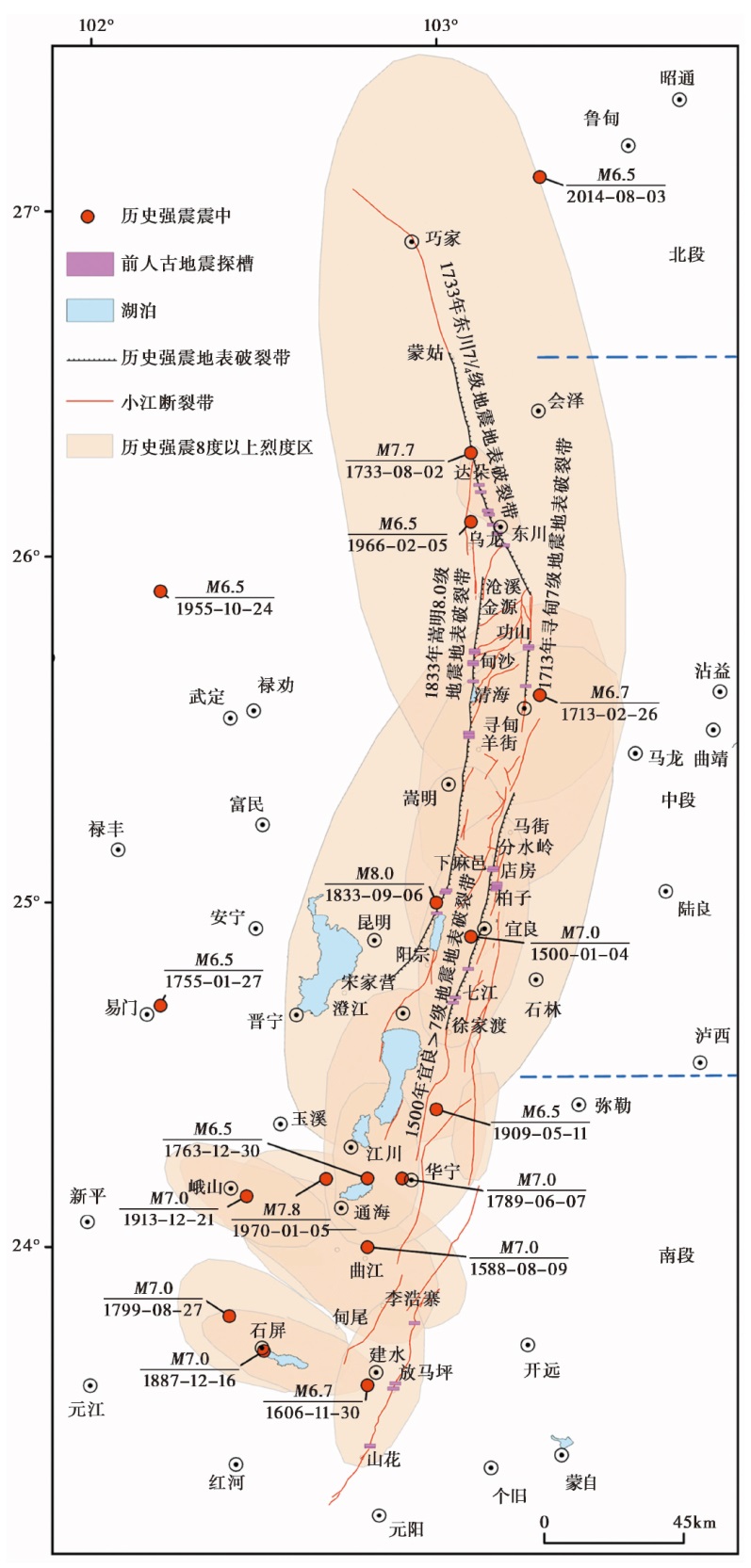
Fig. 5 Maps of distributions of trenches、 rupture extents, and M≥8 seismic intensity distributions of strong earthquakes on the Xiaojiang fault zone.
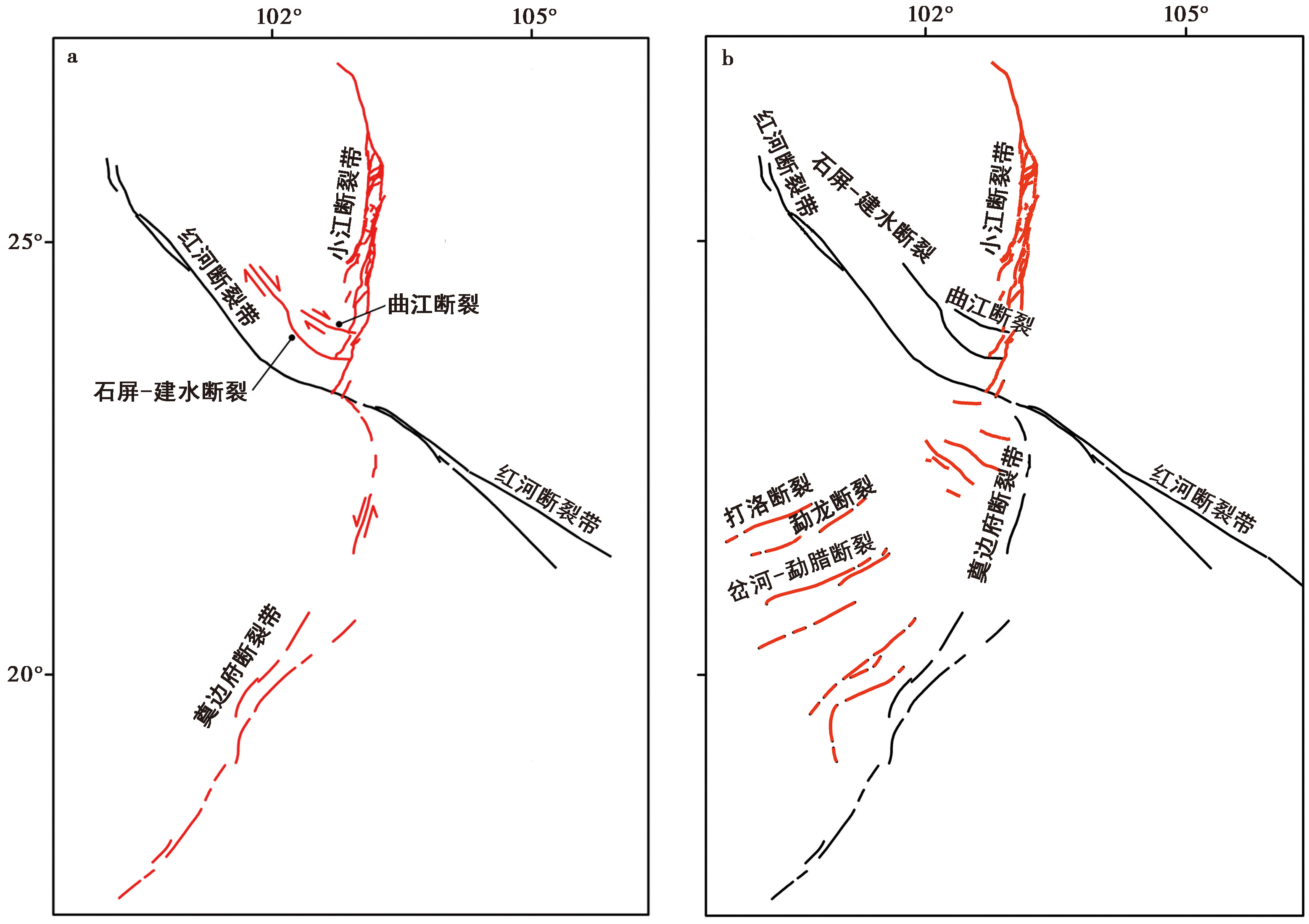
Fig. 6 Deformation coordination at the intersection of Xiaojiang and Red River fault zones.
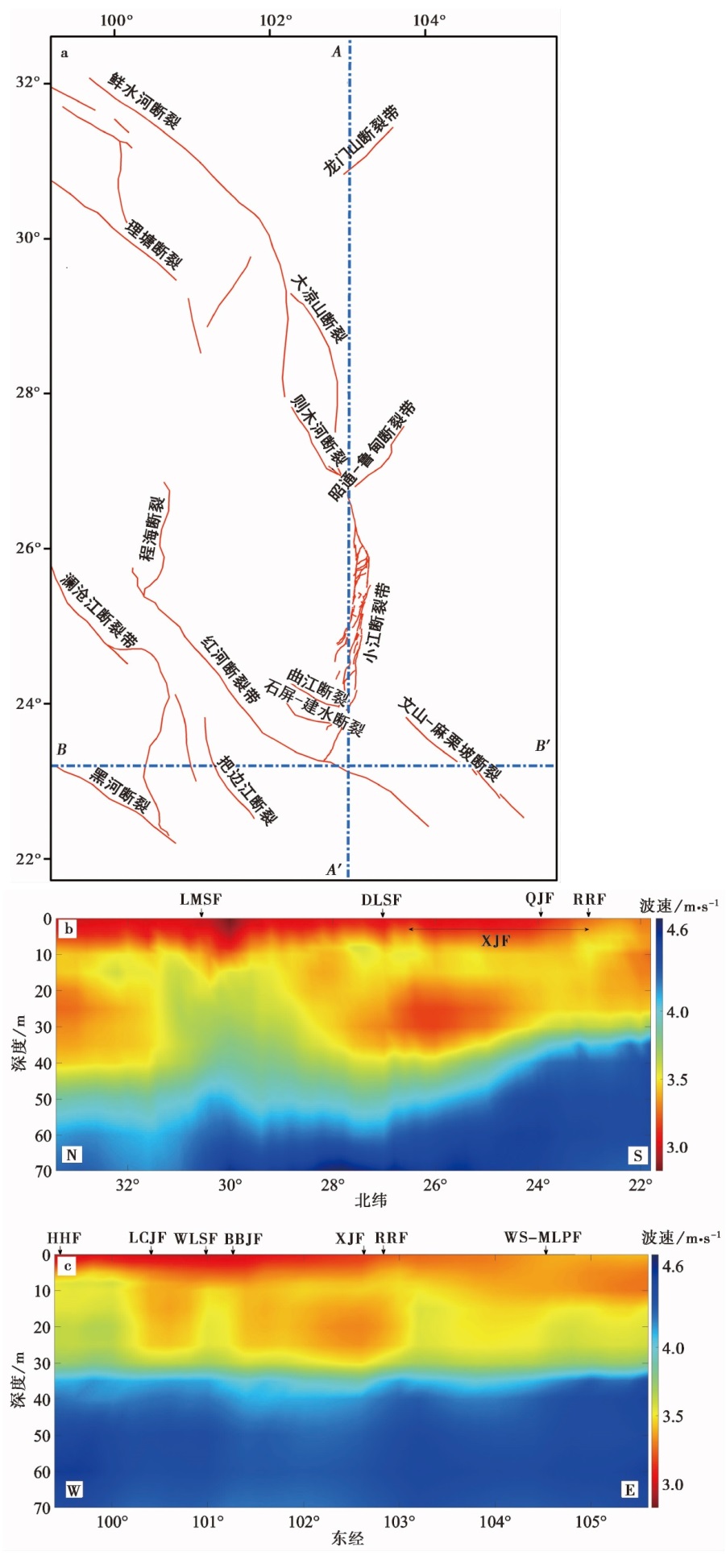
Fig. 7 The vertical S-wave velocity model in the crust and uppermost mantle around the Xiaojiang fault zone.
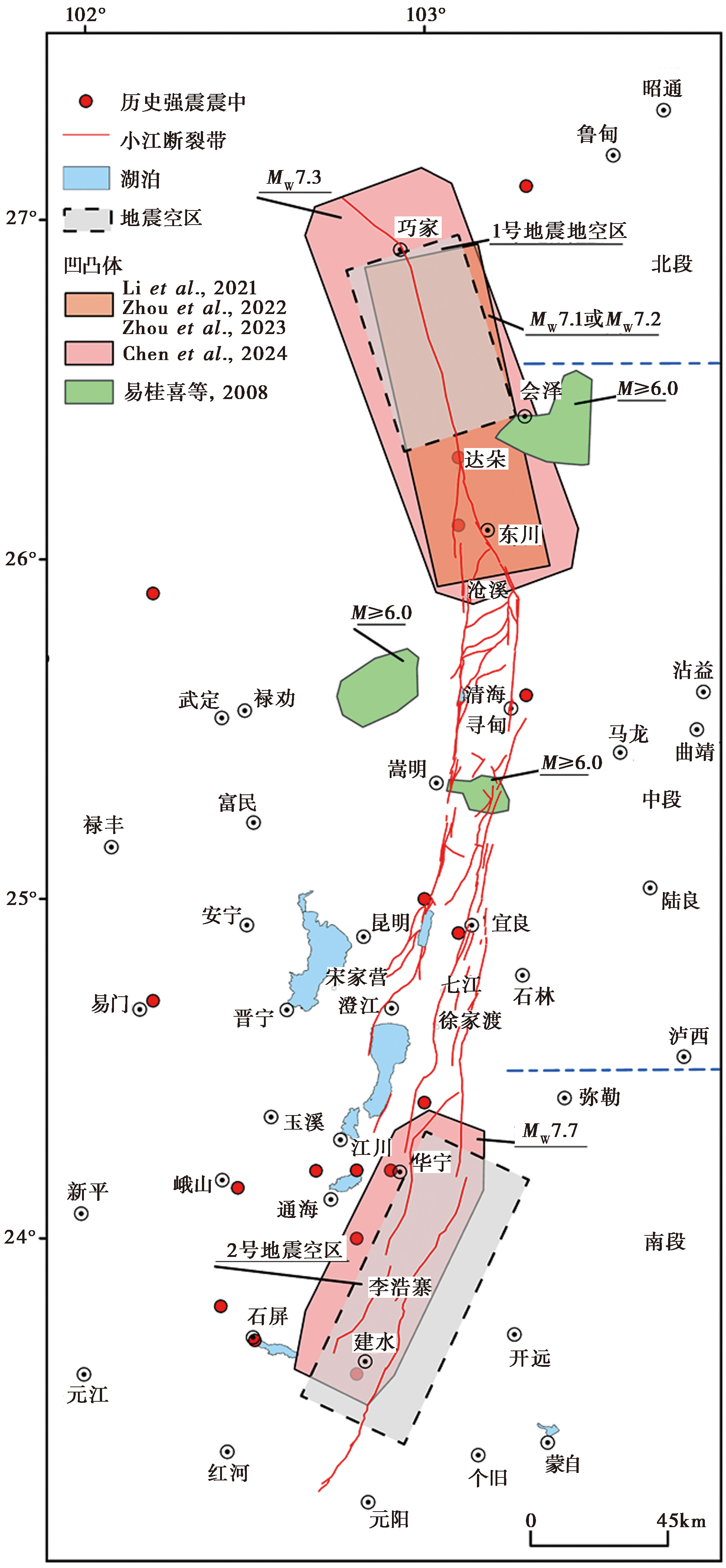
Fig. 8 The distribution of the seismic gaps and asperities of the Xiaojiang fault zone.
| [1] |
常玉巧, 陈立春, 李西, 等. 2021. 小江断裂带宜良盆地西缘断裂晚第四纪活动的地质地貌证据[J]. 地震研究, 44(2): 152—161.
|
|
|
|
| [2] |
陈睿, 李玶. 1988. 小江西支断裂的滑动速率与强震重复周期[J]. 地震地质, 10(2): 1—13.
|
|
|
|
| [3] |
程佳. 2008. 川西地区现今地壳运动的大地测量观测研究[D]. 北京: 中国地震局地质研究所.
|
|
|
|
| [4] |
崔腾发, 陈小斌, 李文军, 等. 2023. 小江断裂带东川—寻甸段大地电磁成像及深部孕震环境[J]. 地球物理学报, 66(10): 4224—4240.
|
|
|
|
| [5] |
邓起东, 陈立春, 冉勇康. 2004. 活动构造定量研究与应用[J]. 地学前缘, 11(4): 383—392.
|
|
|
|
| [6] |
封志明, 李文君, 李鹏, 等. 2020. 青藏高原地形起伏度及其地理意义[J]. 地理学报, 75(7): 1359—1372.
|
|
|
|
| [7] |
付博, 王忠礼. 2013. 基于DEM的地势起伏度研究[J]. 吉林建筑工程学院学报, 30(6): 16—18.
|
|
|
|
| [8] |
高原, 石玉涛, 王琼. 2020. 青藏高原东南缘地震各向异性及其深部构造意义[J]. 地球物理学报, 63(3): 802—816.
|
|
|
|
| [9] |
国家地震局地质研究所, 云南省地震局. 1990. 滇西北地区活动断裂[M]. 北京: 地震出版社.
|
|
Institute of Geology, State Seismological Bureau, Seismological Bureau of Yunnan Province. 1990. A Monograph of Active Faults in the Northwest Yunnan Region[M]. Seismological Press, Beijing (in Chinese).
|
|
| [10] |
国家地震局震害防御司. 1995. 中国历史强震目录(公元前23世纪—公元1911年)[Z]. 北京: 地震出版社.
|
|
Department of Earthquake Disaster Prevention, State Seismological Bureau. 1995. Catalog of Historical Strong Earthquakes in China(23rd Century BC to 1911AD)[Z]. Seismological Press, Beijing (in Chinese).
|
|
| [11] |
韩竹军, 董绍鹏, 毛泽斌, 等. 2017. 小江断裂带南段全新世活动的地质地貌证据与滑动速率[J]. 地震地质, 39(1): 1—19. doi: 10.3969/j.issn.0253-4967.2017.01.001.
|
|
|
|
| [12] |
何宏林, 方仲景, 李玶. 1993. 小江断裂带西支断裂南段新活动初探[J]. 地震研究, 16(3): 291—298.
|
|
|
|
| [13] |
何宏林, 李玶, 方仲景. 1992. 滇东南楔形构造区发震构造背景探讨[J]. 地震地质, 14(3): 217—226.
|
|
|
|
| [14] |
胡萌萌, 吴中海, 黄小龙, 等. 2020. 云南1588年通海-曲江7.0级地震的发震断层厘定及小江断裂带南端的未来强震危险性问题[J]. 地质学报, 94(10): 3090—3105.
|
|
|
|
| [15] |
胡萌萌, 吴中海, 李家存, 等. 2023. 小江断裂带巧家段晚第四纪走滑速率研究[J]. 地质学报, 97(1): 16—29.
|
|
|
|
| [16] |
黄伟亮, 张家乐, 项闻, 等. 2023. 晚第四纪以来巴塘断裂的活动特征及滑动速率[J]. 地震地质, 45(6): 1265—1285. doi: 10.3969/j.issn.0253-4967.2023.06.002.
|
|
|
|
| [17] |
李乐, 陈棋福, 钮凤林, 等. 2013. 基于重复微震的小江断裂带深部滑动速率研究[J]. 地球物理学报, 56(10): 3373—3384.
|
|
|
|
| [18] |
李玶. 1993. 鲜水河-小江断裂带[M]. 北京: 地震出版社.
|
|
|
|
| [19] |
李西. 2015. 川滇地块云南地区不同发育阶段边界断裂破裂特征研究[D]. 北京: 中国地震局地质研究所.
|
|
|
|
| [20] |
李西, 冉勇康, 吴富峣, 等. 2018. 小江断裂带西支晚第四纪强震破裂特征[J]. 地震地质, 40(6): 1179—1203.
|
|
|
|
| [21] |
刘耀辉, 李金平, 王刘伟. 2015. 小江断裂带地壳运动特征及地震危险性研究[J]. 测绘工程, 24(7): 58—60.
|
|
|
|
| [22] |
沈军, 汪一鹏. 1999. 用断裂滑动速率估计小江断裂带的地震危险性[J]. 地震研究, 22(3): 251—259.
|
|
|
|
| [23] |
沈军, 汪一鹏, 宋方敏, 等. 1998. 相对蠕滑速率与特征地震复发间隔的估计: 以小江断裂带为例[J]. 地震地质, 20(4): 328—331.
|
|
|
|
| [24] |
施发奇, 尤伟, 付云文. 2012. GPS资料揭示的小江断裂近期运动特征[J]. 地震研究, 35(2): 207—213.
|
|
|
|
| [25] |
宋方敏, 汪一鹏, 俞维贤, 等, 1998. 小江活动断裂带[M]. 北京: 地震出版社.
|
|
|
|
| [26] |
唐文清, 刘宇平, 陈智梁, 等. 2006. 云南小江断裂中南段现今活动特征[J]. 沉积与特提斯地质, 26(2): 21—24.
|
|
|
|
| [27] |
王阎昭, 王恩宁, 沈正康, 等. 2008. 基于GPS资料约束反演川滇地区主要断裂现今活动速率[J]. 中国科学(D辑), 38(5): 582—597.
|
|
|
|
| [28] |
魏文薪, 江在森, 武艳强, 等. 2012. 小江断裂带的运动及应变积累特征研究[J]. 大地测量与地球动力学, 32(2): 11—15.
|
|
|
|
| [29] |
闻学泽. 2018. 巴颜喀拉块体东边界千年破裂历史与2008年汶川、 2013年芦山和2017年九寨沟地震[J]. 地震学报, 40(3): 255—267.
|
|
|
|
| [30] |
闻学泽, 杜方, 龙峰, 等. 2011. 小江和曲江-石屏两断裂系统的构造动力学与强震序列的关联性[J]. 中国科学(D辑), 41(5): 713—724.
|
|
|
|
| [31] |
吴中海. 2024. 青藏高原陆陆碰撞-挤出活动构造体系控震作用: 以1990年以来强震活动为例[J]. 地质力学学报, 30(2): 189—205.
|
|
|
|
| [32] |
吴中海, 龙长兴, 范桃园, 等. 2015. 青藏高原东南缘弧形旋扭活动构造体系及其动力学特征与机制[J]. 地质通报, 34(1): 1—31.
|
|
|
|
| [33] |
吴中海, 赵根模, 刘杰. 2016. 2015年尼泊尔 MS8.1 地震构造成因及对青藏高原及邻区未来强震趋势的影响[J]. 地质学报, 90(6): 1062—1085.
|
|
|
|
| [34] |
徐锡伟, 韩竹军, 杨晓平, 等. 2016. 中国及邻近地区地震构造图[CM]. 北京: 地震出版社.
|
|
|
|
| [35] |
徐锡伟, 闻学泽, 郑荣章, 等. 2003. 川滇地区活动块体最新构造变动样式及其动力来源[J]. 中国科学(D辑), 33(S1): 151—162.
|
|
|
|
| [36] |
易桂喜, 闻学泽, 苏有锦. 2008. 川滇活动地块东边界强震危险性研究[J]. 地球物理学报, 51(6): 1719—1725.
|
|
|
|
| [37] |
俞维贤, 宋方敏, 曹忠权, 等. 1995. 小江东支断裂带中段古地震初步研究[G]//国家地震局地质研究所. 活动断裂研究(4). 北京: 地震出版社.
|
|
|
|
| [38] |
俞维贤, 汪一鹏, 王彬, 等. 2004. 云南小江西支断裂古地震及现今地震危险性研究[J]. 地震研究, 27(S1): 29—32.
|
|
|
|
| [39] |
张会平, 张培震, 郑德文, 等. 2012. 祁连山构造地貌特征: 青藏高原东北缘晚新生代构造变形和地貌演化过程的启示[J]. 第四纪研究, 32(5): 907—920.
|
|
|
|
| [40] |
张培震, 邓起东, 张国民, 等. 2003. 中国大陆的强震活动与活动地块[J]. 中国科学(D辑), 33(增刊): 12—20.
|
|
|
|
| [41] |
张世民, 谢富仁. 2001. 鲜水河-小江断裂带7级以上强震构造区的划分及其构造地貌特征[J]. 地震学报, 23(1): 36—44, 111.
|
|
|
|
| [42] |
赵静, 江在森, 牛安福, 等. 2015. 川滇菱形块体东边界断层闭锁程度与滑动亏损动态特征研究[J]. 地球物理学报, 58(3): 872—885.
|
|
|
|
| [43] |
中国地震局震害防御司. 1999. 中国近代地震目录(公元1912—1990年, MS≥4.7)[Z]. 北京: 中国科学技术出版社.
|
|
Department of Earthquake Disaster Prevention, China Earthquake Administration. 1999. Catalogue of Chinese Earthquakes(1912—1990, MS≥4.7)[Z]. China Science and Technology Press, Beijing (in Chinese).
|
|
| [44] |
祝爱玉, 张东宁, 蒋长胜. 2015. 川滇地块东边界中南段构造应力分布特征与历史强震活动关系的数值模拟[J]. 地震学报, 37(5): 762—773.
|
|
|
|
| [45] |
朱成男. 1982. 小江断裂全新世运动速率测定与地震危险性评价[A]. 史前地震与第四纪地质文集[C]. 西安: 陕西科学技术出版社.
|
|
|
|
| [46] |
朱向军. 1988. 云南东川强震重复间隔的初步研究[D]. 北京: 国家地震局地质研究所.
|
|
|
|
| [47] |
邹俊杰, 周永胜, 何宏林, 等. 2022. 基岩断层面古地震研究的主要方法与选点原则[J]. 地震科学进展, 52(2): 60—66.
|
|
|
|
| [48] |
|
| [49] |
|
| [50] |
|
| [51] |
|
| [52] |
|
| [53] |
|
| [54] |
|
| [55] |
|
| [56] |
|
| [57] |
|
| [58] |
|
| [59] |
DOI URL |
| [60] |
|
| [61] |
|
| [62] |
|
| [63] |
|
| [64] |
|
| [65] |
DOI URL |
| [66] |
|
| [67] |
DOI URL |
| [68] |
|
| [69] |
|
| [70] |
DOI URL |
| [71] |
|
| [72] |
|
| [73] |
DOI URL |
| [74] |
|
| [75] |
|
| [76] |
|
| [77] |
|
| [78] |
|
| [79] |
|
| [80] |
|
| [81] |
|
| [82] |
|
| [83] |
|
| [84] |
|
| [85] |
|
| [86] |
|
| [87] |
|
| [88] |
|
| [89] |
DOI URL |
| [90] |
|
| [91] |
|
| [92] |
|
| [93] |
|
| [94] |
DOI URL |
| [95] |
|
| [96] |
|
| [97] |
|
| [98] |
DOI URL |
| [99] |
|
| [100] |
DOI URL |
| [101] |
|
| [102] |
|
| [103] |
|
| [104] |
DOI URL |
| [105] |
|
| [106] |
|
| [107] |
|
| [108] |
|
| [109] |
|
| [1] | CHEN Chang-yun, YIN Hai-quan. CRUSTAL DEFORMATION CHARACTERISTICS AND PROBABILITY PREDICTION OF STRONG EARTHQUAKE RISK IN XINJIANG AND ITS ADJACENT REGION [J]. SEISMOLOGY AND GEOLOGY, 2025, 47(2): 384-404. |
| [2] | XU Wei, LIU Zhi-cheng, WANG Ji, GAO Zhan-wu, YIN Jin-hui. PRELIMINARY STUDY ON FAULTED LANDFORMS AND AGES OF RECENT STRONG EARTHQUAKE ACTIVITY ON THE KARAKORUM FAULT IN NGARI, TIBET [J]. SEISMOLOGY AND GEOLOGY, 2022, 44(4): 925-943. |
| [3] | DAI Cheng-long, ZHANG Ling, LIANG Shi-ming, ZHANG Ke-liang, XIONG Xiao-hui, GAN Wei-jun. PRESENT-DAY STRIKE-SLIP RATE AND ITS SEGMENTAL VARIATION OF THE TALAS-FERGHANA FAULT IN CENTRAL ASIA: INSIGHT FROM GPS GEODETIC OBSERVATIONS [J]. SEISMOLOGY AND GEOLOGY, 2021, 43(2): 263-279. |
| [4] | ZHENG Wen-jun, WANG Qing-liang, YUAN Dao-yang, ZHANG Dong-li, ZHANG Zhu-qi, ZHANG Yi-peng. THE CONCEPT, REVIEW AND NEW INSIGHTS OF THE ACTIVE-TECTONIC BLOCK HYPOTHESIS [J]. SEISMOLOGY AND GEOLOGY, 2020, 42(2): 245-270. |
| [5] | CHEN Fu-chao, GUO Liang-qian, ZHENG Zhi-jiang. RESEARCH ON ACTIVITY OF ZHANGJIAKOU-BOHAI FAULT ZONE BASED ON GPS OBSERVATIONS [J]. SEISMOLOGY AND GEOLOGY, 2020, 42(1): 95-108. |
| [6] | LI Xi, RAN Yong-kang, WU Fu-yao, MA Xing-quan, ZHANG Yan-qi, CAO Jun. RUPTURE CHARACTERISTICS OF LATE QUATERNARY STRONG EARTHQUAKES ON THE WESTERN BRANCH OF THE XIAOJIANG FAULT ZONE [J]. SEISMOLOGY AND GEOLOGY, 2018, 40(6): 1179-1203. |
| [7] | ZHU Cheng-lin, GAN Wei-jun, JIA Yuan, LI Jie, YIN Hai-tao, KONG Xiang-yang. THE RELATIONSHIP BETWEEN REGIONAL SEISMIC ENERGY RELEASE AND RELATIVE MOTION BETWEEN BLOCKS ON BOTH SIDES OF YISHU FAULT ZONE [J]. SEISMOLOGY AND GEOLOGY, 2018, 40(2): 299-309. |
| [8] | SHEN Xiao-qi, YAO Da-quan, ZHENG Hai-gang, YANG Yuan-yuan, ZHAI Hong-tao, ZHENG Ying-ping, WANG Jun, ZHAO Peng, XIAO Wei-peng. THE RESEARCH ON ACTIVITY BEHAVIOR OF CHONGGANGSHAN-WANGQIAN SEGMENT OF TAN-LU FAULT ZONE SINCE LATE PLEISTOCENE [J]. SEISMOLOGY AND GEOLOGY, 2015, 37(1): 139-148. |
| [9] | CHENG Jia, LIU Jie, XU Xi-wei, GAN Wei-jun. TECTONIC CHARACTERISTICS OF STRONG EARTHQUAKES IN DALIANGSHAN SUB-BLOCK AND IMPACT OF THE MS6.5 LUDIAN EARTHQUAKE IN 2014 ON THE SURROUNDING FAULTS [J]. SEISMOLOGY AND GEOLOGY, 2014, 36(4): 1228-1243. |
| [10] | CHEN Shun-yun, LIU Pei-xun, LIU Li-qiang, MA Jin. A PHENOMENON OF GROUND TEMPERATURE CHANGE PRIOR TO LUSHAN EARTHQUAKE OBSERVED IN KANGDING [J]. SEISMOLOGY AND GEOLOGY, 2013, 35(3): 634-640. |
| [11] | SHAO Zhi-gang, MA Zong-jin, CAI Jin-an, REN Jin-wei, CHEN Hui-zhong, ZHANG Lang-ping. THE CHARACTERISTICS OF TIME SERIES OF STRONG EARTHQUAKES IN THE WORLD AND CHINA'S MAINLAND [J]. SEISMOLOGY AND GEOLOGY, 2012, (4): 551-565. |
| [12] | WANG Hui, CAO Jian-ling, JING Yan, LI Zhen. SPATIOTEMPORAL PATTERN OF b-VALUE BEFORE MAJOR EARTHQUAKES IN THE SICHUAN-YUNNAN REGION [J]. SEISMOLOGY AND GEOLOGY, 2012, (3): 531-543. |
| [13] | MA Hong-sheng, ZHANG Guo-min, LIU Jie, WANG Hui. RESEARCH ON THE CHARACTERISTICS OF LARGE EARTHQUAKE ACTIVITY ON THE ACTIVE TICTONIC BOUNDARIES IN CHINESE MAINLAND [J]. SEISMOLOGY AND GEOLOGY, 2006, 28(1): 48-60. |
| [14] | Zhao Ruibin, Yang Zhu'en, Zhou Weixin, Guo Fang. MESOZOIC-CENOZOIC STRUCTURAL CHARACTERISTICS AND SEISMICITY OF THE DEPRESSIONS ON THE SOUTH AND NORTH SIDES OF THE TIANSHAN MOUNTAIN [J]. SEISMOLOGY AND GEOLOGY, 2000, 22(3): 295-304. |
| [15] | Wang Liang-mou. SOME FEATURES OF STRONG EARTHQUAKE ACTIVITY IN SPACE AND TIME VARIATION AND RECENT SEISMICALLY ACTIVE TREND IN NORTH CHINA [J]. SEISMOLOGY AND GEOLOGY, 1987, 9(2): 39-47. |
| Viewed | ||||||
|
Full text |
|
|||||
|
Abstract |
|
|||||
Copyright © SEISMOLOGY AND GEOLOGY, All Rights Reserved.
Tel: 010-62009049/9063 E-mail: dzdz@ies.ac.cn
Powered by Beijing Magtech Co., Ltd.