RESEARCH ON EARLY AFTERSHOCKS OF THE 2025 DINGRI M6.8 EARTHQUAKE BASED ON THE DEEP-LEARNING-BASED SINGLE-STATION LOCATION METHOD
ZHI Long-xiang1,2,3)(), ZHAO Xu1,2,3),*()
1)Key Laboratory of Earth and Planetary Physics, Institute of Geology and Geophysics, Chinese Academy of Sciences, Beijing 100029, China 2)College of Earth and Planetary Sciences, University of Chinese Academy of Sciences, Beijing 100049, China 3)Center for Earth and Planetary Physics, Institute of Geology and Geophysics, Chinese Academy of Sciences, Beijing 100029, China
ZHI Long-xiang, ZHAO Xu. RESEARCH ON EARLY AFTERSHOCKS OF THE 2025 DINGRI M6.8 EARTHQUAKE BASED ON THE DEEP-LEARNING-BASED SINGLE-STATION LOCATION METHOD[J]. SEISMOLOGY AND GEOLOGY, 2025, 47(3): 820-834.
Table2 Comparison of the mainshock location results based on waveforms observed at the station RKZ and different methods, to the results from USGS
人工拾取 P波、S波走时 /s
体波走时表法 震中距 /km
体波法 后方位角 /(°)
面波法 震中距 /km
面波法 后方位角 /(°)
体波法 主震发震时间 震中位置
面波法 主震发震时间 震中位置
USGS 主震发震时间 震中位置
27.4, 46.3
158.76
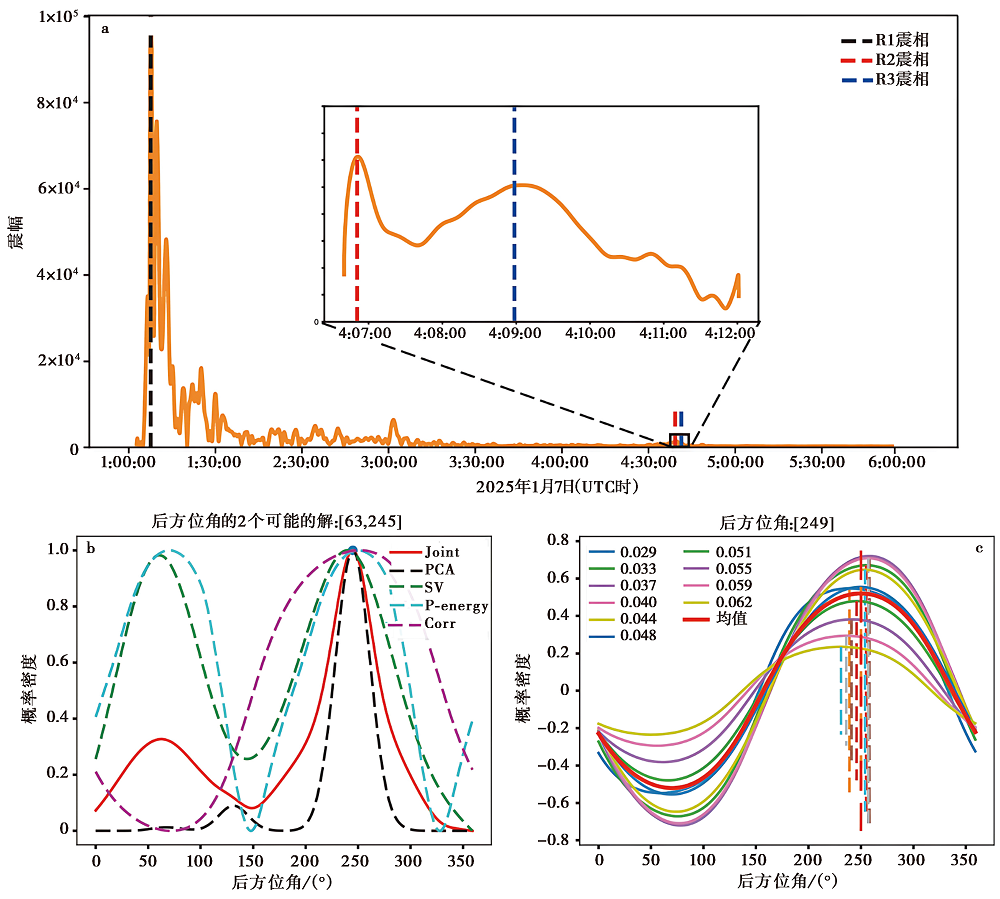
245
157.9
249
2025-01-07, 09:05:16.374 (28.612°N, 87.381°E)
2025-01-07, 09:05:16.770 (28.706°N, 87.340°E)
2025-01-07, 09:05:16.824 (28.639°N, 87.361°E)
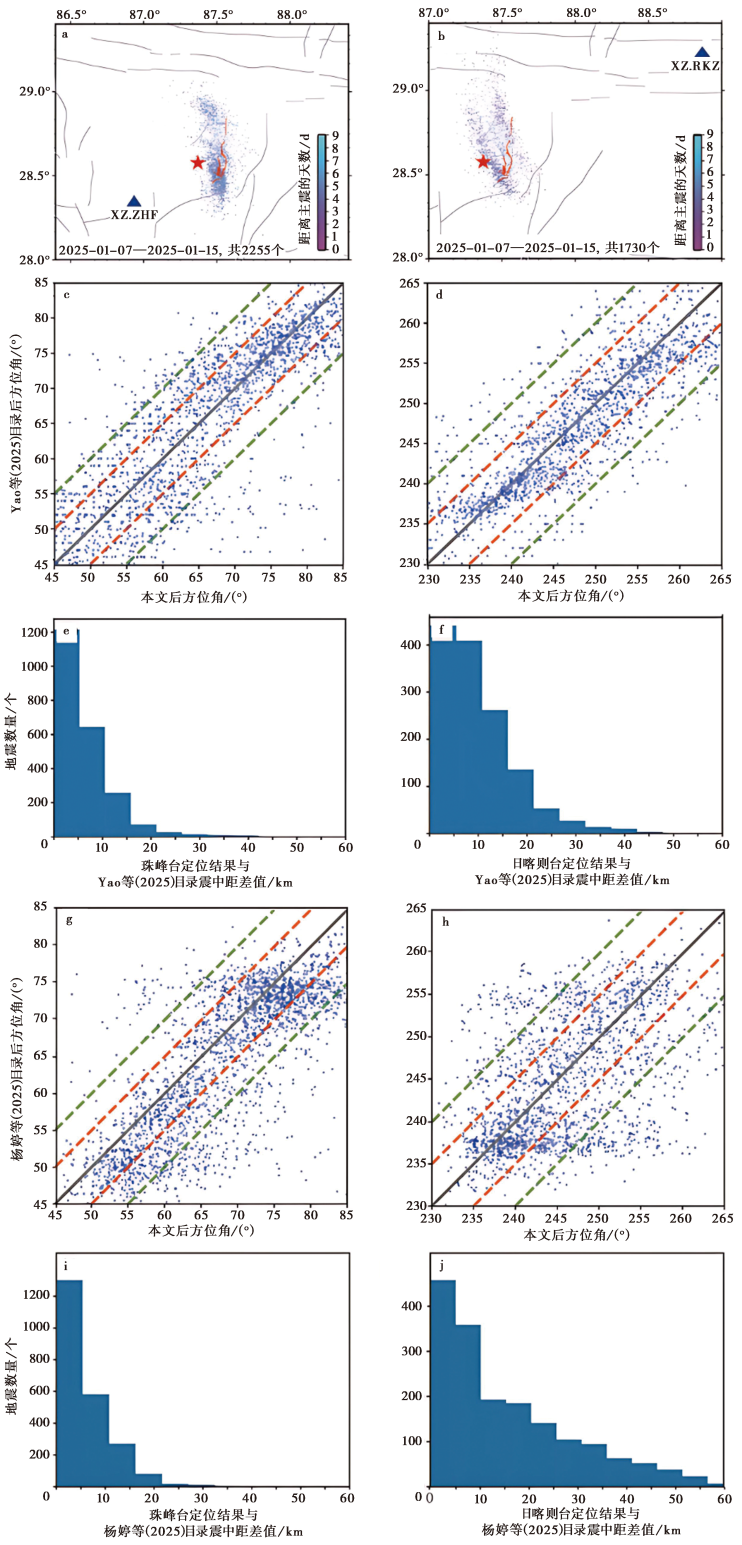
Fig. 5 Comparison of single-station location results from stations ZHF and RKZ, to the results with multi-station location.
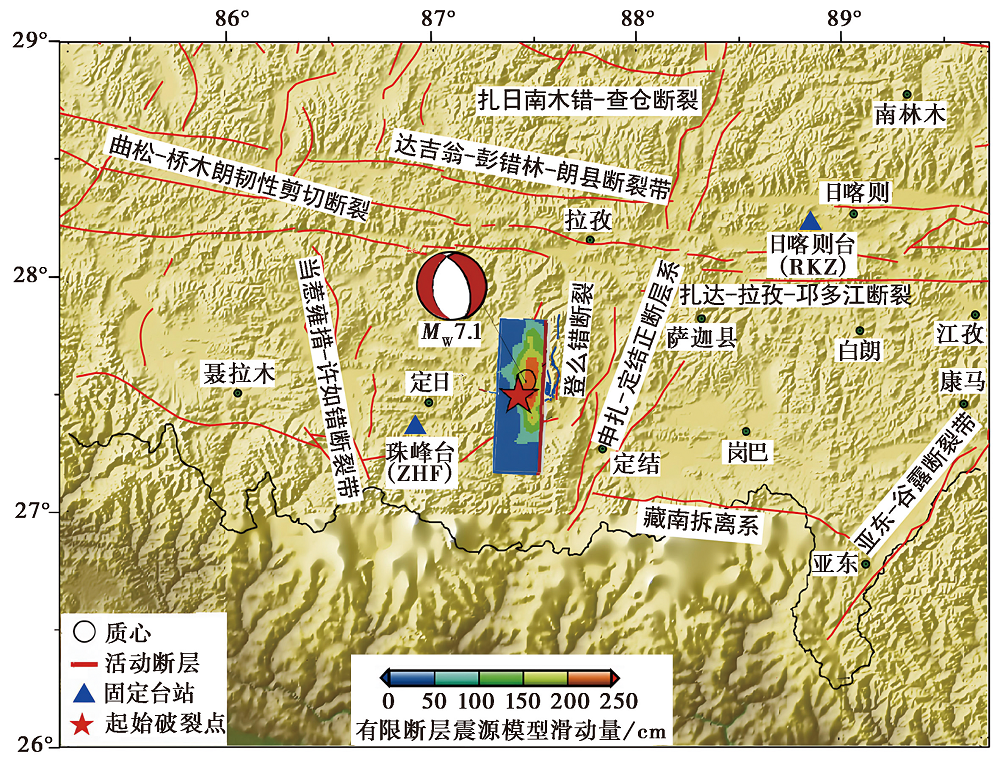
Fig. 6 The distribution of the aftershock sequence of the M6.8 Dingri, Xizang earthquake and surface projection of the coseismic slip distribution of the mainshock
SHIFeng, LIANGMing-jian, LUOQuan-xing, et al. 2025. Seismogenic fault and coseismic surface deformation of Dingri MS6.8 earthquake in Tibet, China[J]. Seismology and Geology, 47(1): 1-15 (in Chinese).
TIANTing-ting, WUZhong-hai. 2023. Recent prehistoric major earthquake event of Dingmucuo Normal fault in the southern segment of Shenzha-Dingjie Rift and its seismic geological significance[J]. Geological Review, 69(1): 53-55 (in Chinese).
WANYong-ge, JINZhi-tong, CUIHua-wei, et al. 2017. Study on displacement of the peaks of the Himalaya generated by the 2015 nepal earthquake sequence[J]. Seismology and Geology, 39(4): 699-711 (in Chinese).
YANGTing, WANGShi-guang, FANGLi-hua, et al. 2017. Analysis of earthquake sequence and seismogenic structure of the 2025 MS6.8 Dingri earthquake in Tibetan plateau[J]. Earth Science, 50(5): 1721-1732 (in Chinese).
[5]
AllenR M, GaspariniP, KamigaichiO, et al. 2009. The status of earthquake early warning around the world: An introductory overview[J]. Seismological Research Letters, 80(5): 682-693.
[6]
AvouacJ P, MengL, WeiS, et al. 2015. Lower edge of locked Main Himalayan Thrust unzipped by the 2015 Gorkha earthquake[J]. Nature Geoscience, 8(9): 708-711.
[7]
BakerG E, StevensJ L. 2004. Backazimuth estimation reliability using surface wave polari-zation[J]. Geophysical Research Letters, 31(9): l09611.
[8]
BöseM, ClintonJ F, CeylanS, et al. 2017. A probabilistic framework for single-station location of seismicity on Earth and Mars[J]. Physics of the Earth and Planetary Interiors, 262: 48-65.
[9]
ChaelE P. 1997. An automated Rayleigh-wave detection algorithm[J]. Bulletin of the Seismological Society of America, 87(1): 157-163.
[10]
ClintonJ, GiardiniD, BöseM, et al. 2018. The Marsquake service: Securing daily analysis of SEIS data and building the Martian seismicity catalogue for InSight[J]. Space Science Reviews, 214: 1-33.
[11]
ClintonJ F, CeylanS, van DrielM, et al. 2021. The Marsquake catalogue from InSight, sols 0-478[J]. Physics of the Earth and Planetary Interiors, 310:106595.
[12]
CrotwellH P, OwensT J, RitsemaJ. 1999. The TauP Toolkit: Flexible seismic travel-time and raypath utilities[J]. Seismological Research Letters, 70: 154-160.
[13]
DrilleauM, SamuelH, GarciaR F, et al. 2022. Marsquake locations and 1-D seismic models for Mars from InSight data[J]. Journal of Geophysical Research: Planets, 127(9): e-2021JE007067.
[14]
EisermannA S, ZivA, Wust-BlochG H. 2015. Real-time back azimuth for earthquake early warning[J]. Bulletin of the Seismological Society of America, 105(4): 2274-2285.
[15]
GodaK, KiyotaT, PokhrelR M, et al. 2015. The 2015 Gorkha Nepal earthquake: Insights from earthquake damage survey[J]. Frontiers in Built Environment, 1:8.
[16]
KhanA, van DrielM, BöseM, et al. 2016. Single-station and single-event marsquake location and inversion for structure using synthetic Martian waveforms[J]. Physics of the Earth and Planetary Interiors, 258: 28-42.
[17]
NakamuraY. 1988. On the urgent earthquake detection and alarm system(UrEDAS)[C]. 9th World Conference on Earthquake Engineering, Tokyo: 673-678.
[18]
NodaS, YamamotoS, SatoS, et al. 2012. Improvement of back-azimuth estimation in real-time by using a single station record[J]. Earth, planets and space, 64: 305-308.
[19]
PanningM P, BanerdtW B, BegheinC, et al. 2023. Locating the largest event observed on Mars with multi-orbit surface waves[J]. Geophysical Research Letters, 50(1): e-2022GL101270.
[20]
PanningM P, BeuclerÉ, DrilleauM, et al. 2015. Verifying single-station seismic approaches using Earth-based data: Preparation for data return from the InSight mission to Mars[J]. Icarus, 248: 230-242.
[21]
RajendranC P, RajendranK. 2022. Earthquakes of the Indian Sub-continent[M]. Springer Nature, Singapore: 159-171.
[22]
WesselP, LuisJ F, UiedaL, et al. 2019. The generic mapping tools version 6[J]. Geochemistry, Geophysics, Geosystems, 20(11): 5556-5564.
YaoJ Y, YaoD D, ChenF, et al. 2025. A Preliminary catalog of early aftershocks following the 7 January 2025 MS6. 8 Dingri, Xizang earthquake[J]. Journal of Earth Science, 36: 856-860.
[24]
ZhaoM, XiaoZ W, ChenS, et al. 2023. DiTing: A large-scale Chinese seismic benchmark dataset for artificial intelligence in seismology[J]. Earthquake Science, 36(2): 84-94.
[25]
ZhaoM, XiaoZ W, ZhangB, et al. 2024. ‘DiTing’ and ‘DiTingtools’: A large multi-label dataset and algorithm set for intelligent seismic data processing established based on the China Seismological Network[R]. European Geosciences Union General Assembly 2024. Viena.
[26]
ZhaoX, DuputelZ, YaoZ X, et al. 2017. Regional W-phase source inversion for moderate to large earthquakes in China and neighboring areas[J]. Journal of Geophysical Research: Solid Earth, 122(12): 10052-10068.
[27]
ZhaoX, XiaoZ W, WangW, et al. 2023. Fine seismogenic fault structures and complex rupture characteristics of the 2022 M6.8 Luding, Sichuan earthquake sequence revealed by deep learning and waveform modeling[J]. Geophysical Research Letters, 50(18): e2023GL102976.
[28]
ZhengX F, YaoZ X, LiangJ H, et al. 2010. The role played and opportunities provided by IGP DMC of China National Seismic Network in Wenchuan earthquake disaster relief and researches[J]. Bulletin of the Seismological Society of America, 100(5B): 2866-2872.
[29]
ZhuW Q, MousaviS M, BerozaG C. 2019. Seismic signal denoising and decomposition using deep neural networks[J]. Institute of Electrical and Electronics Engineers Transactions on Geoscience and Remote Sensing, 57(11): 9476-9488.