地震地质 ›› 2026, Vol. 48 ›› Issue (5): 1423-1437.DOI: 10.3969/j.issn.0253-4967.20250173
畅柳( ), 占伟*(), 郭南男
收稿日期:2025-11-18
修回日期:2026-01-15
出版日期:2026-11-11
发布日期:2026-11-11
通讯作者:
占伟
作者简介:畅柳, 女, 1990年生, 2013年于武汉大学获大地测量学与测量工程专业硕士学位, 高级工程师, 研究方向为大地测量数据处理与形变分析, E-mail: changliu1990@whu.edu.cn。
基金资助:
CHANG Liu(), ZHAN Wei*(), GUO Nan-nan
Received:2025-11-18
Revised:2026-01-15
Online:2026-11-11
Published:2026-11-11
Contact:
ZHAN Wei
摘要:
文中基于1954-2012年唐山7.8级地震的震前、同震及震后传统大地测量原始观测资料, 采用改进的动态平差算法重建了唐山地震震前、同震、震后的三维地表形变场。通过综合分析垂向与水平向形变结果, 揭示了唐山地震从震前大范围较强烈的差异运动演变为大范围运动减弱及震中区显著区域性隆升、同震高应变释放到震后短期调整与长期趋于稳定的形变演化序列。通过形变数据约束的断层滑动反演结果表明, 同震和震后的断层滑动在空间上具有一定的继承性和互补性。文中首次系统量化了唐山地震震前-同震-震后3个阶段的形变时空演化过程, 为华北地区强震复发规律和孕震机理研究提供了关键形变基础数据。
畅柳, 占伟, 郭南男. 唐山7.8级地震震前-同震-震后三维变形和断层运动特征[J]. 地震地质, 2026, 48(5): 1423-1437.
CHANG Liu, ZHAN Wei, GUO Nan-nan. THREE-DIMENSIONAL DEFORMATION AND FAULT MOTION CHARACTERISTICS OF THE TANGSHAN M7.8 EARTHQUAKE DURING THE PRE-, CO-, AND POST-SEISMIC PHASES[J]. SEISMOLOGY AND GEOLOGY, 2026, 48(5): 1423-1437.
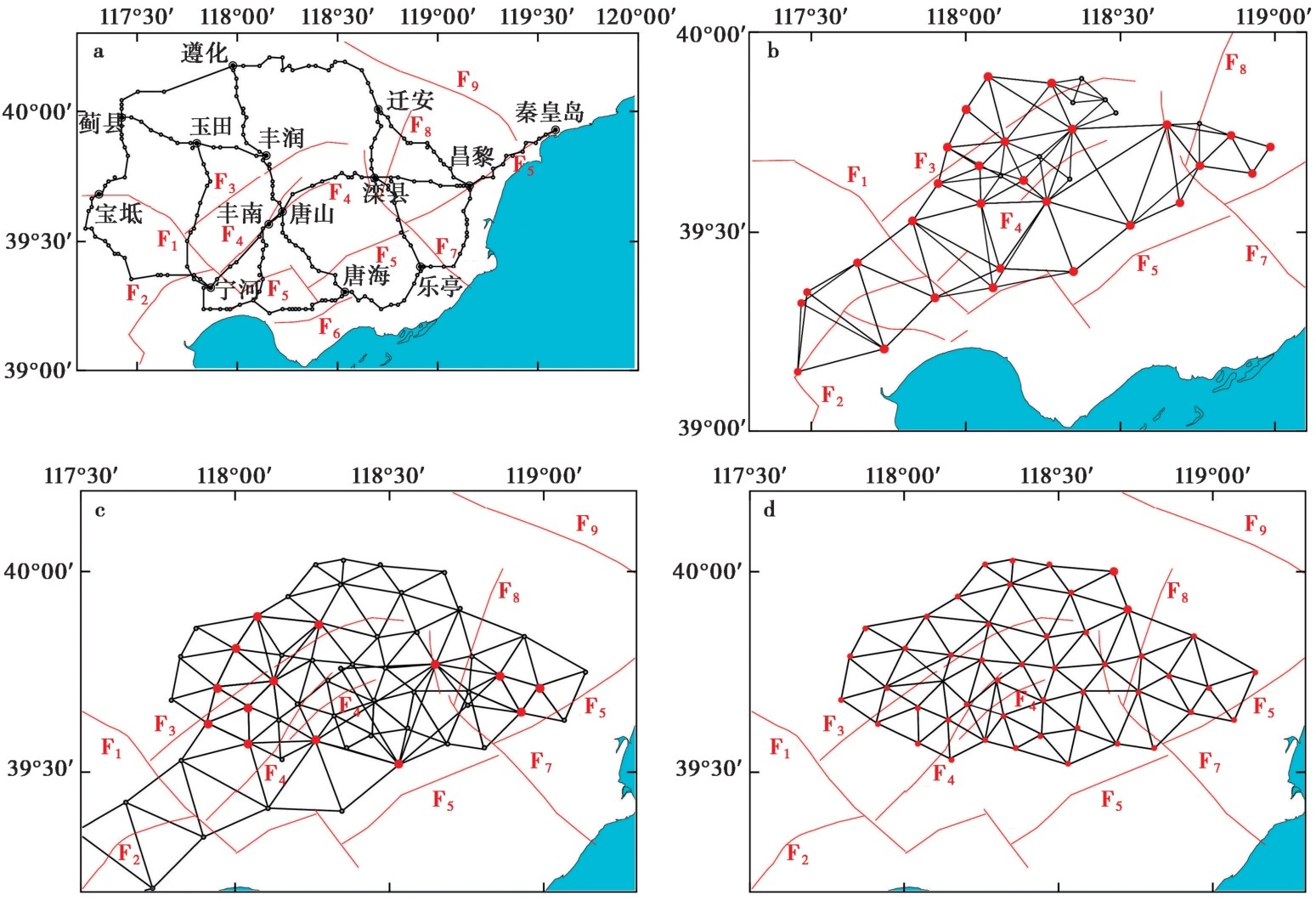
图1 唐山震区传统大地测量测网 a 1968-2012年水准网; b 1954-1976年测角、测边网; c 1976-1977年测角、测边网; d 1977-1985年测角、测边网。F1蓟运河断裂; F2沧东断裂; F3丰台-野鸡坨断裂; F4唐山断裂; F5宁河-昌黎断裂; F6西南庄断裂; F7滦县-乐亭断裂; F8卢龙断裂; F9建昌营断裂
Fig. 1 Geodetic network in the Tangshan earthquake region.
| 年份 | 测点数 | 测段数 | 测线长度/km | 点位平均误差 |
|---|---|---|---|---|
| 1968-1971 | 225 | 466 | 2599.0 | 2.6mm/a |
| 1971-1975 | 225 | 466 | 2598.9 | 2.3mm/a |
| 同震 | 225 | 466 | 2580.5 | 11.4mm |
| 1976-1980 | 145 | 306 | 2672.7 | 4.9mm/a |
| 1980-1992 | 216 | 446 | 2557.3 | 1.5mm/a |
| 1992-2001 | 183 | 372 | 2946.5 | 1.3mm/a |
| 2001-2012 | 316 | 638 | 3779.2 | 4.7mm/a |
表1 区域水准动态平差结果统计
Table1 Statistics of dynamic adjustment results for leveling network
| 年份 | 测点数 | 测段数 | 测线长度/km | 点位平均误差 |
|---|---|---|---|---|
| 1968-1971 | 225 | 466 | 2599.0 | 2.6mm/a |
| 1971-1975 | 225 | 466 | 2598.9 | 2.3mm/a |
| 同震 | 225 | 466 | 2580.5 | 11.4mm |
| 1976-1980 | 145 | 306 | 2672.7 | 4.9mm/a |
| 1980-1992 | 216 | 446 | 2557.3 | 1.5mm/a |
| 1992-2001 | 183 | 372 | 2946.5 | 1.3mm/a |
| 2001-2012 | 316 | 638 | 3779.2 | 4.7mm/a |
| 年份 | 测点数 | 公共测点数 | 测边观测值数 | 测角观测值数 | N向平均误差 | E向平均误差 |
|---|---|---|---|---|---|---|
| 1954-1971 | 37 | 25 | 45 | 250 | 4.2mm/a | 5.1mm/a |
| 同震 | 26 | 24 | 100 | 0 | 60.4mm | 54.6mm |
| 1977-1985 | 48 | 48 | 120 | 238 | 1.2mm/a | 1.0mm/a |
表2 测边角网动态平差结果统计
Table2 Statistics of dynamic adjustment results for trilateration network
| 年份 | 测点数 | 公共测点数 | 测边观测值数 | 测角观测值数 | N向平均误差 | E向平均误差 |
|---|---|---|---|---|---|---|
| 1954-1971 | 37 | 25 | 45 | 250 | 4.2mm/a | 5.1mm/a |
| 同震 | 26 | 24 | 100 | 0 | 60.4mm | 54.6mm |
| 1977-1985 | 48 | 48 | 120 | 238 | 1.2mm/a | 1.0mm/a |
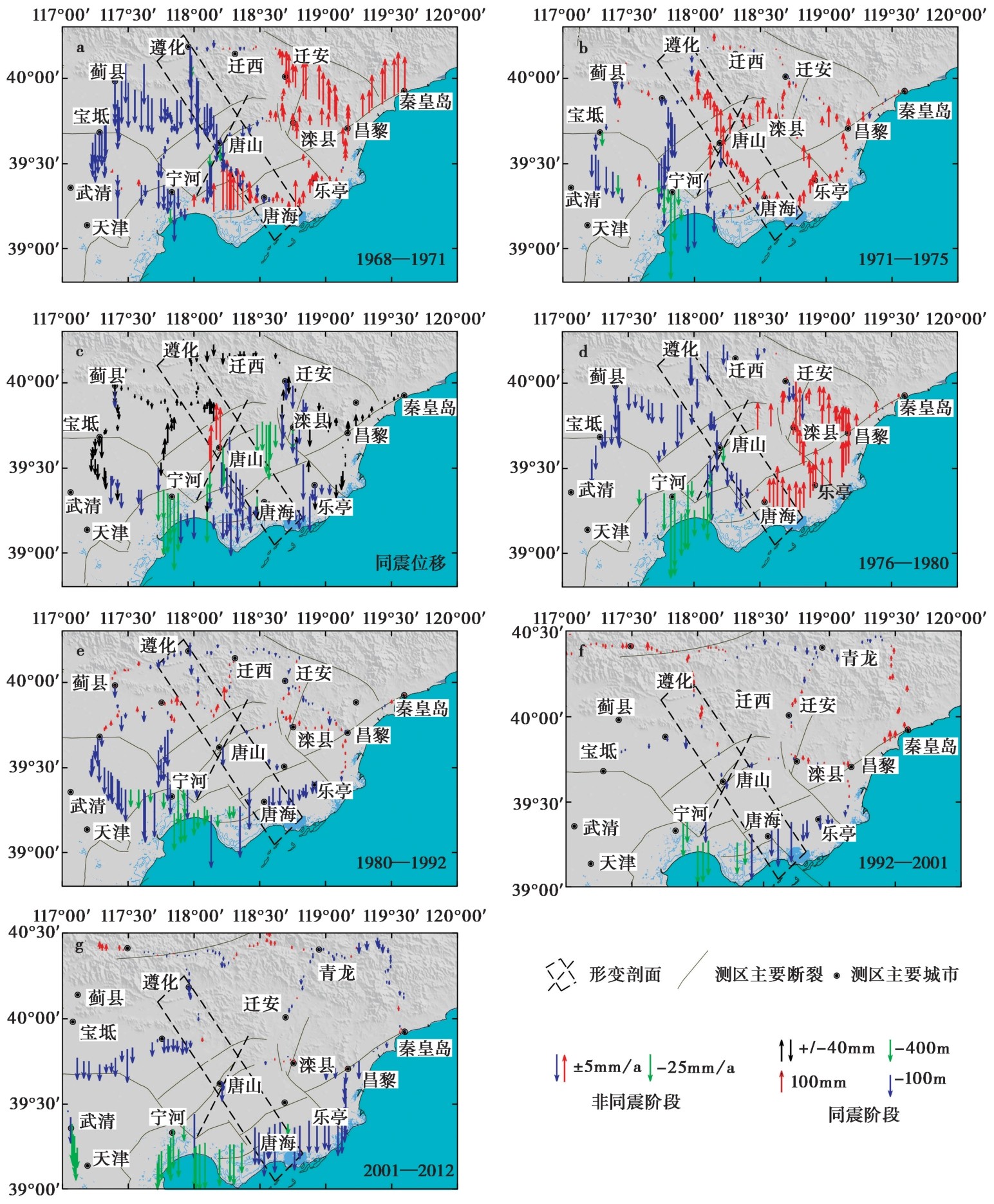
图2 唐山地震垂向形变场 a震前1968-1971年; b震前1971-1975年; c同震; d震后1976-1980年; e震后1980-1992年; f震后1992-2001年; g震后2001-2012年
Fig. 2 Vertical deformation field associated with the Tangshan earthquake.
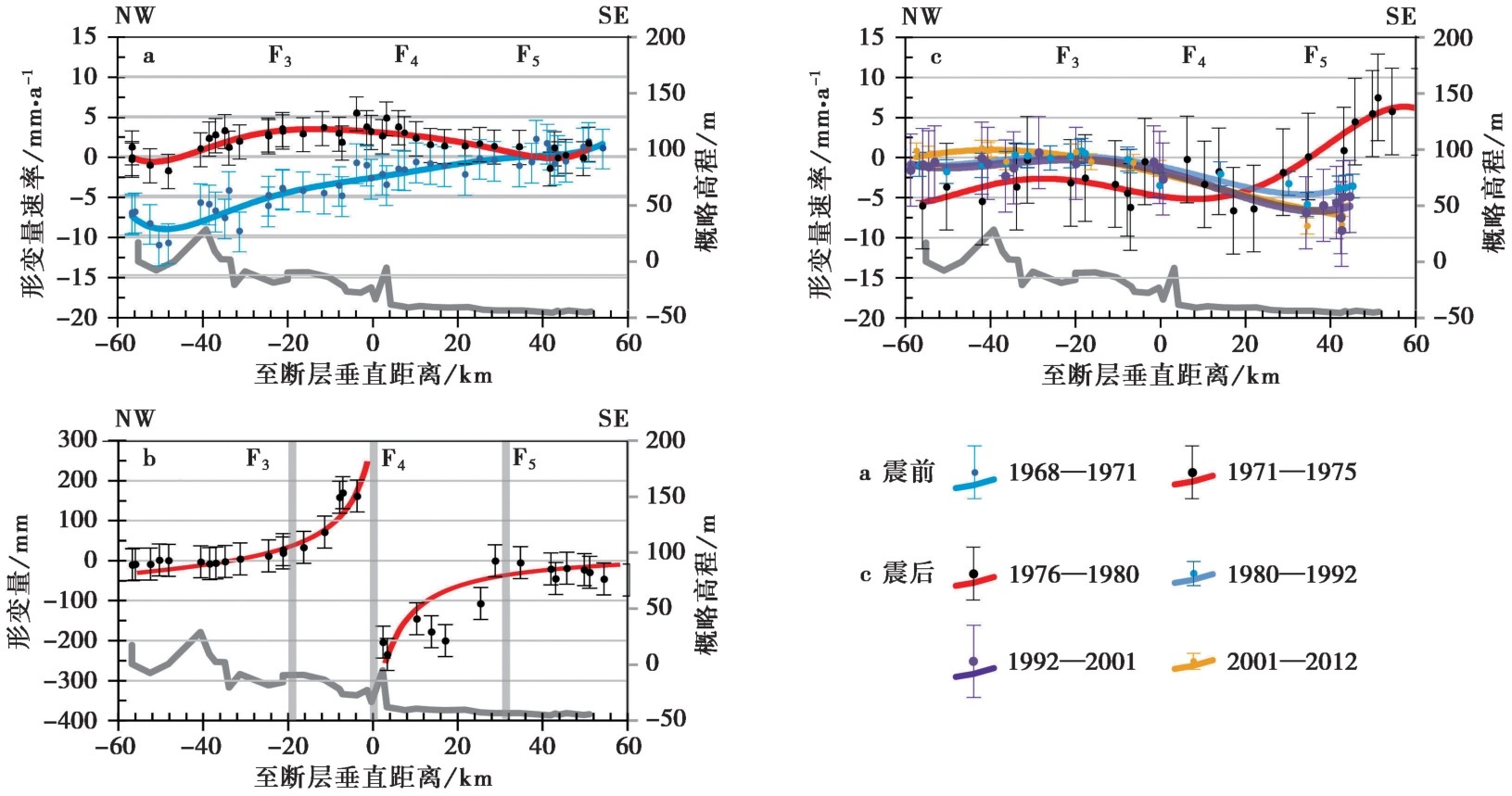
图3 唐山地震垂向形变剖面 a震前阶段1968-1975年; b同震; c震后阶段1976-2012年
Fig. 3 Vertical deformation profile associated with the Tangshan earthquake.
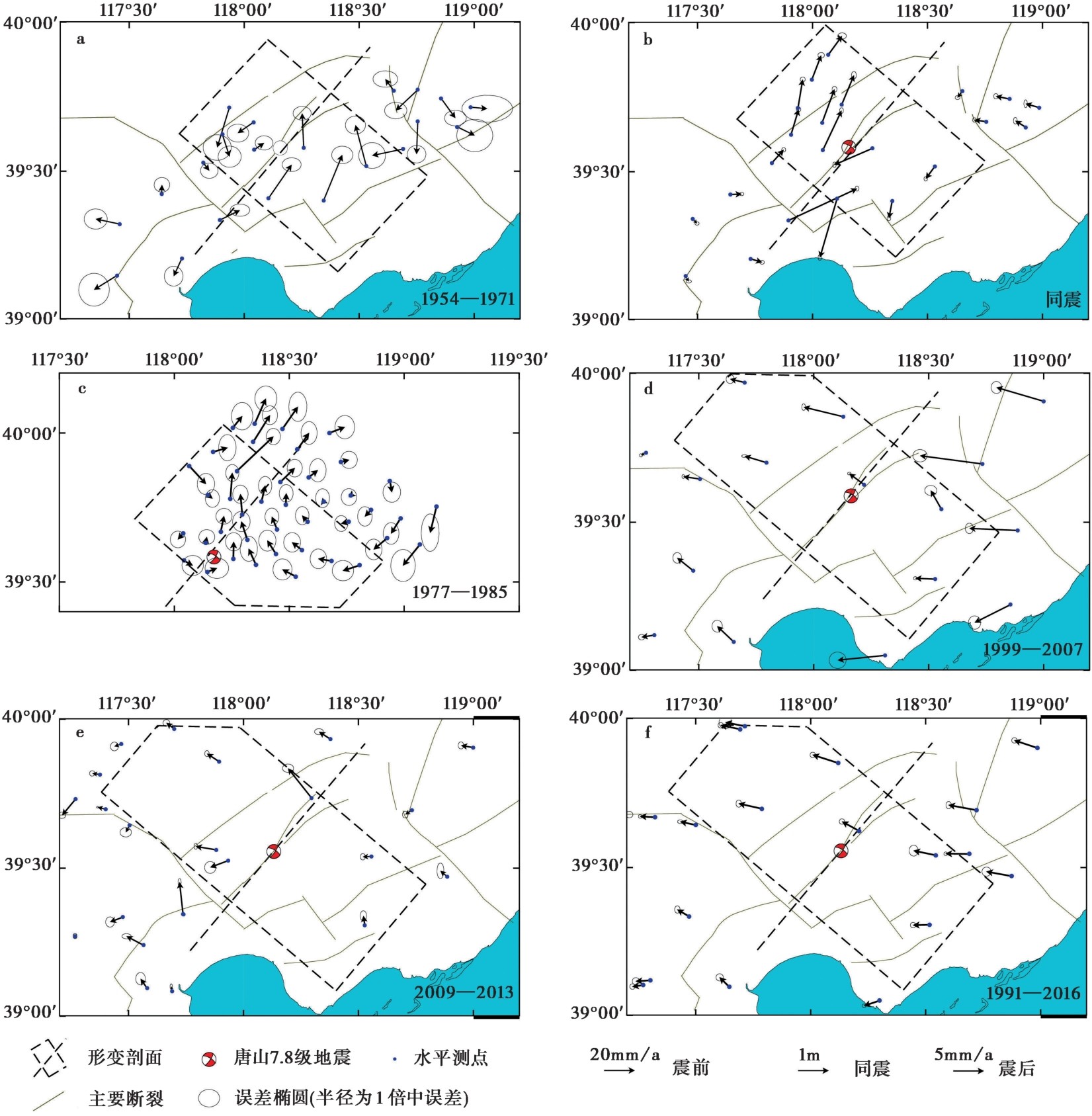
图4 唐山地震水平形变场 a震前1954-1971年; b同震; c震后1977-1985年; d震后1999-2007年(武艳强等, 2016); e震后2009-2013年; f震后1991-2016年(Wang et al., 2020)
Fig. 4 Horizontal deformation field associated with the Tangshan earthquake.
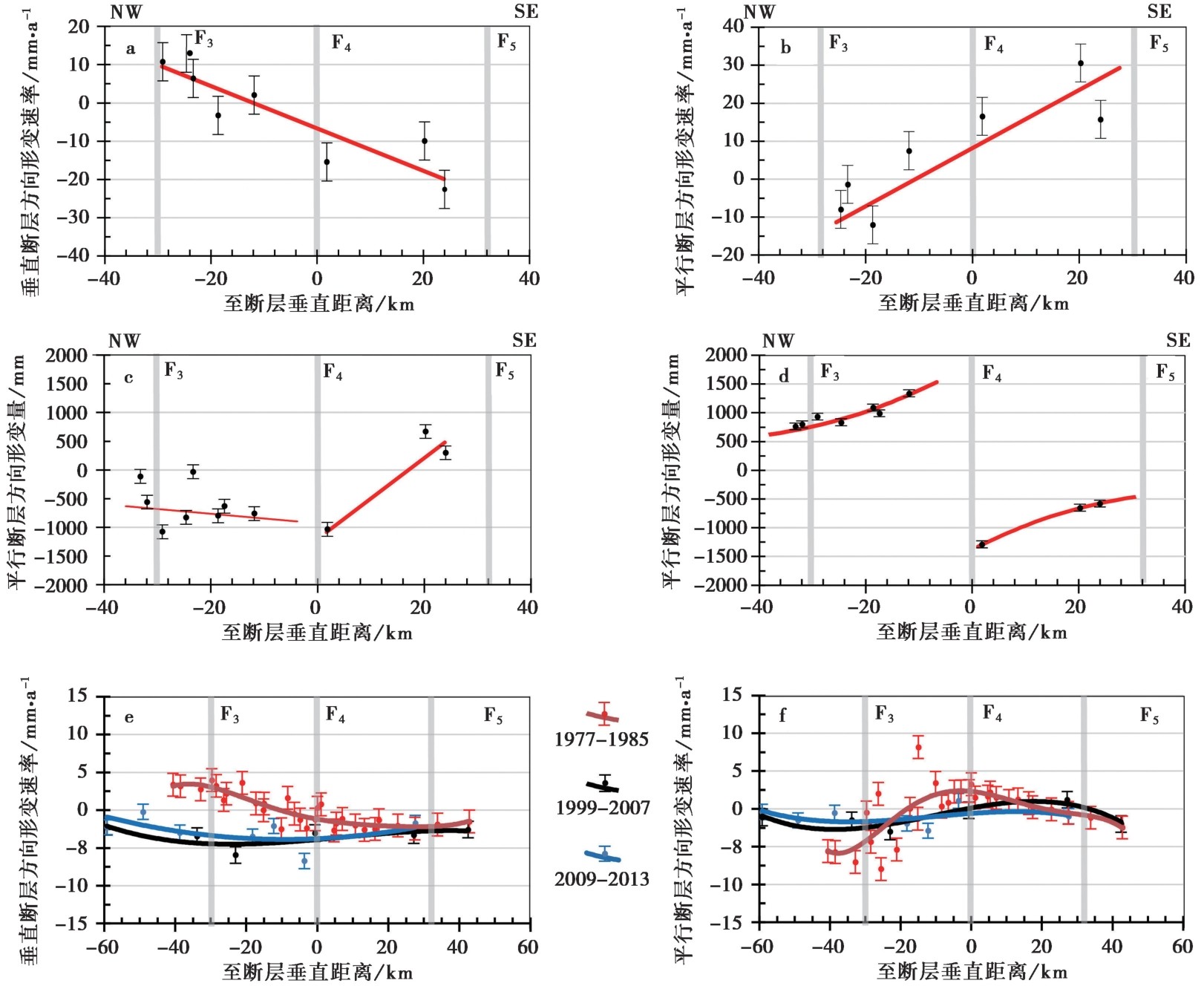
图5 唐山地震水平形变剖面 a震前阶段(1954-1971年)垂直于断层方向的水平形变速率剖面; b震前阶段(1954-1971年)平行于断层方向的水平形变速率剖面; c垂直于断层方向的同震形变剖面; d平行于断层方向的同震形变剖面; e震后阶段(1977-2016年)垂直于断层方向的水平形变速率剖面; f震后阶段(1977-2016年)平行于断层方向的水平形变速率剖面
Fig. 5 Horizontal deformation profile associated with the Tangshan earthquake.
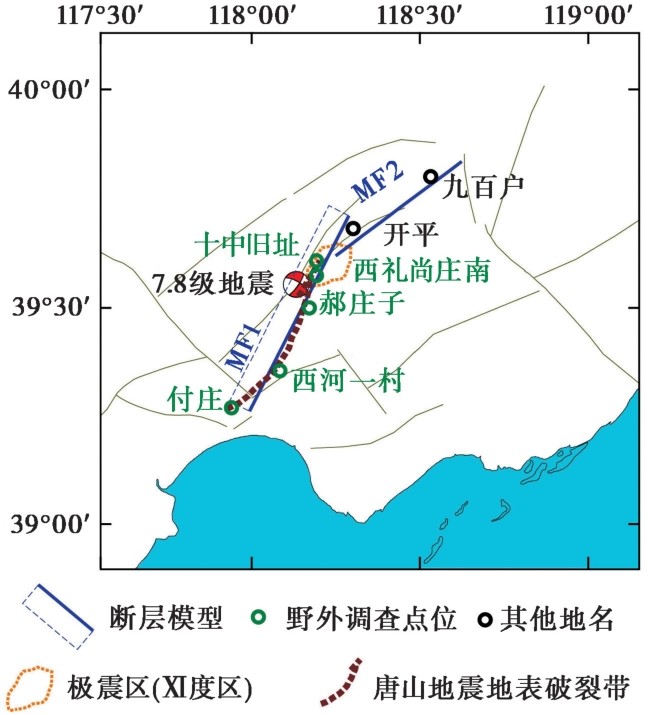
图6 唐山地震断层模型的空间展布(畅柳等,2022) MF1为唐山主震断层南段断层模型, MF2为唐山主震断层北段断层模型
Fig. 6 Fault model for the Tangshan earthquake(from CHANG Liu et al., 2022).
| 断层 | 断层起点经度 | 断层起点纬度 | 长度 | 宽度 | 走向 | 倾向 |
|---|---|---|---|---|---|---|
| 唐山主震断层南段 | 117.983°E | 39.247°N | 56km | 22km | 207° | 75° |
| 唐山主震断层北段 | 118.250°E | 39.620°N | 40km | 22km | 233° | 90° |
表3 唐山地震断层模型参数(畅柳等, 2022)
Table3 Fault model parameters for the Tangshan earthquake(from CHANG Liu et al., 2022)
| 断层 | 断层起点经度 | 断层起点纬度 | 长度 | 宽度 | 走向 | 倾向 |
|---|---|---|---|---|---|---|
| 唐山主震断层南段 | 117.983°E | 39.247°N | 56km | 22km | 207° | 75° |
| 唐山主震断层北段 | 118.250°E | 39.620°N | 40km | 22km | 233° | 90° |
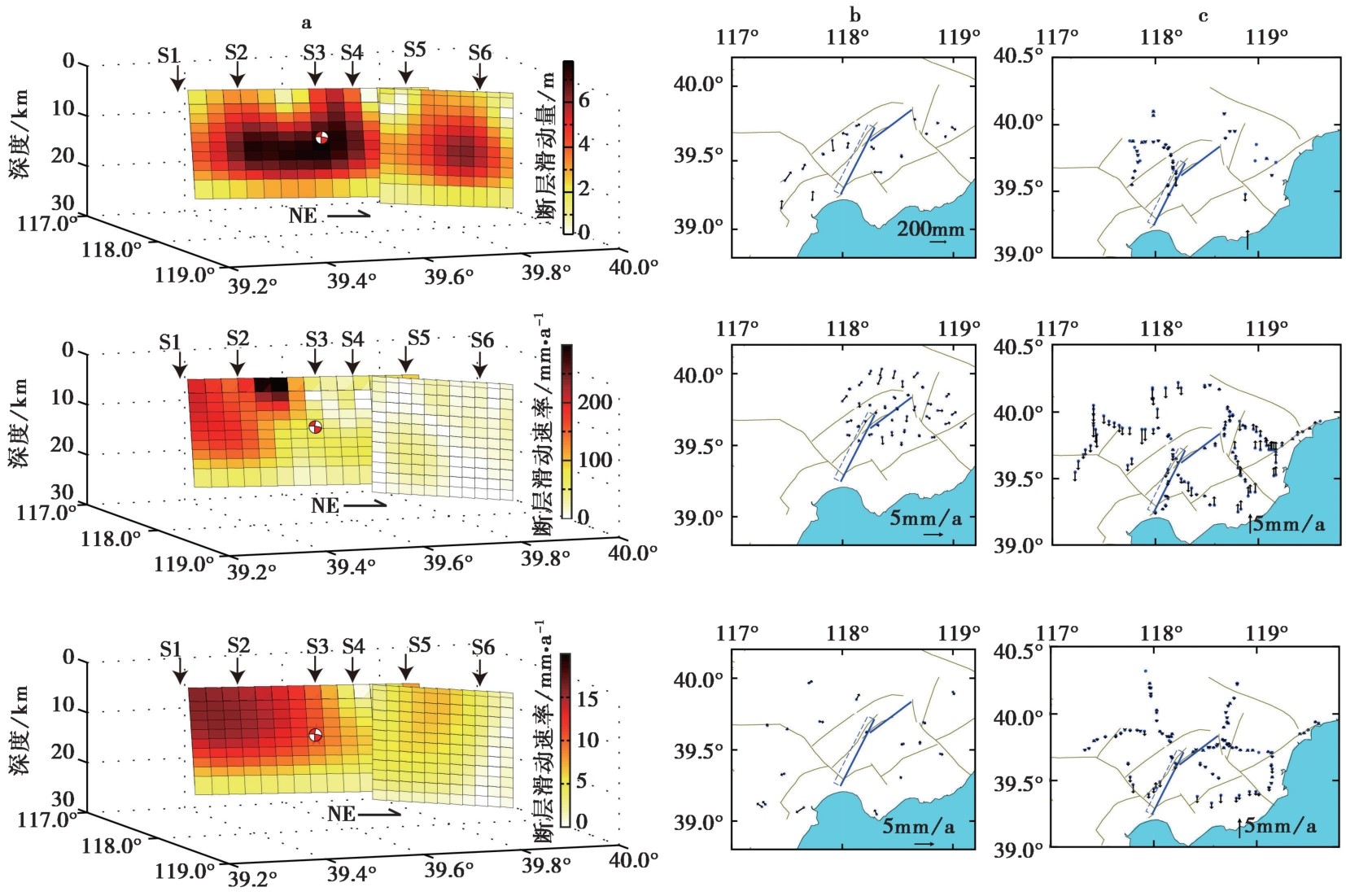
图7 唐山7.8级地震同震及震后断层滑动反演结果 a同震阶段(上图)、震后1976-1980年(中图)、震后1980-2016年(下图)的断层滑动分布; b同震阶段(上图)、震后1976-1980年(中图)、震后1980-2016年(下图)的垂向地表形变残差分布; c同震阶段(上图)、震后1976-1980年(中图)、震后1980-2016年(下图)的水平向地表形变残差分布。图a中, S1-S6分别表示图6中的付庄(S1)、西河一村(S2)、郝庄子(S3)、十中旧址(S4)、开平(S5)、九百户(S6)的位置。需补充说明的是: 图b中图所用的水平形变数据时间为1975-1985年; 由于图b下图在唐山断裂南段观测点位过少, 对主要滑动区域的约束作用较弱, 因此该阶段滑动模型 (图a下图)的时间范围以反演所采用的垂向形变数据的时间跨度为准
Fig. 7 Coseismic and postseismic fault slip inversion results of the Tangshan M7.8 earthquake.
| 期次 | 数模相关系数 | RMS均值 |
|---|---|---|
| 同震 | 0.964 | 127.8mm |
| 1976-1985 | 0.928 | 2.1mm/a |
| 1980-2016 | 0.691 | 0.9mm/a |
表4 不同阶段断层滑动反演结果统计
Table4 Statistics of fault slip inversion results in different period
| 期次 | 数模相关系数 | RMS均值 |
|---|---|---|
| 同震 | 0.964 | 127.8mm |
| 1976-1985 | 0.928 | 2.1mm/a |
| 1980-2016 | 0.691 | 0.9mm/a |
| [1] |
白武明, 林邦慧, 陈祖安. 2003. 1976年唐山大震发生对华北地区各地块运动与变形影响的数值模拟研究[J]. 中国科学(D辑), 33(S1): 99-107.
|
|
|
|
| [2] |
畅柳, 武艳强, 杨博, 等. 2022. 唐山7.8级地震三维地表形变和断层运动特征[J]. 武汉大学学报(信息科学版), 47(6): 916-926.
|
|
|
|
| [3] |
陈运泰, 林邦慧, 王新华, 等. 1979. 用大地测量资料反演的1976年唐山地震的位错模式[J]. 地球物理学报, 22(3): 201-217.
|
|
|
|
| [4] |
杜晨晓, 谢富仁, 张扬, 等. 2010. 1976年MS7.8唐山地震断层动态破裂及近断层强地面运动特征[J]. 地球物理学报, 53(2): 290-304.
|
|
|
|
| [5] |
郭慧, 江娃利, 谢新生. 2011. 对1976年河北唐山MS7.8地震地表破裂带展布及位移特征的新认识[J]. 地震地质, 33(3): 506-524. doi: 10.3969/j.issn.0253-4967.2011.03.002.
|
|
DOI |
|
| [6] |
国家地震局. 1982. 一九七六年唐山地震[M]. 北京: 地震出版社.
|
|
State Seismological Bureau. 1982. The 1976 Tangshan Earthquake[M]. Beijing: Seismological Press (in Chinese).
|
|
| [7] |
黄立人. 1981. 用广义逆法分析唐山地震的水平位移场及其与经典方法的比较[J]. 地壳形变与地震, (3): 1-11.
|
|
|
|
| [8] |
黄立人, 王学忠, 刘天奎. 1988. 唐山地震前后的水平形变[J]. 地震学报, 10(4): 375-384.
|
|
DOI URL |
|
| [9] |
刘晓霞, 江在森, 武艳强. 2018. 唐山、汶川地震地壳形变特征综合研究[J]. 地球物理学进展, 33(3): 941-950.
|
|
|
|
| [10] |
孟国杰, 于莉, 高锡铭. 1995. 唐山地震的非均匀错动模型: 水准资料的反演结果[J]. 地壳形变与地震, 15(2): 7-14.
|
|
|
|
| [11] |
梅世蓉. 1996. 地震前兆场物理模式与前兆时空分布机制研究(三): 强震孕育时地震活动与地壳形变场异常及机制[J]. 地震学报, 18(2): 170-178.
|
|
|
|
| [12] |
邵志刚, 李旖雯, 王芃. 2015. 1966年邢台强震群震前、同震和震后断层运动特征分析[J]. 地震, 35(3): 1-9.
|
|
|
|
| [13] |
孙荀英, 刘激扬, 王仁. 1994. 1976年唐山地震震时和震后变形的模拟[J]. 地球物理学报, 37(1): 46-55.
|
|
|
|
| [14] |
万永革, 万永魁, 靳志同, 等. 2017. 用形变资料反演1976年唐山地震序列的破裂分布[J]. 地球物理学报, 60(9): 3378-3395.
DOI |
|
|
|
| [15] |
王椿镛, 吴庆举, 段永红, 等. 2017. 华北地壳上地幔结构及其大地震深部构造成因[J]. 中国科学(D辑), 47(6): 684-719.
|
|
|
|
| [16] |
王双绪, 江在森. 1997. 丽江7.0级和唐山7.8级地震前形变场动态演化与异常特征[J]. 地壳形变与地震, 17(4): 42-47.
|
|
|
|
| [17] |
武艳强, 黄立人, 陈长云, 等. 2016. 1976年唐山MS7.8地震同震及现今形变特征[J]. 地震学报, 38(4): 609-617.
|
|
|
|
| [18] |
谢觉民, 黄立人. 1987. 唐山地震前后的地壳垂直运动[J]. 地震地质, 9(3): 1-10.
|
|
|
|
| [19] |
张祖胜. 1983. 1976年唐山地震区的地壳水平形变场研究[J]. 地壳形变与地震, (1): 1-9.
|
|
|
|
| [20] |
张祖胜, 谢觉民, 徐峰壮, 等. 1981. 唐山7.8级地震的地壳垂直形变[J]. 地球物理学报, 24(2): 182-191.
|
|
|
|
| [21] |
DOI URL |
| [22] |
DOI URL |
| [23] |
|
| [24] |
|
| [25] |
|
| [1] | 陈倩, 张竹琪. 太原盆地地壳形变特征及其反映的强震危险性[J]. 地震地质, 2025, 47(1): 189-213. |
| [2] | 李媛, 杨周胜, 庞亚瑾, 梁洪宝, 刘峡. 2022年门源 MS6.9 地震前断层活动及应力状态的数值模拟[J]. 地震地质, 2023, 45(6): 1286-1308. |
| [3] | 刘洁, 宋惠珍. 邢台地震断层运动特征反演分析[J]. 地震地质, 1999, 21(3): 229-237. |
| [4] | 张崇立, 任金卫. 则木河断裂的现今活动方式及其地形变鉴别标志探讨[J]. 地震地质, 1995, 17(4): 427-431. |
| [5] | 侯康明, 袁道阳, 孟万辉. 走滑断裂粘滑、蠕滑作用形成的地质地貌特征[J]. 地震地质, 1995, 17(3): 253-258. |
| [6] | 杨主恩, 郑炳华, 方仲景, 汪良谋, 俞理宝, 金钟燮. 华北北部地区主要断裂带的小构造和显微构造研究[J]. 地震地质, 1994, 16(4): 305-312. |
| [7] | 陈以健, 赵颇, 卢景芬, 乔力. 黄河小浪底水库区断层的ESR年龄测定[J]. 地震地质, 1989, 11(4): 83-90. |
| 阅读次数 | ||||||
|
全文 |
|
|||||
|
摘要 |
|
|||||