地震地质 ›› 2026, Vol. 48 ›› Issue (5): 1197-1213.DOI: 10.3969/j.issn.0253-4967.20260046
俞晶星1)( ), 石磊2), 赵帅3), 李占飞4), 范莉苹2), 苗文培2), 张会平1)
收稿日期:2026-03-30
修回日期:2026-05-13
出版日期:2026-11-11
发布日期:2026-11-11
作者简介:俞晶星, 男, 1987年生, 研究员, 主要从事新构造与活动构造研究, E-mail: jingxingyu@ies.ac.cn。
基金资助:
YU Jing-xing1)(), SHI Lei2), ZHAO Shuai3), LI Zhan-fei4), FAN Li-ping2), MIAO Wen-pei2), ZHANG Hui-ping1)
Received:2026-03-30
Revised:2026-05-13
Online:2026-11-11
Published:2026-11-11
摘要:
巨厚沉积区发育的隐伏活动断层是城市直下型强震的重要发震构造, 断层引发的强震会造成毁灭性灾害, 开展巨厚沉积区活动断层的精准探测对地震灾害风险防控意义重大。然而, 受断层高隐伏性、浅层弱变形特征、松散沉积物的信号吸收、人类活动的强干扰等多重因素影响, 巨厚沉积区的活动断层探测面临诸多技术难题。文中在总结前人研究成果的基础上, 结合京西北巨厚沉积区相关研究的最新进展, 从深部孕震环境探测、浅层精细断层结构探测、钻孔联合剖面与古地震探槽等方面, 系统梳理了当前该领域的主要研究方法与技术进展, 重点围绕重磁测量、断层围陷波分析、多尺度全波形反演、浅层断层结构探测新技术等方面进行论述。以京西北的南口-孙河隐伏断裂为探测实例, 介绍了“由深到浅”的隐伏活动断层综合探测体系, 即通过深部孕震环境探测-浅部断层精细结构探测-钻孔联合剖面-探槽的顺序, 由深到浅逐渐查清断层空间展布和上断点埋深, 并最终通过探槽开挖揭示断层的活动参数和强震复发历史, 为评估未来地震危险性提供关键数据, 也为在类似区域开展沉积区隐伏活断层探测提供方法参考与实践依据。
俞晶星, 石磊, 赵帅, 李占飞, 范莉苹, 苗文培, 张会平. 巨厚沉积区活动断层探测[J]. 地震地质, 2026, 48(5): 1197-1213.
YU Jing-xing, SHI Lei, ZHAO Shuai, LI Zhan-fei, FAN Li-ping, MIAO Wen-pei, ZHANG Hui-ping. ACTIVE FAULT DETECTION IN ULTRA-THICK SEDIMENT-COVERED REGION[J]. SEISMOLOGY AND GEOLOGY, 2026, 48(5): 1197-1213.
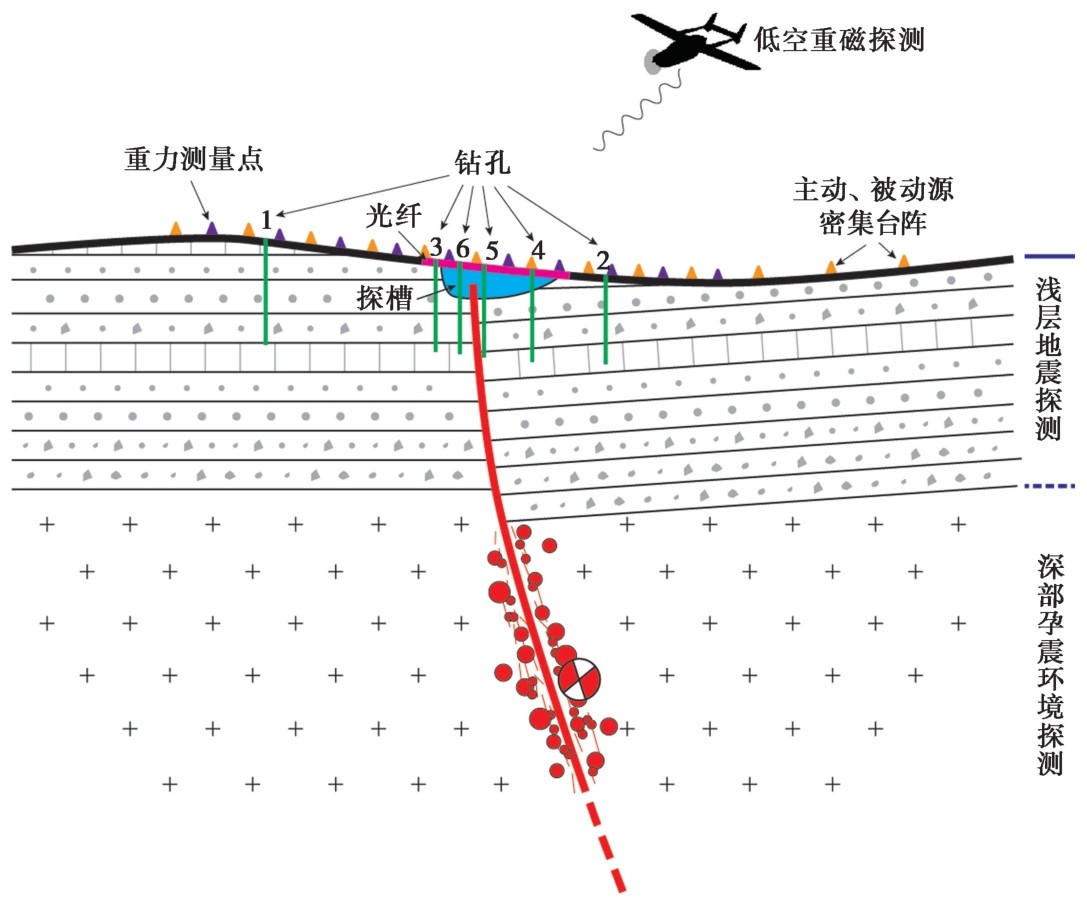
图1 巨厚沉积区活动断层综合探测示意图
Fig. 1 Schematic diagram of integrated detection of active faults in ultra-thick sediment-covered region.
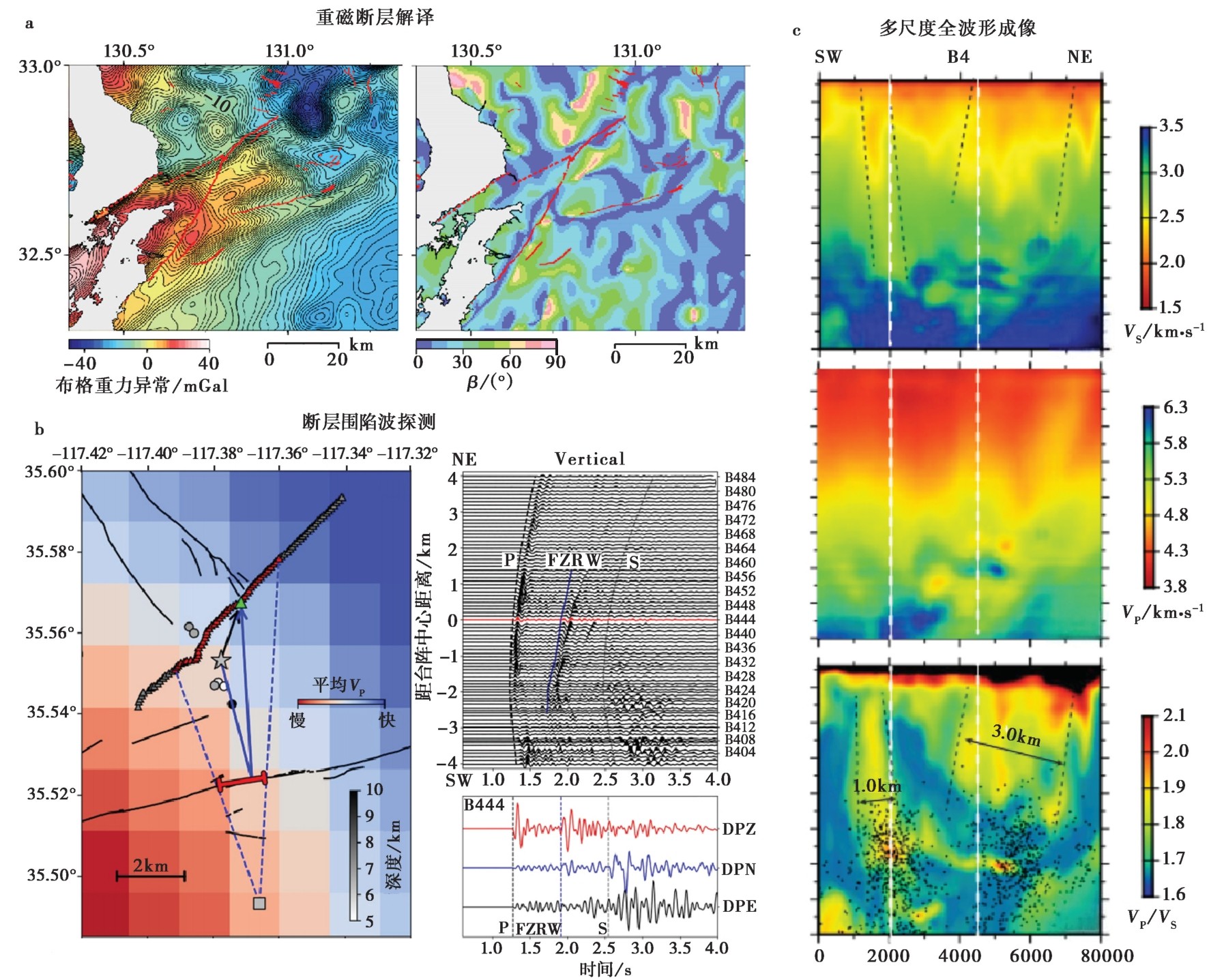
图2 深部孕震环境探测 a利用重力异常识别断层和估算倾角(修改自Matsumoto等(2016)); b台站记录到的断层围陷波(修改自Qiu等(2023)); c多尺度全波形反演得到的速度模型揭示的断层结构(修改自Li等(2024))
Fig. 2 Deep seismogenic environment detection of active faults.
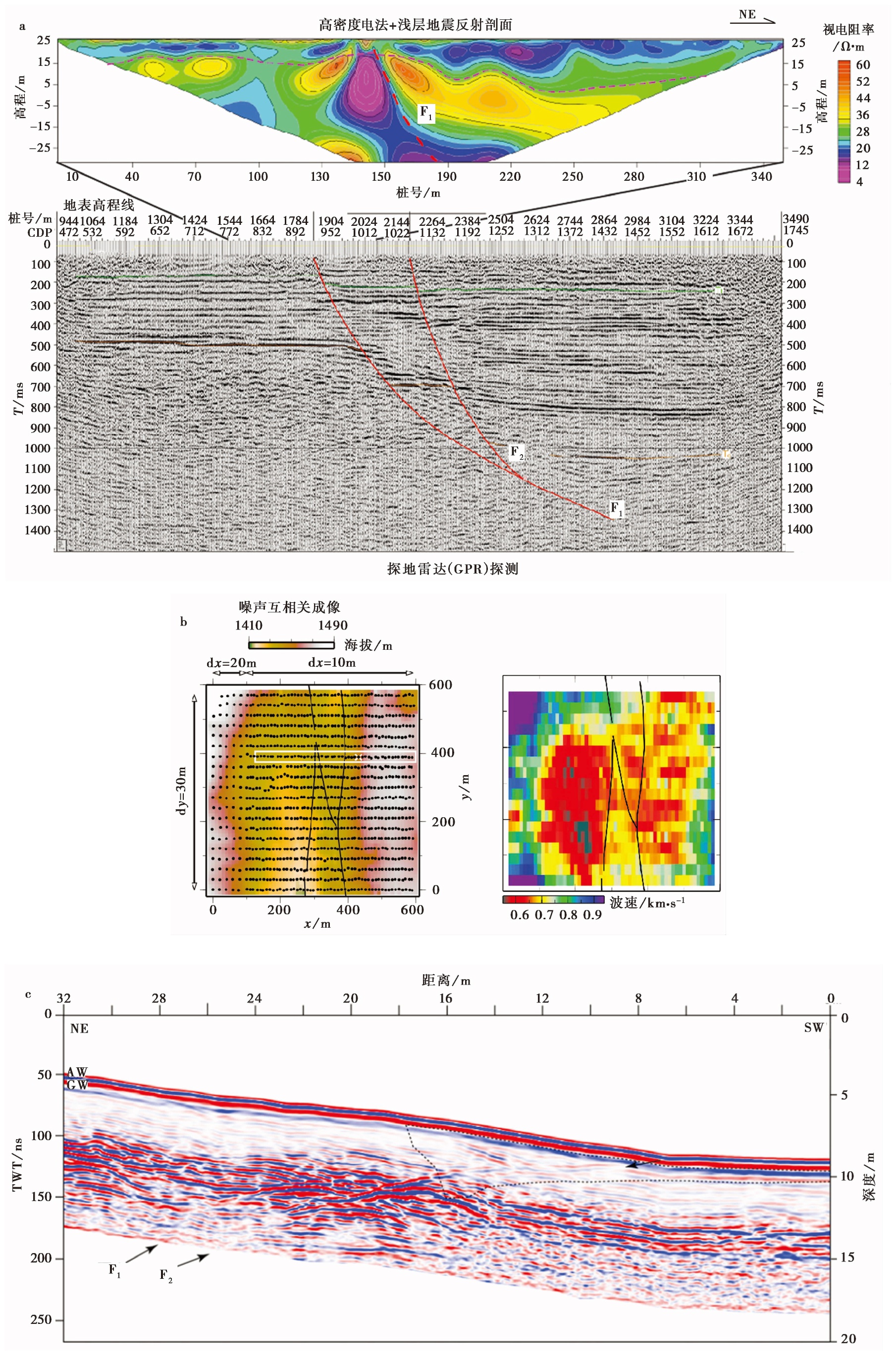
图3 断层带浅部结构探测 a高密度电法和浅层地震反射剖面共同揭示黄庄-高丽营断层浅部结构; b探地雷达探测剖面显示2条低角度逆冲断层(F1、F2)(修改自Malik等(2010)); c超密集台阵所有台站间的噪声互相关揭示1km以浅的高分辨率盆地沉积和断层带分布(修改自Hillers等(2016))
Fig. 3 Shallow structural detection of active faults.
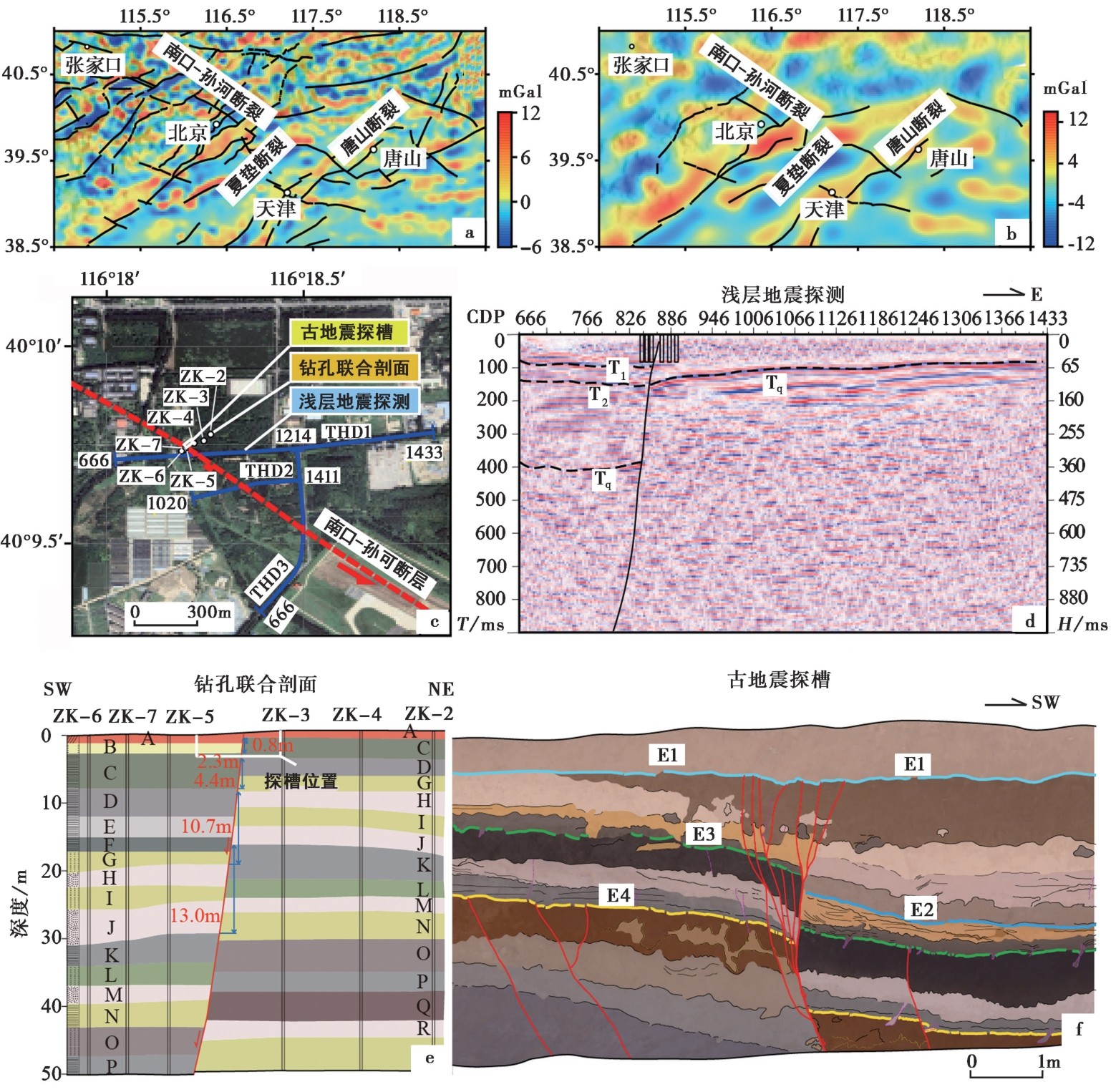
图4 南口-孙河断裂活动断层的综合探测结果 a对布格重力异常做小波多尺度分析的二阶细节场, 对应平均深度为5~9km的上地壳异常; b四阶细节场, 对应平均深度为20~25km; c卫星影像显示断层、浅层测线、钻孔及探槽位置; d浅层地震反射剖面探测结果; e钻孔联合剖面; f古地震探测剖面
Fig. 4 Integrated detection result of the Nankou-Sunhe Fault.
| [1] |
柴炽章, 孟广魁, 杜鹏, 等. 2006. 隐伏活动断层的多层次综合探测: 以银川隐伏活动断层为例[J]. 地震地质, 28(4): 536-546.
|
|
|
|
| [2] |
邓起东, 徐锡伟, 张先康, 等. 2003a. 城市活动断裂探测的方法和技术[J]. 地学前缘, 10(1): 93-104.
|
|
|
|
| [3] |
邓起东, 张培震, 冉勇康, 等. 2003b. 中国活动构造与地震活动[J]. 地学前缘, 10(S1): 66-73.
|
|
|
|
| [4] |
酆少英, 龙长兴, 高锐, 等. 2010. 高分辨折射和浅层反射地震方法在活断层探测中的联合应用[J]. 地震学报, 32(6): 718-724.
|
|
|
|
| [5] |
高锐, 周卉, 卢占武, 等. 2022. 深地震反射剖面揭露青藏高原陆-陆碰撞与地壳生长的深部过程[J]. 地学前缘, 29(2): 14-27.
DOI |
|
DOI |
|
| [6] |
郭慧, 江娃利, 谢新生. 2011. 钻孔与探槽揭示1976年河北唐山MS7.8地震发震构造晚第四纪强震活动[J]. 中国科学(地球科学), 41(7): 1009-1028.
|
|
|
|
| [7] |
虢顺民, 李志义, 程绍平, 等. 1977. 唐山地震区域构造背景和发震模式的讨论[J]. 地质科学, 12(4): 305-321.
|
|
|
|
| [8] |
雷启云, 柴炽章, 孟广魁, 等. 2008. 银川隐伏断层钻孔联合剖面探测[J]. 地震地质, 30(1): 250-263.
|
|
|
|
| [9] |
雷启云, 柴炽章, 孟广魁, 等. 2011. 隐伏活断层钻孔联合剖面对折定位方法[J]. 地震地质, 33(1): 45-55. doi: 10.3969/j.issn.0253-4967.2011.01.005.
|
|
DOI |
|
| [10] |
李新宇, 石磊, 李永华. 2026. 多种重力边缘识别方法在华北厚覆盖区断裂识别中的对比与应用效果分析[J]. CT理论与应用研究, 35(5): 1-11.
|
|
|
|
| [11] |
刘保金, 柴炽章, 酆少英, 等. 2008. 第四纪沉积区断层及其上断点探测的地震方法技术: 以银川隐伏活动断层为例[J]. 地球物理学报, 51(5): 1475-1483.
|
|
|
|
| [12] |
刘静, 袁兆德, 徐岳仁, 等. 2021. 古地震学: 活动断裂强震复发规律的研究[J]. 地学前缘, 28(2): 211-231.
DOI |
|
DOI |
|
| [13] |
孟绿汀, 张慧茜, 黄清华. 2022. 二维与三维大地电磁反演的敏感度研究[J]. 地球物理学报, 65(8): 3078-3087.
|
|
|
|
| [14] |
倪四道, 徐义刚, 杨春和, 等. 2026. 地震起止过程与机理研究进展及挑战[J]. 中国科学(地球科学), 56(3): 986-995.
|
|
|
|
| [15] |
冉勇康, 王虎, 李彦宝, 等. 2012. 中国大陆古地震研究的关键技术与案例解析(1): 走滑活动断裂的探槽地点、布设与事件识别标志[J]. 地震地质, 34(2): 197-210. doi: 10.3969/j.issn.0253-4967.2012.02.001.
|
|
DOI |
|
| [16] |
石磊, 陈涛, 李永华. 2022. 利用重力异常分析2021年青海玛多MS7.4地震发震断层与结构特征[J]. 地球物理学报, 65(10): 3858-3870.
|
|
|
|
| [17] |
王景明, 郑文俊, 陈国顺, 等. 1981. 唐山地震断面主断裂带及地震成因[J]. 地震研究, 4(4): 427-450.
|
|
|
|
| [18] |
向宏发, 王学潮, 虢顺民, 等. 2000. 聊城-兰考隐伏断裂第四纪活动性的综合探测研究[J]. 地震地质, 22(4): 351-359.
|
|
|
|
| [19] |
徐锡伟, 李峰, 程佳, 等. 2023. 活动断层研究进展及其科学前沿问题讨论[J]. 煤田地质与勘探, 51(12): 1-16.
|
|
|
|
| [20] |
徐锡伟, 吴为民, 张先康, 等. 2002. 首都圈地区地壳最新构造变动与地震[M]. 北京: 科学出版社: 118-127.
|
|
|
|
| [21] |
严加永, 孟贵祥, 吕庆田, 等. 2021. 综合地球物理在荒漠覆盖区隐伏矿床预测与定位中的应用: 以新疆拉伊克勒克铜多金属矿床为例[J]. 地球物理学报, 64(11): 4117-4133.
DOI |
|
|
|
| [22] |
杨卓欣, 袁道阳, 段永红, 等. 2009. 高分辨折射勘探技术在浅层反射勘探失效地区的应用: 兰州市活断层浅层地震探测实例[J]. 地震地质, 31(1): 57-68. doi: 10.3969/j.issn.0253-4967.2009.01.006.
|
|
DOI |
|
| [23] |
袁道阳, 王有林, 李树武, 等. 2023. 活动构造研究的关键环节与发展趋势[J]. 煤田地质与勘探, 51(12): 17-28.
|
|
|
|
| [24] |
袁兆德, 刘静, 李占飞, 等. 2016. 走滑断裂古地震探槽选址范例[J]. 地质通报, 35(11): 1807-1828.
|
|
|
|
| [25] |
张培震, 邓起东, 张国民, 等. 2003. 中国大陆的强震活动与活动地块[J]. 中国科学(D辑), 33(S1): 12-20.
|
|
|
|
| [26] |
赵帅, 李占飞, 贾启超, 等. 2023. 基于古地震探槽的南口-孙河断裂最新走滑变形证据研究[J]. 震灾防御技术, 18(4): 736-744.
|
|
|
|
| [27] |
郑文俊, 张培震, 袁道阳, 等. 2019. 中国大陆活动构造基本特征及其对区域动力过程的控制[J]. 地质力学学报, 25(5): 699-721.
|
|
|
|
| [28] |
朱金芳, 徐锡伟, 黄宗林, 等. 2005. 福州市活断层探测与地震危险性评价[M]. 北京: 科学出版社: 246-278.
|
|
|
|
| [29] |
|
| [30] |
DOI URL |
| [31] |
|
| [32] |
|
| [33] |
DOI URL |
| [34] |
DOI URL |
| [35] |
DOI URL |
| [36] |
DOI PMID |
| [37] |
DOI URL |
| [38] |
DOI URL |
| [39] |
|
| [40] |
|
| [41] |
DOI URL |
| [42] |
DOI URL |
| [43] |
|
| [44] |
DOI URL |
| [45] |
|
| [46] |
|
| [47] |
PMID |
| [48] |
DOI URL |
| [49] |
|
| [50] |
DOI URL |
| [51] |
|
| [52] |
DOI URL |
| [53] |
DOI URL |
| [54] |
DOI |
| [55] |
DOI URL |
| [56] |
DOI URL |
| [57] |
|
| [58] |
|
| [59] |
DOI PMID |
| [60] |
|
| [61] |
DOI URL |
| [62] |
DOI URL |
| [63] |
|
| [64] |
DOI URL |
| [65] |
DOI URL |
| [66] |
DOI URL |
| [67] |
|
| [68] |
|
| [69] |
DOI URL |
| [1] | 吉宇, 张广伟, 任俊杰, 何静, 王肖薇. 基于背景噪声成像研究北京地区三维S波速度结构[J]. 地震地质, 2025, 47(1): 306-324. |
| [2] | 曹筠, 李彦宝, 冉勇康, 徐锡伟, 马董伟, 张志强. 城市隐伏活动断层避让典型案例分析--以新沂市郯庐断裂带沿线某场地为例[J]. 地震地质, 2022, 44(4): 1071-1085. |
| [3] | 张磊, 白凌燕, 赵勇, 张晓亮, 杨天水, 蔡向民, 何付兵. 北京南口-孙河断裂与黄庄-高丽营断裂交会区沉积速率差异对断裂活动性的响应[J]. 地震地质, 2017, 39(5): 1048-1065. |
| [4] | 尉洋, 沈军, 于晓辉, 吴晓歌. 石油地震资料在隐伏活断层探测中的应用——以松原活断层探测为例[J]. 地震地质, 2016, 38(2): 423-433. |
| [5] | 李峰, 张效亮, 刘华国. 重庆市主要构造地震危险性评价[J]. 地震地质, 2013, 35(3): 518-531. |
| [6] | 杨卓欣, 袁道阳, 段永红, 徐朝繁, 嘉世旭, 酆少英. 高分辨折射勘探技术在浅层反射勘探失效地区的应用——兰州市活断层浅层地震探测实例[J]. 地震地质, 2009, 31(1): 57-68. |
| [7] | 袁道阳, 王兰民, 何文贵, 刘百篪, 葛伟鹏, 刘兴旺, 梁明剑, 郑文俊. 兰州市地震活断层探测新进展[J]. 地震地质, 2008, 30(1): 236-249. |
| [8] | 周本刚, 宋新初, 杨晓平, 韩竹军, 杜龙, 董绍鹏. 宁波育王山山前断层探测结果的工程应用问题[J]. 地震地质, 2008, 30(1): 209-217. |
| [9] | 王志才, 晁洪太, 杜宪宋, 贾荣光, 周斌, 鹿子林. 南黄海北部千里岩断裂活动性初探[J]. 地震地质, 2008, 30(1): 176-186. |
| [10] | 赵树贤, 刘玉娟. 活断层探测成果的三维可视化[J]. 地震地质, 2007, 29(4): 787-795. |
| [11] | 张世民, 王丹丹, 刘旭东, 任俊杰, 罗明辉, 张国宏, 赵国存, 王瑞, 张英礼. 北京南口-孙河断裂带北段晚第四纪活动的层序地层学研究[J]. 地震地质, 2007, 29(4): 729-743. |
| [12] | 于贵华, 徐锡伟, 柴炽章, 王银, 刘保金. 利用活断层探测资料构建银川探测区地下三维结构模型[J]. 地震地质, 2007, 29(2): 320-329. |
| [13] | 于贵华, 徐锡伟, 孙怡, 朱金芳, 张兰凤. 城市活断层探测信息系统的设计与实现——以福州市活断层信息管理系统为例[J]. 地震地质, 2006, 28(4): 655-662. |
| [14] | 柴炽章, 孟广魁, 杜鹏, 王银, 刘保金, 沈卫华, 雷启云, 廖玉华, 赵成斌, 酆少英, 张学辉, 谢晓峰. 隐伏活动断层的多层次综合探测——以银川隐伏活动断层为例[J]. 地震地质, 2006, 28(4): 536-546. |
| [15] | 徐朝繁, 张先康, 朱金芳, 段永红, 田晓峰, 潘纪顺. 复杂介质结构中折射界面的哈格多恩原理波前成像[J]. 地震地质, 2002, 24(4): 542-548. |
| 阅读次数 | ||||||
|
全文 |
|
|||||
|
摘要 |
|
|||||