地震地质 ›› 2026, Vol. 48 ›› Issue (5): 1400-1422.DOI: 10.3969/j.issn.0253-4967.20260022
熊辉( ), 李正芳*(), 张志亮, 廖贻莹, 梁佳奥, 周本刚
收稿日期:2026-02-27
修回日期:2026-06-24
出版日期:2026-11-11
发布日期:2026-11-11
通讯作者:
李正芳
作者简介:熊辉, 男, 2002年生, 2024年于西北大学获自然地理与资源环境专业学士学位, 现为中国地震局地质研究所构造地质学在读硕士研究生, 主要研究方向为强震构造判别与地震危险性分析, E-mail: 770029064@qq.com。
基金资助:
XIONG Hui(), LI Zheng-fang*(), ZHANG Zhi-liang, LIAO Yi-ying, LIANG Jia-ao, ZHOU Ben-gang
Received:2026-02-27
Revised:2026-06-24
Online:2026-11-11
Published:2026-11-11
Contact:
LI Zheng-fang
摘要:
北京位于华北平原北缘构造过渡带, 隐伏断裂发育且新构造活动显著。为约束区域第四纪地层年代框架, 文中选取廊固凹陷内大兴凸起东缘断裂南侧DX01钻孔岩心, 开展磁性地层学、磁化率各向异性(AMS)与光释光(OSL)、电子自旋共振(ESR)综合年代学研究。基于特征剩磁(ChRM)方向与岩性对比, 采用相邻层位不少于4件样品的磁倾角一致判据, 建立了稳定的古地磁极性序列。研究共识别出23个磁性区间, 包括12个正极性段和11个负极性段, 其极性结构与国际地磁极性时间标尺(GPTS)具有良好的对应关系。布容正极性时(0~112.2m, 0~0.78Ma)、松山负极性时(112.2~331.8m, 0.78~2.58Ma)及高斯正极性时(331.8m以深)均有清晰记录, 并进一步识别出贾拉米洛(Jaramillo)和奥尔都维(Olduvai)正极性亚时及多次短暂极性漂移事件。AMS结果指示, 磁化率椭球主要受沉积压实作用控制, 原生沉积组构保存良好, 后期构造扰动较弱, 磁性记录未发生显著失真。OSL和ESR测年结果与磁性地层划分相互印证, 为年代框架提供了独立的年代约束。在此基础上, 厘定DX01孔第四纪主要地层界面为: 全新统底界深约11.8m, 上更新统底界深58.6m, 中更新统底界对应Brunhes/Matuyama(B/M)倒转界面(112.2m), 第四系底界对应Matuyama/Gauss(M/G)界面(331.8m)。通过与区域多个钻孔的联合对比发现关键极性界面埋深呈“凸起浅、凹陷深”的系统性梯度变化, 揭示了自早更新世晚期以来廊固凹陷相对于大兴凸起的差异性沉降累积效应。文中研究建立了DX01孔高分辨率第四纪磁性地层序列及年代框架, 为北京南部平原区地层对比、隐伏断裂活动性厘定及构造-沉积耦合机制研究提供了重要的时间约束。
熊辉, 李正芳, 张志亮, 廖贻莹, 梁佳奥, 周本刚. 北京南部廊固凹陷DX01钻孔第四系磁性地层序列及年代学约束[J]. 地震地质, 2026, 48(5): 1400-1422.
XIONG Hui, LI Zheng-fang, ZHANG Zhi-liang, LIAO Yi-ying, LIANG Jia-ao, ZHOU Ben-gang. QUATERNARY MAGNETOSTRATIGRAPHIC SEQUENCE AND CHRONOLOGICAL CONSTRAINTS OF THE DX01 BOREHOLE IN THE LANGGU DEPRESSION, SOUTHERN BEIJING[J]. SEISMOLOGY AND GEOLOGY, 2026, 48(5): 1400-1422.
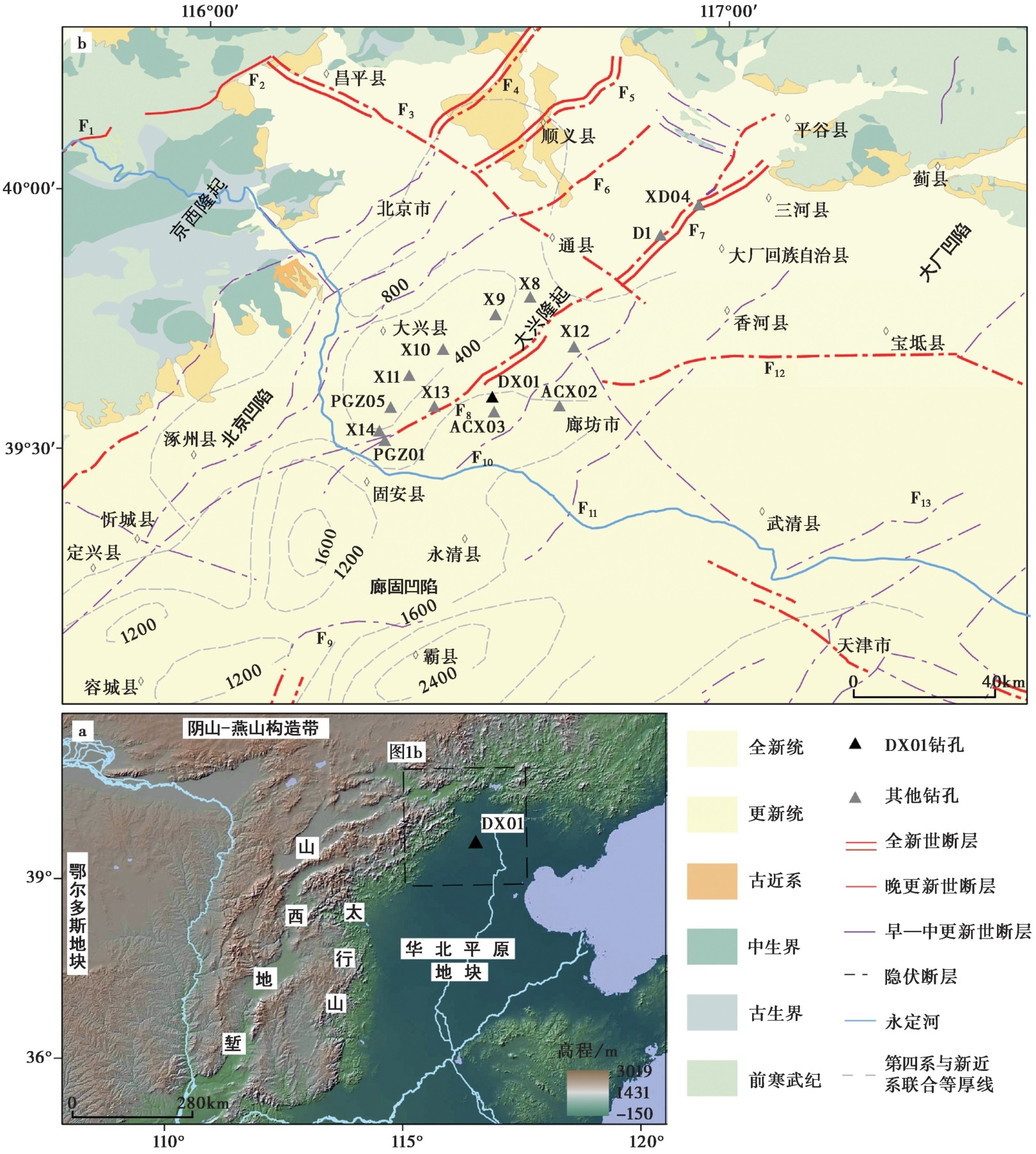
图1 DX01钻孔位置及构造简图 a研究区区域位置图, 使用GeoMapApp制作 ① (Ryan et al., 2009); b研究区构造单元图, 第四纪等厚值及断裂矢量数据来源于本文的资助项目“大震震源探测《目标区活动断层探测与地震危险性评价(大兴凸起东缘断裂)》”; 构造单元划分参考石光耀等(2023)。F1紫荆关断裂; F2南口山前断裂; F3南口-孙河断裂; F4黄庄-高丽营断裂; F5顺义-良乡断裂; F6南苑-通县断裂; F7夏垫断裂; F8大兴凸起东缘断裂; F9永清盆地北缘断裂; F10牛驼镇凸起东缘断裂; F11河西务断裂; F12宝坻断裂; F13天津北断裂
Fig. 1 Location and tectonic setting of the DX01 borehole.
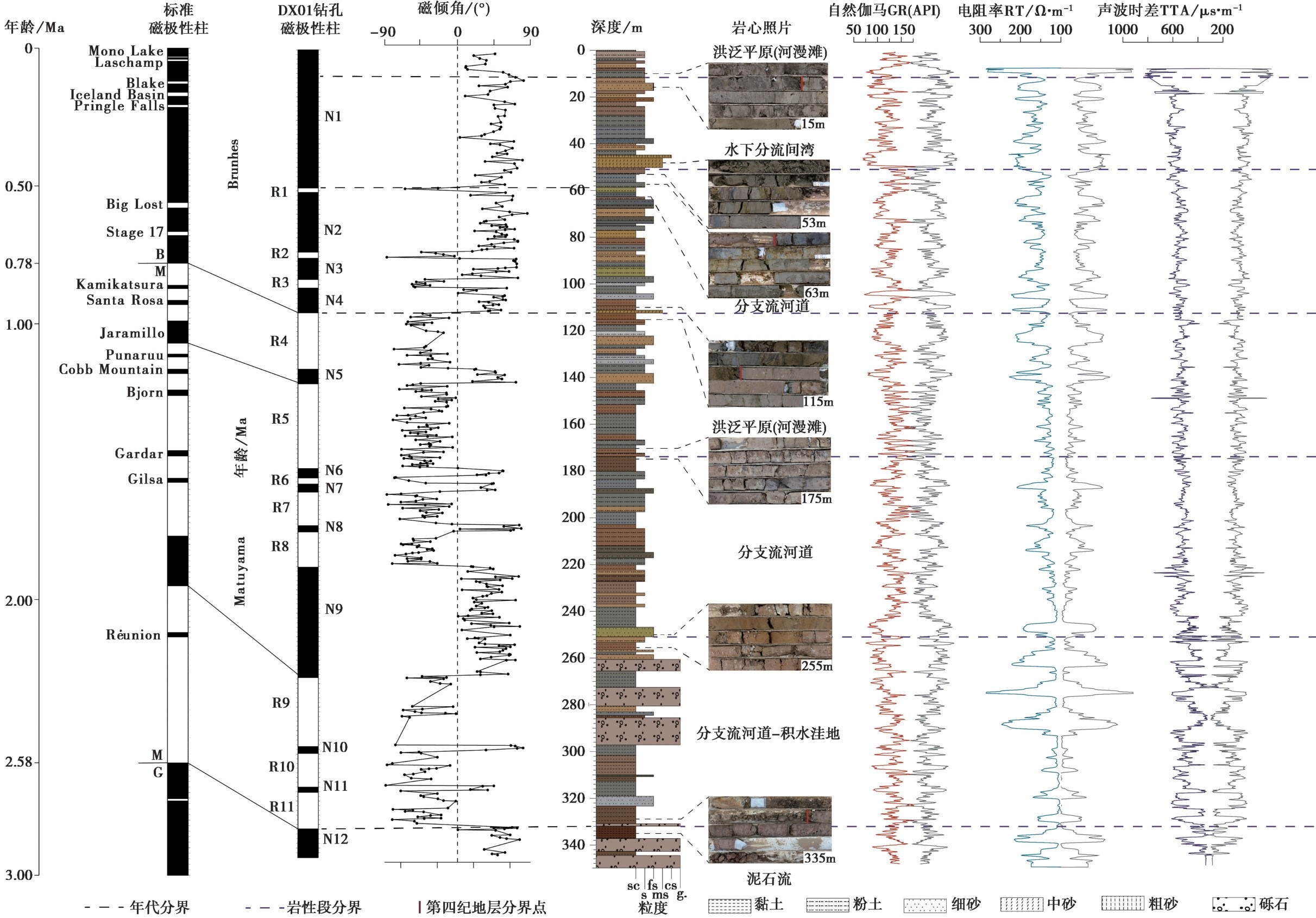
图2 DX01孔磁倾角变化、古地磁极性序列与年代框架及测井曲线综合对比图
Fig. 2 Integrated comparison of magnetic inclination variations, paleomagnetic polarity sequence, chronological framework and well logging curves of the DX01 borehole.
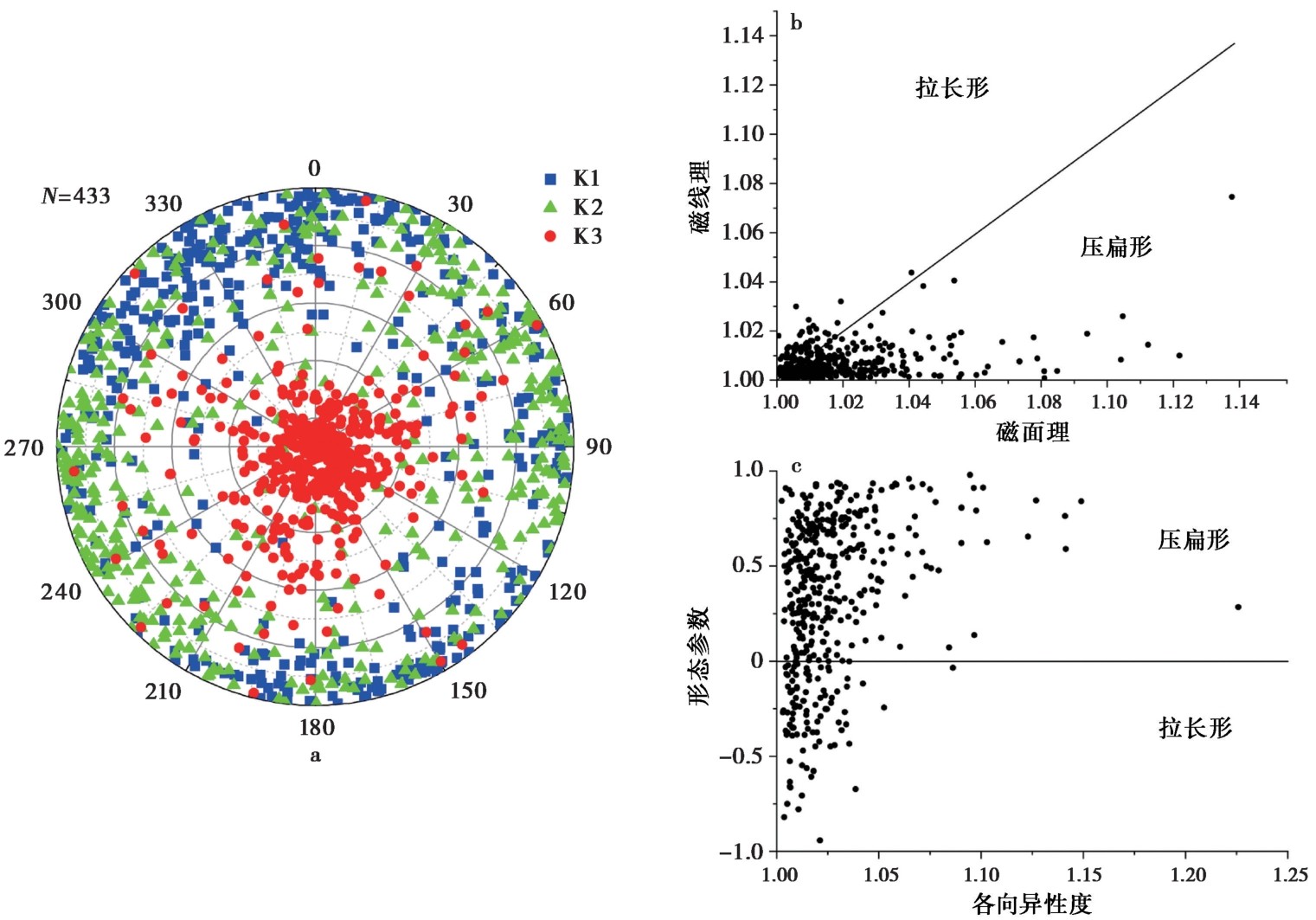
图3 DX01钻孔磁化率各向异性(AMS)结果 a AMS最大轴(K1)、中间轴(K2)、最小轴(K3)等面积投影图; b磁线理与磁面理关系图; c磁化率各向异性度与形态参数的关系图
Fig. 3 Anisotropy of magnetic susceptibility (AMS) results from the DX01 borehole.
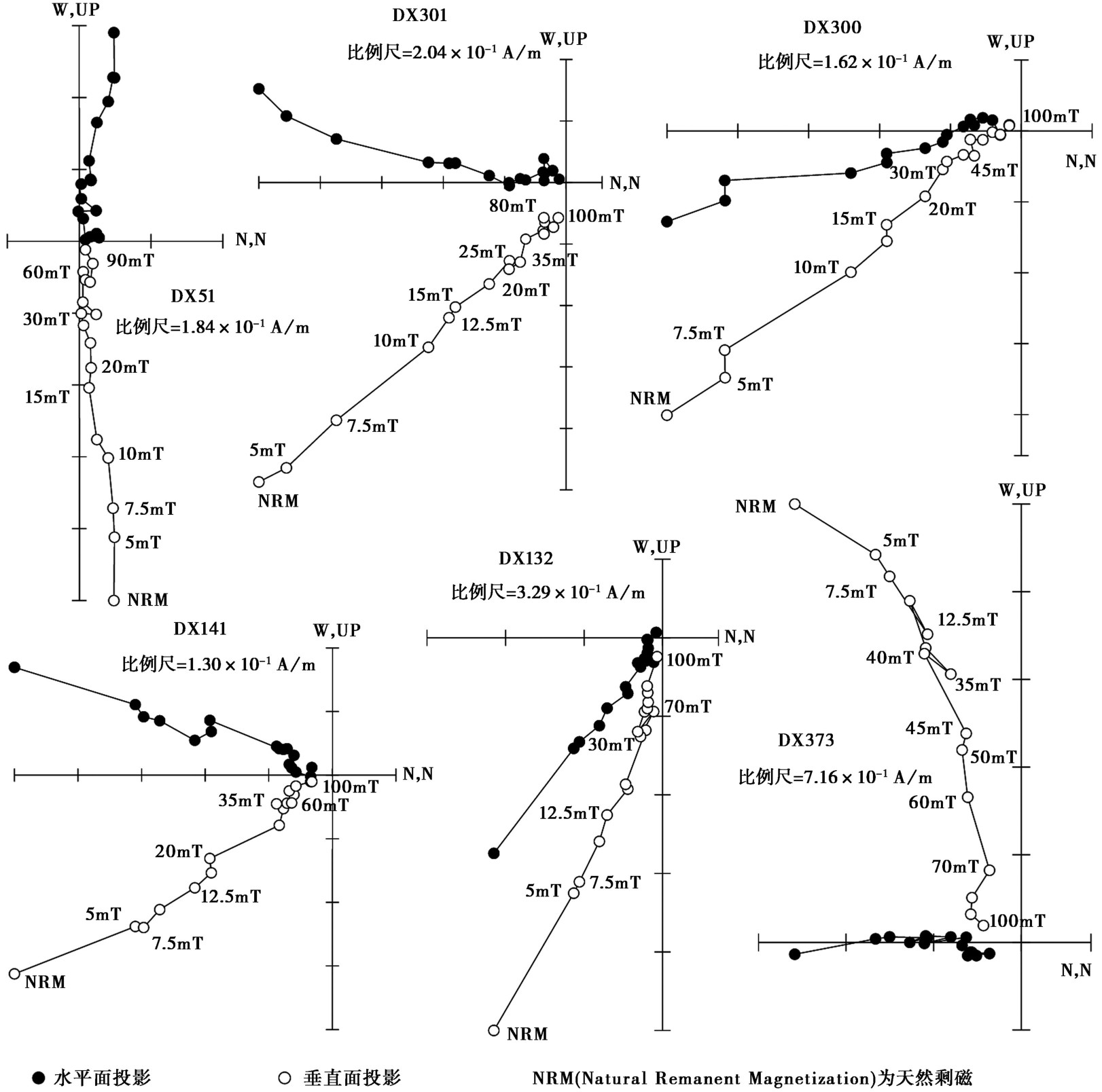
图4 DX01钻孔代表性样品退磁正交矢量图
Fig. 4 Orthogonal demagnetization diagrams of representative samples from the DX01 borehole.
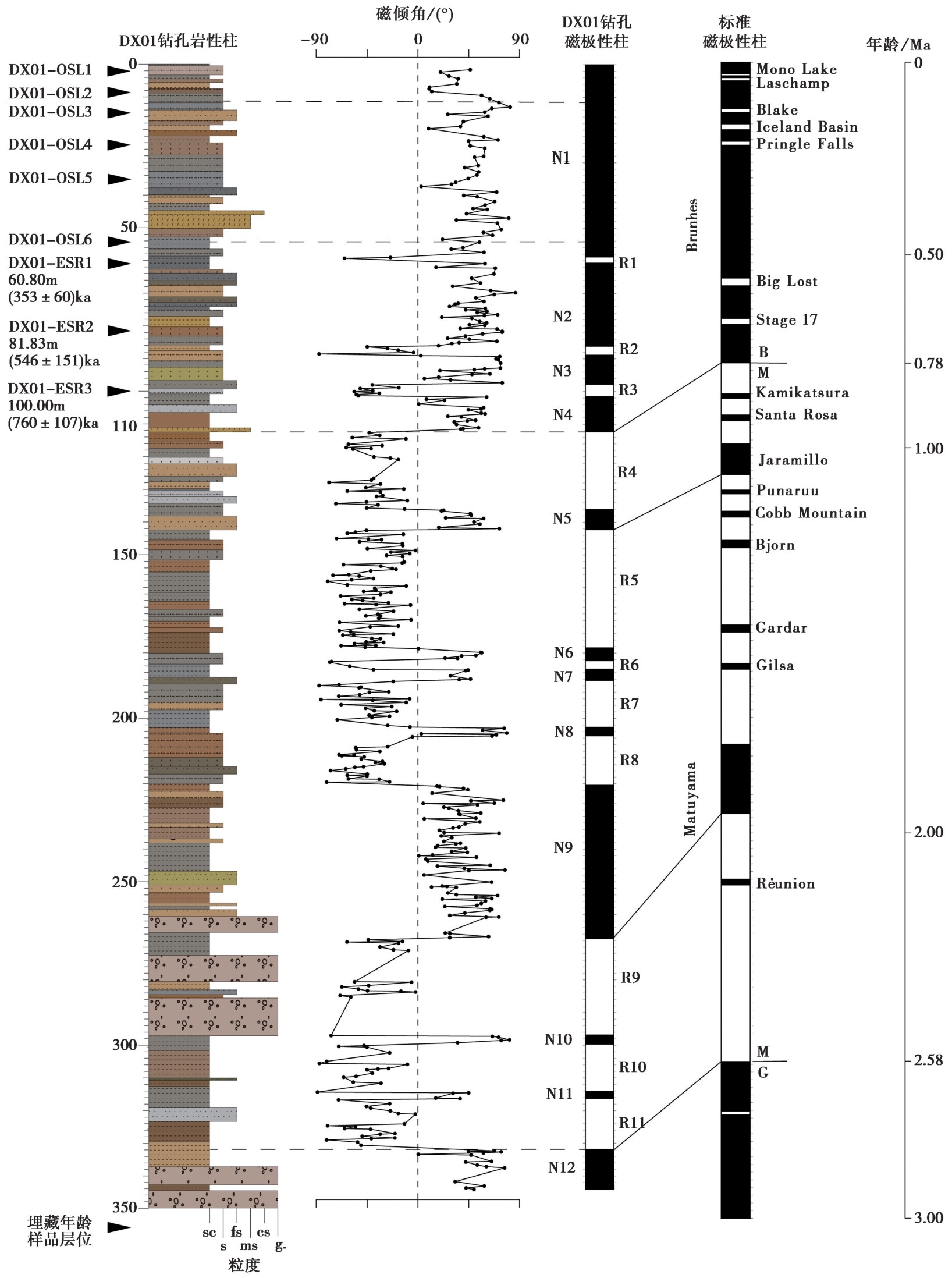
图5 DX01钻孔磁倾角变化特征、古地磁极性序列及年代约束
Fig. 5 Variations in magnetic inclination, geomagnetic polarity sequence, and age constraints of the DX01 borehole.
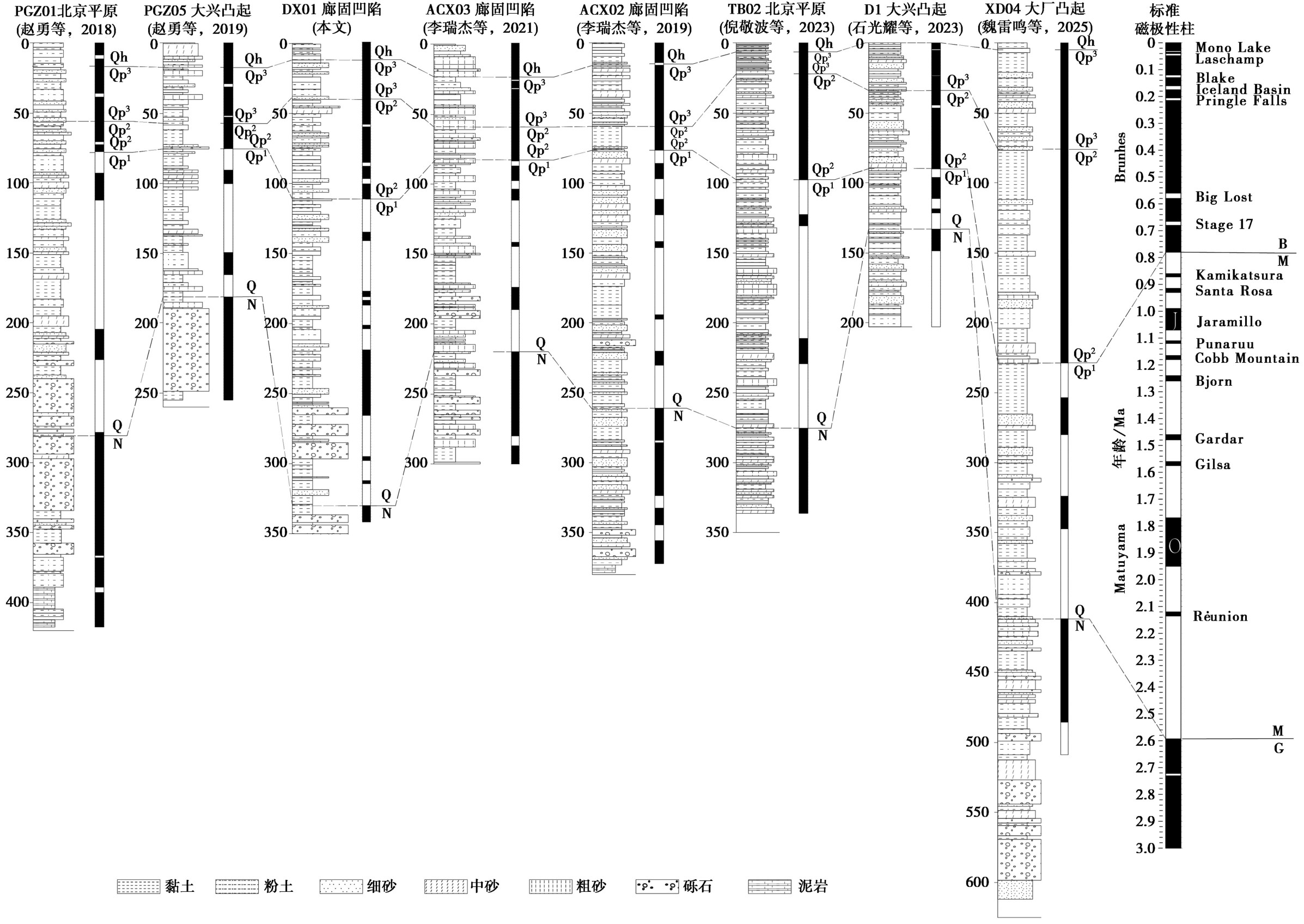
图6 北京平原南部不同次级构造单元钻孔岩性与磁性地层对比图
Fig. 6 Lithologic and magnetostratigraphic correlation of the borehole data from different secondary tectonic units in the southern Beijing plain.
| 野外编号 | 埋深 /m | 238U/ Bq·kg-1 | 226Ra/ Bq·kg-1 | 232Th/ Bq·kg-1 | 40K/ Bq·kg-1 | 含水量 /% | 环境剂量率 /Gy·ka-1 | 等效剂量 /Gy | 年龄 /ka |
|---|---|---|---|---|---|---|---|---|---|
| DX-OSL-1 | 2.00 | 24.5±8.4 | 21.6±0.6 | 40.4±0.9 | 578.7±22.7 | 29±5 | 2.7±0.1 | 9.4±0.2 | 3.4±0.2 |
| DX-OSL-2 | 8.80 | 19.8±6.3 | 12.3±0.4 | 23.2±0.6 | 645.3±24.2 | 25±5 | 2.1±0.1 | 7.7±0.8 | 3.7±0.4 |
| DX-OSL-3 | 14.67 | 24.2±5.8 | 19.7±0.4 | 34.8±0.7 | 510.5±19.3 | 19±5 | 2.7±0.1 | 139.9±2.9 | 52.5±2.7 |
| DX-OSL-4 | 24.80 | 34.7±7.0 | 17.8±0.5 | 35.8±0.8 | 635.7±24.1 | 21±5 | 3.0±0.1 | 249.2±11.7 | 84.5±5.7 |
| DX-OSL-5 | 35.00 | 33.0±7.6 | 19.2±0.5 | 36.6±0.8 | 605.4±23.4 | 24±5 | 2.7±0.1 | 288.9±18.2 | 106.1±9.1 |
| DX-OSL-6 | 54.40 | 34.8±8.6 | 15.6±0.6 | 58.1±1.1 | 726.3±27.7 | 22±5 | 3.5±0.2 | >430 | >120 |
表1 DX01孔光释光样品测试年龄一览
Table1 Optically stimulated luminescence(OSL) ages of samples from the DX01 borehole
| 野外编号 | 埋深 /m | 238U/ Bq·kg-1 | 226Ra/ Bq·kg-1 | 232Th/ Bq·kg-1 | 40K/ Bq·kg-1 | 含水量 /% | 环境剂量率 /Gy·ka-1 | 等效剂量 /Gy | 年龄 /ka |
|---|---|---|---|---|---|---|---|---|---|
| DX-OSL-1 | 2.00 | 24.5±8.4 | 21.6±0.6 | 40.4±0.9 | 578.7±22.7 | 29±5 | 2.7±0.1 | 9.4±0.2 | 3.4±0.2 |
| DX-OSL-2 | 8.80 | 19.8±6.3 | 12.3±0.4 | 23.2±0.6 | 645.3±24.2 | 25±5 | 2.1±0.1 | 7.7±0.8 | 3.7±0.4 |
| DX-OSL-3 | 14.67 | 24.2±5.8 | 19.7±0.4 | 34.8±0.7 | 510.5±19.3 | 19±5 | 2.7±0.1 | 139.9±2.9 | 52.5±2.7 |
| DX-OSL-4 | 24.80 | 34.7±7.0 | 17.8±0.5 | 35.8±0.8 | 635.7±24.1 | 21±5 | 3.0±0.1 | 249.2±11.7 | 84.5±5.7 |
| DX-OSL-5 | 35.00 | 33.0±7.6 | 19.2±0.5 | 36.6±0.8 | 605.4±23.4 | 24±5 | 2.7±0.1 | 288.9±18.2 | 106.1±9.1 |
| DX-OSL-6 | 54.40 | 34.8±8.6 | 15.6±0.6 | 58.1±1.1 | 726.3±27.7 | 22±5 | 3.5±0.2 | >430 | >120 |
| 样品号 | 埋深 /m | U /μg·g-1 | Th /μg·g-1 | K /% | 含水率 /% | 等效剂量 /Gy | 年剂量率 /Gy·ka-1 | 年龄 /ka |
|---|---|---|---|---|---|---|---|---|
| DX-ESR1 | 60.8 | 3.694 | 10.756 | 1.878 | 22.73 | 965±162 | 2.73±0.06 | 353±60 |
| DX-ESR2 | 81.83 | 1.191 | 6.914 | 2.13 | 20.551 | 1258±347 | 2.31±0.06 | 546±151 |
| DX-ESR3 | 100.8 | 2.628 | 12.254 | 2.241 | 25.189 | 2153±298 | 2.83±0.07 | 760±107 |
表2 DX01孔电子自旋共振样品测试年龄一览
Table2 Electron spin resonance(ESR) ages of samples from the DX01 borehole
| 样品号 | 埋深 /m | U /μg·g-1 | Th /μg·g-1 | K /% | 含水率 /% | 等效剂量 /Gy | 年剂量率 /Gy·ka-1 | 年龄 /ka |
|---|---|---|---|---|---|---|---|---|
| DX-ESR1 | 60.8 | 3.694 | 10.756 | 1.878 | 22.73 | 965±162 | 2.73±0.06 | 353±60 |
| DX-ESR2 | 81.83 | 1.191 | 6.914 | 2.13 | 20.551 | 1258±347 | 2.31±0.06 | 546±151 |
| DX-ESR3 | 100.8 | 2.628 | 12.254 | 2.241 | 25.189 | 2153±298 | 2.83±0.07 | 760±107 |
| Beta实验室编号 | 样品编号 | 深度/m | 常规放射性碳年龄 | IRMSδ13C |
|---|---|---|---|---|
| 789961 | DX-14C-1 | 6.90 | (3770±30)aBP | -20.6o/oo |
| 789962 | DX-14C-2 | 9.57 | (4830±30)aBP | -19.39o/oo |
| 789963 | DX-14C-3 | 12.50 | (18870±70)aBP | -20.64o/oo |
| 789964 | DX-14C-4 | 13.50 | (19100±60)aBP | -23.15o/oo |
| 789965 | DX-14C-5 | 13.85 | (23590±100)aBP | -20.41o/oo |
表3 DX01孔14C样品测试年龄一览
Table3 List of 14C ages of samples from the DX01 borehole
| Beta实验室编号 | 样品编号 | 深度/m | 常规放射性碳年龄 | IRMSδ13C |
|---|---|---|---|---|
| 789961 | DX-14C-1 | 6.90 | (3770±30)aBP | -20.6o/oo |
| 789962 | DX-14C-2 | 9.57 | (4830±30)aBP | -19.39o/oo |
| 789963 | DX-14C-3 | 12.50 | (18870±70)aBP | -20.64o/oo |
| 789964 | DX-14C-4 | 13.50 | (19100±60)aBP | -23.15o/oo |
| 789965 | DX-14C-5 | 13.85 | (23590±100)aBP | -20.41o/oo |
| 地层单元 | 底界 深度 | 岩石地层依据 | 测井依据 | 年代学控制 | 磁性地层标志 |
|---|---|---|---|---|---|
| 全新统 Qh | 11.8m | 有机质富集淤泥层与砂层界限(全新统标志) | GR升高、RT降低, 细粒沉积响应 | 9.57m处14C年龄: (4830±30)aBP;12.5m处14C年龄:(18870±70)aBP | |
| 上更新统 Qp3 | 58.6m | 棕色砂层向下过渡为灰绿色黏土,发育钙质结核及锰染斑点(上/中更新统标志) | 由“上动”向“下稳” 转变 | 35.0m处OSL年龄:(106.1±9.1)ka;54.4m处OSL年龄:120ka | |
| 中更新统 Qp2 | 112.2m | 浊黄棕色致密中砂向下发育红棕色粉质黏土,夹钙质结核 | GR由低升高, RT显著降低 | 100.8m处ESR年龄:(760.1±167)ka | B/M极性 倒转界面 |
| 下更新统 Qp1 | 331.8m | 砂质、黏土质沉积为主含砾石层向下过渡为棕红色黏土(上新统标志层) | RT增大,声波时差 特征转变 | M/G极性 倒转界面 |
表4 DX01孔第四纪地层划分综合依据与多指标约束汇总表
Table4 Summary of integrated evidence and multi-indicator constraints for the Quaternary stratigraphic division of the DX01 borehole
| 地层单元 | 底界 深度 | 岩石地层依据 | 测井依据 | 年代学控制 | 磁性地层标志 |
|---|---|---|---|---|---|
| 全新统 Qh | 11.8m | 有机质富集淤泥层与砂层界限(全新统标志) | GR升高、RT降低, 细粒沉积响应 | 9.57m处14C年龄: (4830±30)aBP;12.5m处14C年龄:(18870±70)aBP | |
| 上更新统 Qp3 | 58.6m | 棕色砂层向下过渡为灰绿色黏土,发育钙质结核及锰染斑点(上/中更新统标志) | 由“上动”向“下稳” 转变 | 35.0m处OSL年龄:(106.1±9.1)ka;54.4m处OSL年龄:120ka | |
| 中更新统 Qp2 | 112.2m | 浊黄棕色致密中砂向下发育红棕色粉质黏土,夹钙质结核 | GR由低升高, RT显著降低 | 100.8m处ESR年龄:(760.1±167)ka | B/M极性 倒转界面 |
| 下更新统 Qp1 | 331.8m | 砂质、黏土质沉积为主含砾石层向下过渡为棕红色黏土(上新统标志层) | RT增大,声波时差 特征转变 | M/G极性 倒转界面 |
| [1] |
白凌燕, 张磊, 蔡向民, 等. 2014. 磁性地层年代对北京平原顺义断裂第四纪活动性的约束[J]. 现代地质, 28(6): 1234-1242.
|
|
|
|
| [2] |
蔡向民, 栾英波, 郭高轩, 等. 2009. 北京平原第四系的三维结构[J]. 中国地质, 36(5): 1021-1029.
|
|
|
|
| [3] |
蔡向民, 张磊, 郭高轩, 等. 2016. 北京平原地区第四纪地质研究新进展[J]. 中国地质, 43(3): 1055-1066.
|
|
|
|
| [4] |
程天赦, 杨文静, 代鹏, 等. 2021. 永定河冲洪积平原南部QHJ01孔第四纪地层划分及其环境意义[J]. 华北地质, 44(4): 47-54.
|
|
|
|
| [5] |
程瑜, 李向前, 赵增玉, 等. 2016. 苏北盆地TZK9孔磁性地层及重矿物组合特征研究[J]. 地质力学学报, 22(4): 994-1003.
|
|
|
|
| [6] |
代鹏, 邓晓红, 王盛栋, 等. 2019. 河北平原区固安G01孔岩心特征及第四纪地层划分[J]. 第四纪研究, 39(2): 399-407.
|
|
|
|
| [7] |
代鹏, 邓晓红, 王盛栋, 等. 2022. 永定河冲积平原南部第四纪年代地层划分及沉积速率特征[J]. 地质通报, 41(S1): 253-261.
|
|
|
|
| [8] |
高秀林, 王强, 李玉德, 等. 1986. 从天津P8孔看中更新世末期以来海侵期、气候期对比问题[J]. 海洋地质与第四纪地质, 6(1): 53-64, 131.
|
|
|
|
| [9] |
郭高轩, 辛宝东, 叶超, 等. 2009. 北京平原区第四纪地层分区探讨(Ⅰ)[J]. 城市地质, 4(3): 13-16.
|
|
|
|
| [10] |
贾婷, 王永, 浦庆余, 等. 2016. 中国第四纪下限问题研究综述[J]. 地质力学学报, 22(1): 162-177.
|
|
|
|
| [11] |
姜重昕, 沈中山, 秦华峰, 等. 2017. 泥河湾盆地虎头梁剖面河湖相沉积物磁组构特征及其环境意义[J]. 第四纪研究, 37(6): 1320-1333.
|
|
|
|
| [12] |
李长安. 1993. 北京平原区第四纪古气候变化[J]. 中国区域地质, (4): 336-343.
|
|
|
|
| [13] |
李龙吟, 陈华慧. 1994. 北京怀柔HR88-1 钻孔剖面磁性地层学研究[J]. 地层学杂志, 18(1): 39-44.
|
|
|
|
| [14] |
李瑞杰, 王强, 赵勇, 等. 2021. 河北平原廊固凹陷ACX03孔晚上新世以来地层与沉积[J]. 古地理学报, 23(3): 539-554.
DOI |
|
DOI |
|
| [15] |
李瑞杰, 赵勇, 魏波, 等. 2019. 永定河中下游廊固凹陷北部ACX02钻孔地层年代学研究[J]. 地质力学学报, 25(2): 249-256.
|
|
|
|
| [16] |
刘保金, 胡平, 孟勇奇, 等. 2009. 北京地区地壳精细结构的深地震反射剖面探测研究[J]. 地球物理学报, 52(9): 2264-2272.
|
|
|
|
| [17] |
柳富田, 杨吉龙, 陈社明, 等. 2022. 华北平原冀中坳陷东部SFQ1钻孔磁性地层年代学及其地质意义[J]. 地质学报, 96(3): 1079-1090.
|
|
|
|
| [18] |
刘开明, 胥勤勉, 段连峰, 等. 2020. 雄安新区西部GB014孔第四纪地层结构与演化过程[J]. 科学通报, 65(20): 2145-2160.
|
|
|
|
| [19] |
栾英波, 郭高轩, 黄骁. 2008. 北京山前冲洪积缓倾斜平原晚新生代沉积物磁性地层学研究[J]. 城市地质, 3(2): 17-20.
|
|
|
|
| [20] |
马杏垣, 刘和甫, 王维襄, 等. 1983. 中国东部中、新生代裂陷作用和伸展构造[J]. 地质学报, 57(1): 22-32.
|
|
|
|
| [21] |
马正. 1982. 应用自然电位测井曲线解释沉积环境[J]. 石油与天然气地质, 3(1): 25-40.
|
|
|
|
| [22] |
倪敬波, 刘晓, 张晓亮, 等. 2023. 北京平原区东南缘钻孔TB02第四纪地层划分与沉积特征[J]. 地球科学与环境学报, 45(1): 68-79.
|
|
|
|
| [23] |
潘永信, 朱日祥, 刘青松, 等. 1998. 热处理中菱铁矿的磁化率变化与其各向异性交换特征[J]. 科学通报, 43(12): 1319-1323.
|
|
DOI URL |
|
| [24] |
石光耀, 潘志龙, 李庆喆, 等. 2023. 大兴凸起北部D1钻孔岩心特征及第四纪地层划分[J]. 地质通报, 42(12): 2132-2141.
|
|
|
|
| [25] |
王强, 刘立军, 徐海振, 等. 2003. 华北平原第四系下限的再研究[J]. 地质调查与研究, 26(1): 52-60.
|
|
|
|
| [26] |
王强, 吕金福. 1995. 海面变化与海岸线变迁[M]. 北京: 海洋出版社.
|
|
|
|
| [27] |
魏波, 何付兵, 董静, 等. 2018. 永定河断裂带南东段初探[J]. 城市地质, 13(2): 31-36.
|
|
|
|
| [28] |
魏雷鸣, 徐锡伟, 陈桂华, 等. 2025. 北京平原大厂凹陷XD04孔第四纪地层划分及其构造意义[J]. 地球物理学报, 68(10): 3726-3742.
|
|
|
|
| [29] |
肖国桥, 郭正堂, 陈宇坤, 等. 2008. 渤海湾西岸BZ1钻孔的磁性地层学研究[J]. 第四纪研究, 28(5): 909-916.
|
|
|
|
| [30] |
徐锡伟. 2002. 首都圈地区地壳最新构造变动与地震[M]. 北京: 中国地震局地质研究所.
|
|
|
|
| [31] |
袁宝印, 邓成龙, 吕金波, 等. 2002. 北京平原晚第四纪堆积期与史前大洪水[J]. 第四纪研究, 22(5): 474-482.
|
|
|
|
| [32] |
张磊, 白凌燕, 蔡向民, 等. 2014. 北京南口-孙河断裂北西段综合物探剖面定位及其活动性研究[J]. 现代地质, 28(1): 234-242.
|
|
|
|
| [33] |
赵勇, 李瑞杰, 魏波, 等. 2019. 北京大兴凸起南部PGZ05钻孔剖面第四纪磁性地层学[J]. 现代地质, 33(1): 56-62.
|
|
|
|
| [34] |
赵勇, 王强, 李瑞杰, 等. 2018. 北京平原区南部PGZ01孔第四纪地层划分及其环境意义[J]. 古地理学报, 20(2): 337-348.
DOI |
|
|
|
| [35] |
朱日祥, 邓成龙, 潘永信. 2007. 泥河湾盆地磁性地层定年与早期人类演化[J]. 第四纪研究, 27(6): 922-944.
|
|
|
|
| [36] |
宗开红, 宗雯, 康丛轩, 等. 2018. 长江三角洲北翼YBK1孔第四纪地层年代学研究[J]. 地质力学学报, 24(1): 116-127.
|
|
|
|
| [37] |
DOI URL |
| [38] |
DOI URL |
| [39] |
DOI URL |
| [40] |
|
| [41] |
DOI URL |
| [42] |
|
| [43] |
|
| [44] |
DOI URL |
| [45] |
DOI URL |
| [46] |
|
| No related articles found! |
| 阅读次数 | ||||||
|
全文 |
|
|||||
|
摘要 |
|
|||||