地震地质 ›› 2026, Vol. 48 ›› Issue (5): 1552-1569.DOI: 10.3969/j.issn.0253-4967.20260047
• 新技术应用 • 上一篇
王瑛奎1),2)( ), 吴熙彦1),*(), 任俊杰2)
收稿日期:2026-03-31
修回日期:2026-05-15
出版日期:2026-11-11
发布日期:2026-11-11
通讯作者:
吴熙彦
作者简介:王瑛奎, 男, 2003年生, 现为中国地质大学(北京)地理学专业在读硕士研究生, 主要从事活动构造与地震研究, E-mail: wyk513sk@163.com。
基金资助:
WANG Ying-kui1),2)(), WU Xi-yan1),*(), REN Jun-jie2)
Received:2026-03-31
Revised:2026-05-15
Online:2026-11-11
Published:2026-11-11
Contact:
WU Xi-yan
摘要:
活动断层研究及其知识库的构建对地震灾害防御具有重要的作用。传统活动断层数据库构建主要依赖人工收集整理的方式, 存在资料整理效率低、数据更新周期长等问题。近年来, 大语言模型在自然语言处理领域展现出强大的能力。将其引入活动断层知识库构建, 有望在文献信息自动提取与多源数据整合方面, 实现效率上的突破。文中提出了一种基于大语言模型的文献驱动构建活动断层知识库的方法, 并以京西北地区为研究区进行验证。研究设计了包含断层基本参数、构造背景、研究方法、古地震研究和历史地震记录5个模块的标准化报告框架, 构建了涵盖13条主要活动断层的文献库, 开发了基于Qwen3.5大语言模型和LangGraph多智能体框架的智能处理系统。系统通过专家设计的提示词, 对单篇文献进行信息提取, 对多篇文献进行信息识别与融合, 同时辅以人工校验环节, 以保障提取信息的质量, 最终实现从文献库中提取断层知识并生成断层报告。文中通过构建一套基于正确率与完整性2个核心维度的评价体系, 对生成的京西北地区13条断层报告进行评估。评价结果显示, 13条断层报告的平均正确率为77.58%, 平均完整性为80.74%。结果表明, 该方法能够有效提高活动断层信息收集与整合效率, 验证了基于大语言模型的人机协同模式在专业地质文献处理与知识库构建中的可行性与有效性。
王瑛奎, 吴熙彦, 任俊杰. 基于大语言模型的文献驱动构建活动断层知识库的方法--以京西北为例[J]. 地震地质, 2026, 48(5): 1552-1569.
WANG Ying-kui, WU Xi-yan, REN Jun-jie. A LITERATURE-DRIVEN METHOD FOR CONSTRUCTING AN ACTIVE FAULT KNOWLEDGE BASE BASED ON LARGE LANGUAGE MODELS: A CASE STUDY OF THE NORTHWESTERN BEIJING AREA[J]. SEISMOLOGY AND GEOLOGY, 2026, 48(5): 1552-1569.
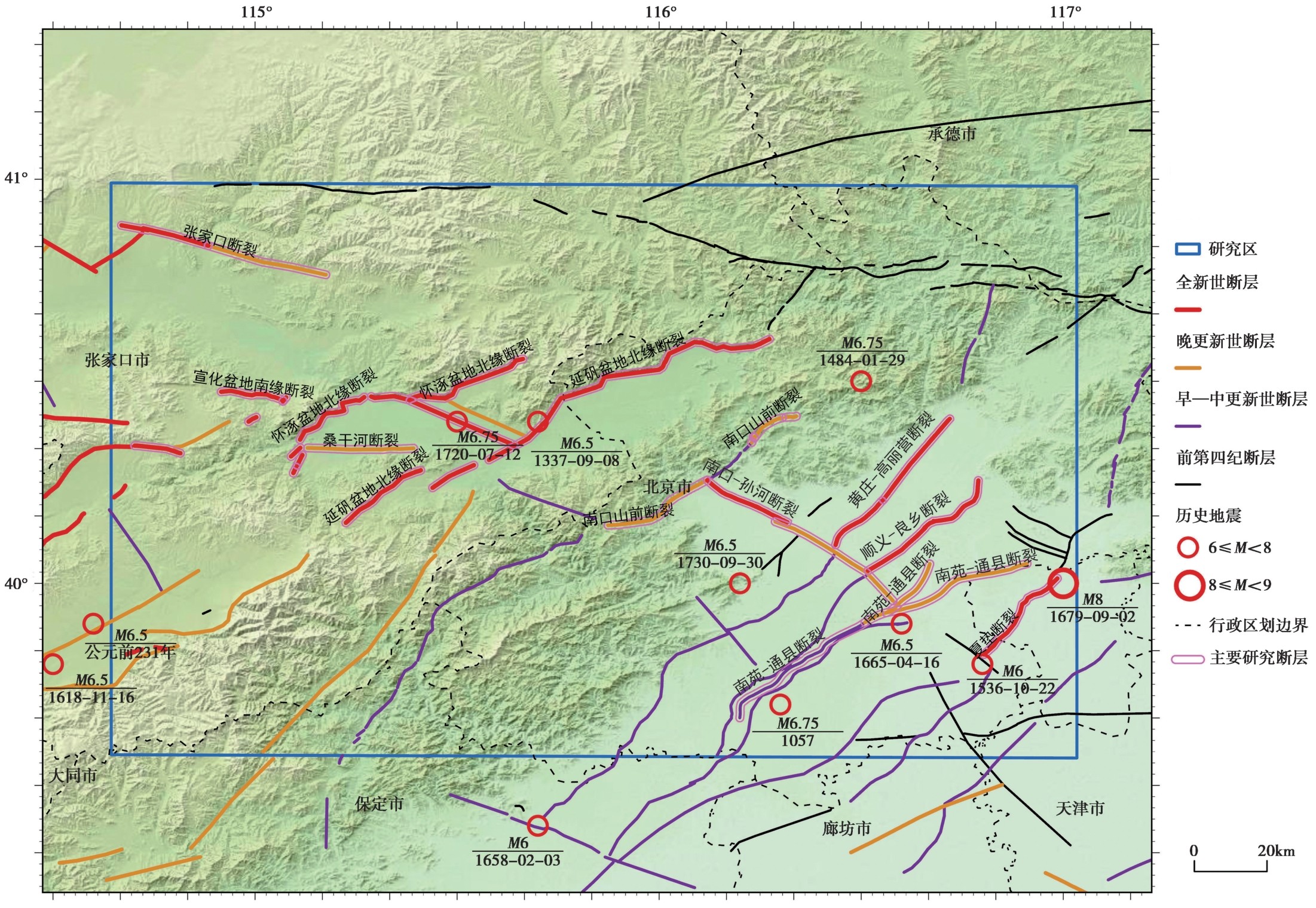
图1 京西北研究区强震和活动断层分布图
Fig. 1 Strong earthquakes and active faults in northwestern Beijing.
| 断层中文名称 | 断层英文名称 | 文献数量(英文/中文) |
|---|---|---|
| 张家口断裂 | Zhangjiakou Fault | 34(7/27) |
| 阳原盆地北缘断裂 | Northern margin fault of the Yangyuan Basin | 1(0/1) |
| 延矾盆地北缘断裂 | Northern margin fault of the Yanfan Basin | 3(0/3) |
| 怀涿盆地北缘断裂 | Northern margin fault of the Huaizhuo Basin | 3(0/3) |
| 宣化盆地南缘断裂 | Southern margin fault of the Xuanhua Basin | 2(0/2) |
| 桑干河断裂 | Sangganhe Fault | 2(0/2) |
| 南口山前断裂 | Nankou Piedmont fault | 2(0/2) |
| 南口-孙河断裂 | Nankou-Sunhe Fault | 35(9/26) |
| 黄庄-高丽营断裂 | Huangzhuang-Gaoliying Fault | 15(5/10) |
| 顺义-良乡断裂 | Shunyi-Liangxiang Fault | 8(0/8) |
| 新保安-沙城断裂 | Xinbao’an-Shacheng Fault | 2(0/2) |
| 夏垫断裂 | Xiadian Fault | 14(3/11) |
| 南苑-通县断裂 | Nanyuan-Tongxian Fault | 16(4/12) |
表1 京西北活动断层文献库
Table1 Literature database of active faults in northwestern Beijing
| 断层中文名称 | 断层英文名称 | 文献数量(英文/中文) |
|---|---|---|
| 张家口断裂 | Zhangjiakou Fault | 34(7/27) |
| 阳原盆地北缘断裂 | Northern margin fault of the Yangyuan Basin | 1(0/1) |
| 延矾盆地北缘断裂 | Northern margin fault of the Yanfan Basin | 3(0/3) |
| 怀涿盆地北缘断裂 | Northern margin fault of the Huaizhuo Basin | 3(0/3) |
| 宣化盆地南缘断裂 | Southern margin fault of the Xuanhua Basin | 2(0/2) |
| 桑干河断裂 | Sangganhe Fault | 2(0/2) |
| 南口山前断裂 | Nankou Piedmont fault | 2(0/2) |
| 南口-孙河断裂 | Nankou-Sunhe Fault | 35(9/26) |
| 黄庄-高丽营断裂 | Huangzhuang-Gaoliying Fault | 15(5/10) |
| 顺义-良乡断裂 | Shunyi-Liangxiang Fault | 8(0/8) |
| 新保安-沙城断裂 | Xinbao’an-Shacheng Fault | 2(0/2) |
| 夏垫断裂 | Xiadian Fault | 14(3/11) |
| 南苑-通县断裂 | Nanyuan-Tongxian Fault | 16(4/12) |
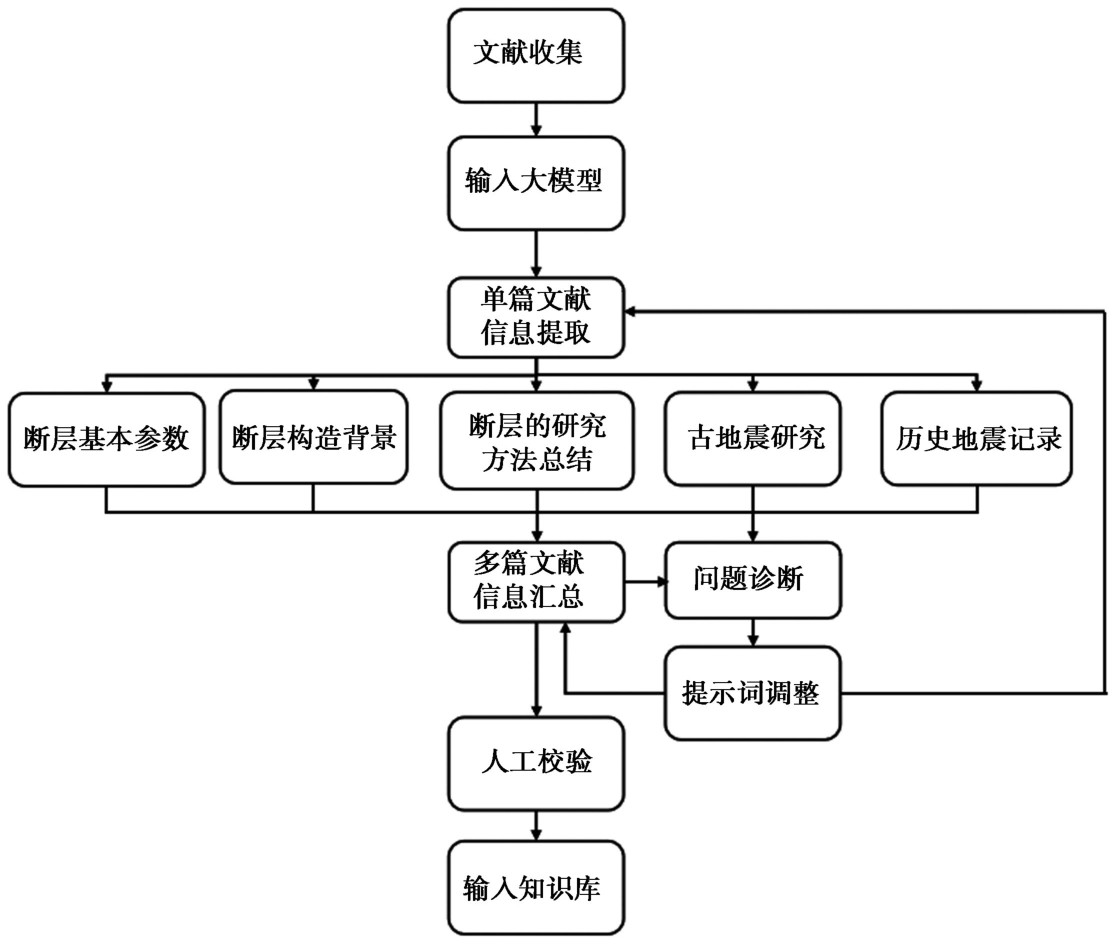
图2 大语言模型文献处理流程图
Fig. 2 Flowchart of literature processing using large language models.
| 提示词要素 | 内容 |
|---|---|
| 任务目标 | (1)本文是否有现代或历史文献记载的关于某断裂的地震记录。使用文献引用方式,用一段话,按时间顺序描述本文中提到的与南口-孙河断裂相关的现代或历史文献记载的地震记录。只返回能够提取到的信息,最后合并相同的内容,去掉无意义内容,限500字以内。 |
| 处理规则 | (1)格式: ([第一作者,发表时间](文献链接))或([第一作者,发表时间](文献链接1); [第一作者,发表时间](文献链接2))。 |
| (2)多源支持同一参数时:使用合并的标注,如([第一作者,发表时间](文献链接1);[第一作者,发表时间](文献链接2))。 | |
| (3)参数来源单一时:仅标注单个该来源,如([第一作者,发表时间](文献链接));若参数无可靠来源,请勿使用。 | |
| 输出约束 | (1)必须:单段落、字数≤500字、参数后紧跟引用、使用markdown链接、中文表述。 (2)禁止:分段换行、无来源的参数、出现文档名称、编造缺失数据、保留“未提及”等占位符。 |
表2 历史地震记录提示词示例
Table2 Example prompts for records of historical earthquakes
| 提示词要素 | 内容 |
|---|---|
| 任务目标 | (1)本文是否有现代或历史文献记载的关于某断裂的地震记录。使用文献引用方式,用一段话,按时间顺序描述本文中提到的与南口-孙河断裂相关的现代或历史文献记载的地震记录。只返回能够提取到的信息,最后合并相同的内容,去掉无意义内容,限500字以内。 |
| 处理规则 | (1)格式: ([第一作者,发表时间](文献链接))或([第一作者,发表时间](文献链接1); [第一作者,发表时间](文献链接2))。 |
| (2)多源支持同一参数时:使用合并的标注,如([第一作者,发表时间](文献链接1);[第一作者,发表时间](文献链接2))。 | |
| (3)参数来源单一时:仅标注单个该来源,如([第一作者,发表时间](文献链接));若参数无可靠来源,请勿使用。 | |
| 输出约束 | (1)必须:单段落、字数≤500字、参数后紧跟引用、使用markdown链接、中文表述。 (2)禁止:分段换行、无来源的参数、出现文档名称、编造缺失数据、保留“未提及”等占位符。 |
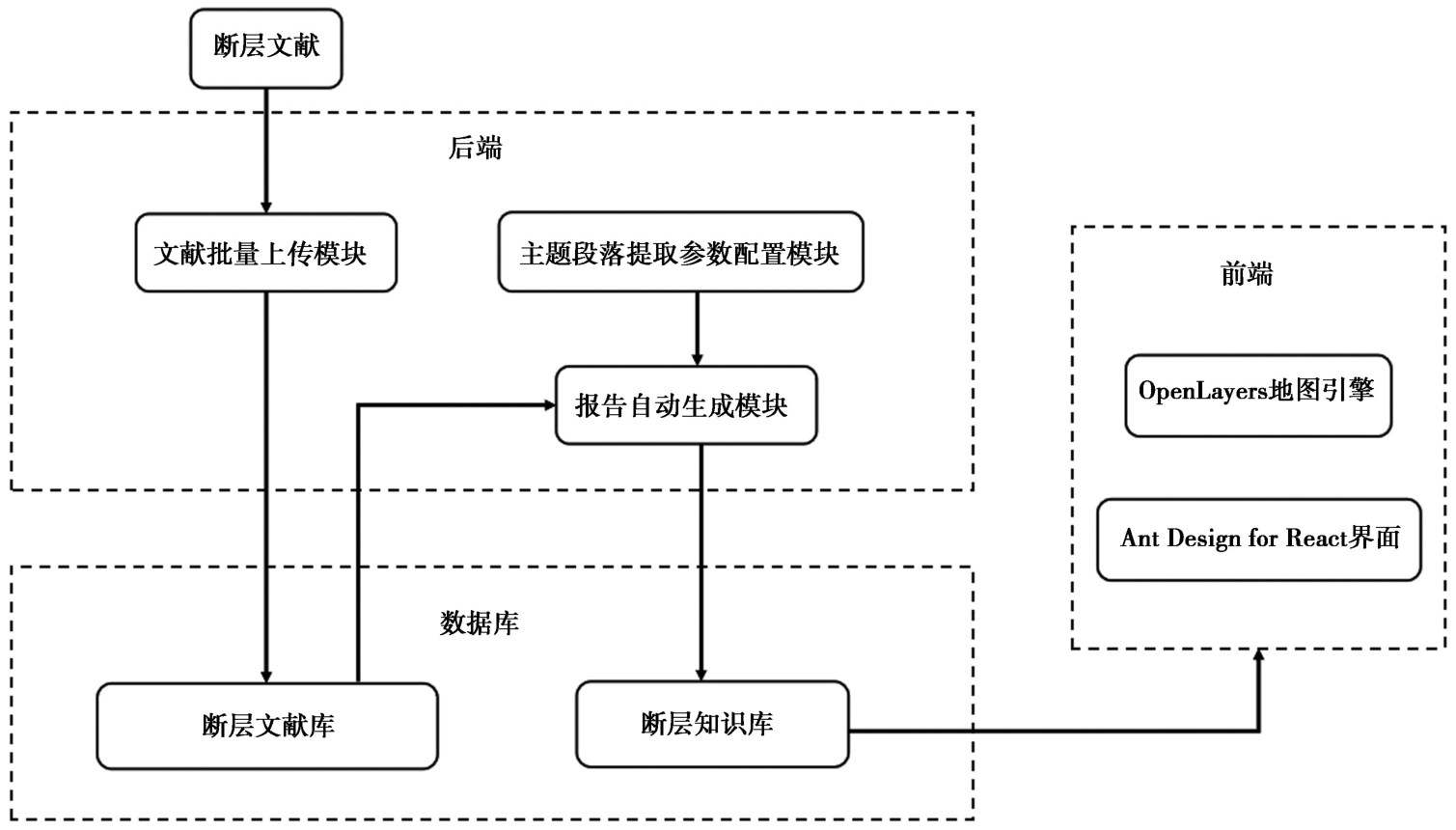
图3 系统架构图
Fig. 3 System architecture diagram.
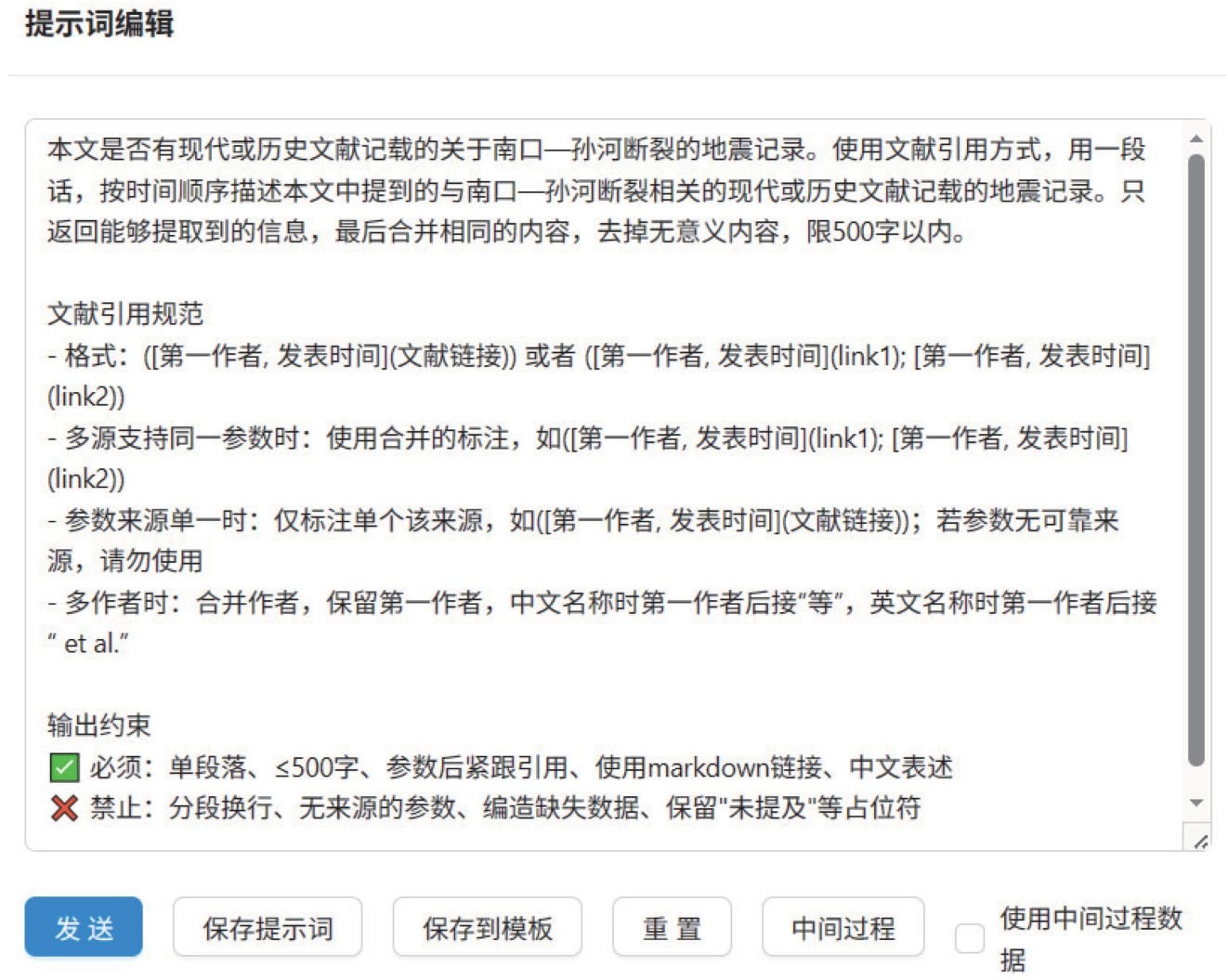
图4 “提示词编辑”面板
Fig. 4 “Prompt Editing” panel.
| 序号 | 断层中文名称 | 断层英文名称 | 正确率/% | 完整性/% |
|---|---|---|---|---|
| 1 | 张家口断裂 | Zhangjiakou Fault | 83.21 | 83.21 |
| 2 | 阳原盆地北缘断裂 | Northern margin fault of the Yangyuan Basin | 62.86 | 84 |
| 3 | 延矾盆地北缘断裂 | Northern margin fault of the Yanfan Basin | 68.57 | 88.57 |
| 4 | 怀涿盆地北缘断裂 | Northern margin fault of the Huaizhuo Basin | 76.67 | 80 |
| 5 | 宣化盆地南缘断裂 | Southern margin fault of the Xuanhua Basin | 91.80 | 91.43 |
| 6 | 桑干河断裂 | Sangganhe Fault | 68 | 72.38 |
| 7 | 南口山前断裂 | Nankoupiedmont Fault | 68.57 | 88.57 |
| 8 | 南口-孙河断裂 | Nankou-Sunhe Fault | 87.14 | 68.57 |
| 9 | 黄庄-高丽营断裂 | Huangzhuang-Gaoliying Fault | 81.78 | 87.11 |
| 10 | 顺义-良乡断裂 | Shunyi-Liangxiang Fault | 81.43 | 85.71 |
| 11 | 新保安-沙城断裂 | Xinbao’an-Shacheng Fault | 70 | 76.67 |
| 12 | 夏垫断裂 | Xiadian Fault | 91.43 | 74.21 |
| 13 | 南苑-通县断裂 | Nanyuan-Tongxian Fault | 77.14 | 69.14 |
| 平均 | 77.58 | 80.74 | ||
表3 京西北活动断层AI报告的评价结果
Table3 Evaluation of AI-generated reports on active faults in northwestern Beijing
| 序号 | 断层中文名称 | 断层英文名称 | 正确率/% | 完整性/% |
|---|---|---|---|---|
| 1 | 张家口断裂 | Zhangjiakou Fault | 83.21 | 83.21 |
| 2 | 阳原盆地北缘断裂 | Northern margin fault of the Yangyuan Basin | 62.86 | 84 |
| 3 | 延矾盆地北缘断裂 | Northern margin fault of the Yanfan Basin | 68.57 | 88.57 |
| 4 | 怀涿盆地北缘断裂 | Northern margin fault of the Huaizhuo Basin | 76.67 | 80 |
| 5 | 宣化盆地南缘断裂 | Southern margin fault of the Xuanhua Basin | 91.80 | 91.43 |
| 6 | 桑干河断裂 | Sangganhe Fault | 68 | 72.38 |
| 7 | 南口山前断裂 | Nankoupiedmont Fault | 68.57 | 88.57 |
| 8 | 南口-孙河断裂 | Nankou-Sunhe Fault | 87.14 | 68.57 |
| 9 | 黄庄-高丽营断裂 | Huangzhuang-Gaoliying Fault | 81.78 | 87.11 |
| 10 | 顺义-良乡断裂 | Shunyi-Liangxiang Fault | 81.43 | 85.71 |
| 11 | 新保安-沙城断裂 | Xinbao’an-Shacheng Fault | 70 | 76.67 |
| 12 | 夏垫断裂 | Xiadian Fault | 91.43 | 74.21 |
| 13 | 南苑-通县断裂 | Nanyuan-Tongxian Fault | 77.14 | 69.14 |
| 平均 | 77.58 | 80.74 | ||
| [1] |
|
| [2] |
白凌燕, 李潇, 秦浩敏, 等. 2018. 北京平原南口-孙河断裂南段第四纪活动性及其构造意义[J]. 现代地质, 32(2): 270-278.
|
|
|
|
| [3] |
鲍亦冈, 刘振锋, 王世发, 等. 2001. 北京地质百年研究: 北京地区基础地质研究的历史与最新成果[M]. 北京: 地质出版社.
|
|
|
|
| [4] |
陈煜磊, 聂钰格, 吴化尧. 2026. 面向软件测试领域知识问答的大模型评估[J]. 软件学报, 37(8): 3144-3160.
|
|
|
|
| [5] |
邓起东, 张培震, 冉勇康, 等. 2002. 中国活动构造基本特征[J]. 中国科学(D辑), 32(12): 1020-1030, 1057.
|
|
|
|
| [6] |
宫猛, 徐锡伟, 张新东, 等. 2017. 华北东部基于背景噪声的壳幔三维S波速度结构[J]. 地震地质, 39(1): 130-146. doi: 10.3969/j.issn.0253-4967.2017.01.010.
|
|
DOI |
|
| [7] |
宫猛, 邹献昆, 王晓山, 等. 2025. 京西北地区地壳速度结构与地震重新定位联合反演[J]. 地震地质, 47(4): 1132-1151. doi: 10.3969/j.issn.0253-4967.2025.04.20240014.
|
|
DOI |
|
| [8] |
何付兵. 2019. 南口-孙河断裂几何学、运动学特征及与地裂缝关系研究[D]. 北京: 中国地震局地质研究所.
|
|
|
|
| [9] |
何付兵, 徐锡伟, 何振军, 等. 2020. 利用浅层地震反射剖面探测研究大兴断裂北段新近纪-第四纪的构造特征[J]. 地震地质, 42(4): 893-908. doi: 10.3969/j.issn.0253-4967.2020.04.008.
|
|
DOI |
|
| [10] |
姜鹏, 任龑, 朱蓓琳. 2024. 大语言模型在分类标引工作中的应用探索[J]. 农业图书情报学报, 36(5): 32-42.
DOI |
|
DOI |
|
| [11] |
江娃利, 侯治华, 谢新生. 2001. 北京平原南口-孙河断裂带昌平旧县探槽古地震事件研究[J]. 中国科学(D辑), 31(6): 501-509.
|
|
|
|
| [12] |
李华章. 1989. 北京地区新构造运动特征与地震的关系[J]. 北京师范大学学报(自然科学版), 25(4): 78-84.
|
|
|
|
| [13] |
刘保金, 胡平, 陈颙, 等. 2009. 北京平原西北部地壳浅部结构和隐伏活动断裂: 由地震反射剖面揭示[J]. 地球物理学报, 52(8): 2015-2025.
|
|
|
|
| [14] |
刘燕翔, 卫俊, 李金, 等. 2020. 京西北地区地震重定位及构造特征[J]. 地震地磁观测与研究, 41(1): 19-24.
|
|
|
|
| [15] |
齐诚, 赵大鹏, 陈颙, 等. 2006. 首都圈地区地壳P波和S波三维速度结构及其与大地震的关系[J]. 地球物理学报, 49(3): 805-815.
|
|
|
|
| [16] |
王丹丹. 2007. 北京南口-孙河断裂北段晚第四纪活动特征的钻孔地层学研究[D]. 北京: 中国地震局地壳应力研究所.
|
|
|
|
| [17] |
王丹丹, 张世民, 刘旭东, 等. 2007. 北京南口-孙河断裂北西段晚第四纪活动特征研究[A]// 中国地震局地壳应力研究所. 地壳构造与地壳应力文集. 北京: 地震出版社, (19): 50-59.
|
|
|
|
| [18] |
徐杰, 马宗晋, 陈国光, 等. 2003. 中国大陆东部新构造期NW向断裂带的初步探讨[J]. 地学前缘, 10(S1): 193-198.
|
|
|
|
| [19] |
徐杰, 王若柏, 王春华, 等. 1998. 我国华北和西南地区2条新生地震构造带的初步研究[J]. 西北地震学报, 20(2): 2-8.
|
|
|
|
| [20] |
徐锡伟, 韩竹军, 杨晓平, 等. 2016. 中国及邻近地区地震构造图[CM]. 北京: 地震出版社.
|
|
|
|
| [21] |
徐锡伟, 冉勇康, 周本刚, 等. 1998. 张北-尚义地震的地震构造环境与宏观破坏特征[J]. 地震地质, 20(2): 135-146.
|
|
|
|
| [22] |
张磊, 白凌燕, 赵勇, 等. 2017. 北京南口-孙河断裂与黄庄-高丽营断裂交会区沉积速率差异对断裂活动性的响应[J]. 地震地质, 39(5): 1048-1065. doi: 10.3969/j.issn.0253-4967.2017.05.013.
|
|
DOI |
|
| [23] |
张培震, 邓起东, 张国民, 等. 2003. 中国大陆的强震活动与活动地块[J]. 中国科学(D辑), 33(S1): 12-20.
|
|
|
|
| [24] |
张世民, 王丹丹, 刘旭东, 等. 2007. 北京南口-孙河断裂带北段晚第四纪活动的层序地层学研究[J]. 地震地质, 29(4): 729-743.
|
|
|
|
| [25] |
张世民, 王丹丹, 刘旭东, 等. 2008. 北京南口-孙河断裂晚第四纪古地震事件的钻孔剖面对比与分析[J]. 中国科学(D辑), 38(7): 881-895.
|
| [1] |
安芷生, 魏兰英, 卢演俦, 等. 1979. 顺5孔的磁性地层学和早松山世的北京海侵[J]. 地球化学, (4): 343-346.
|
| [25] |
|
| [26] |
张晓亮, 张磊, 王志辉, 等. 2020. 基于磁性地层和沉积地层特征对北京市南口-孙河断裂活动性评估[J]. 中国地质, 47(3): 868-878.
|
|
|
|
| [27] |
赵帅, 李占飞, 贾启超, 等. 2023. 基于古地震探槽的南口-孙河断裂最新走滑变形证据研究[J]. 震灾防御技术, 18(4): 736-744.
|
|
|
|
| [28] |
周波, 李珂. 2026. 基于GeoGPT与LightRAG的地质找矿知识图谱及知识问答模型构建方法研究[J]. 地质通报, 45(2-3): 549-560.
|
|
|
|
| [29] |
|
| [30] |
DOI URL |
| [31] |
|
| [32] |
DOI |
| [33] |
|
| [34] |
DOI URL |
| [35] |
DOI |
| [36] |
DOI URL |
| [37] |
DOI URL |
| [1] | 俞晶星, 石磊, 赵帅, 李占飞, 范莉苹, 苗文培, 张会平. 巨厚沉积区活动断层探测[J]. 地震地质, 2026, 48(5): 1197-1213. |
| [2] | 曹筠, 刘书峰, 高晨, 李彦宝, 陈杨. 阳原盆地北缘断裂全新世活动证据及其构造意义[J]. 地震地质, 2026, 48(5): 1253-1266. |
| [3] | 李帅, 房立华, 杨婷, 万永革, 张龙, 张苏祥, 王世广, 范莉苹. 京西北地区地壳应力场空间分布特征及其构造含义[J]. 地震地质, 2026, 48(5): 1319-1338. |
| [4] | 黄杰, 甘俊峰, 袁兆德, 陈杰, 李涛, 刘奇, 邸宁, 杨会丽. 西南天山喀什活动背斜北翼断层初步研究[J]. 地震地质, 2026, 48(4): 1011-1034. |
| [5] | 魏占玉, 何宏林, 邓亚婷, 席茜. 基于震前-震后高精度地形点云数据提取三维地表同震位移场信息[J]. 地震地质, 2025, 47(1): 167-188. |
| [6] | 张伟恒, 张东升, 陈杰, 田勤俭, 何万通. 基于地表破裂带宽度统计的活动断层错断变形区范围分析[J]. 地震地质, 2025, 47(1): 345-366. |
| [7] | 吴熙彦, 鲁人齐, 张金玉, 孙晓, 徐芳, 陈桂华. 中国地震科学实验场三维断层模型Web展示原型系统[J]. 地震地质, 2024, 46(1): 35-47. |
| [8] | 黎益仕. 活动断层探测综合标准化[J]. 地震地质, 2023, 45(2): 455-463. |
| [9] | 杨晨艺, 李晓妮, 冯希杰, 黄引弟, 裴跟弟. 秦岭北缘断裂带的重要分支——桃川-户县断层的浅部结构与第四纪活动性[J]. 地震地质, 2023, 45(2): 464-483. |
| [10] | 张浩, 王金艳, 许汉刚, 李丽梅, 蒋新, 赵启光, 顾勤平. 安丘-莒县断裂新沂段的几何结构特征[J]. 地震地质, 2022, 44(6): 1448-1468. |
| [11] | 曹筠, 李彦宝, 冉勇康, 徐锡伟, 马董伟, 张志强. 城市隐伏活动断层避让典型案例分析--以新沂市郯庐断裂带沿线某场地为例[J]. 地震地质, 2022, 44(4): 1071-1085. |
| [12] | 杨晓平, 王萍, 李晓峰, 谢超, 周本刚, 黄雄南. 地形坡度和高程变异系数在识别墨脱活动断裂带中的应用[J]. 地震地质, 2019, 41(2): 419-435. |
| [13] | 吴熙彦, 徐锡伟, 于贵华, 程佳, 陈桂华, 安艳芬, 王启欣. 国家川滇实验场地震地表破裂带分布图编制[J]. 地震地质, 2018, 40(1): 27-41. |
| [14] | 蔡明刚, 鲁人齐, 何宏林, 徐锡伟, 王振南, 李海鸥, 吴熙彦. 水域三维地形与活动断层探测研究——以西昌邛海为例[J]. 地震地质, 2018, 40(1): 204-214. |
| [15] | 闫兵, 贾东. 沿走滑活动断层的基岩河道系统位错——以青藏高原东部为例[J]. 地震地质, 2017, 39(6): 1127-1142. |
| 阅读次数 | ||||||
|
全文 |
|
|||||
|
摘要 |
|
|||||