地震地质 ›› 2026, Vol. 48 ›› Issue (5): 1267-1296.DOI: 10.3969/j.issn.0253-4967.20260015
肖伟鹏1),2),3)( ), 孙鸿博1),2),3), 郑海刚1),2),3),4),*(), 陆元超1),2),3), 孙伯乐1),2),3), 储飞1),2),3),4), 梁霄1),2),3), 郑荣荧5),6), 余中元5),6), 王季雨1),2),3)
收稿日期:2026-02-01
修回日期:2026-05-02
出版日期:2026-11-11
发布日期:2026-11-11
通讯作者:
郑海刚
作者简介:肖伟鹏, 男, 1986年生, 2011年于中国矿业大学(北京)获地球探测与信息技术专业硕士学位, 工程师, 主要研究方向为活动构造及地球物理场监测与分析, E-mail: xiaoweipeng008@163.com。
基金资助:
XIAO Wei-peng1),2),3)(), SUN Hong-bo1),2),3), ZHENG Hai-gang1),2),3),4),*(), LU Yuan-chao1),2),3), SUN Bo-le1),2),3), CHU Fei1),2),3),4), LIANG Xiao1),2),3), ZHENG Rong-ying5),6), YU Zhong-yuan5),6), WANG Ji-yu1),2),3)
Received:2026-02-01
Revised:2026-05-02
Online:2026-11-11
Published:2026-11-11
Contact:
ZHENG Hai-gang
摘要:
郯庐断裂带肥东-庐江段作为连接张八岭隆起与合肥盆地的关键构造部位, 前人对其晚第四纪活动性与深浅变形关系长期存在不同认识。受限于研究区较厚的第四系覆盖影响, 主要断裂多呈隐伏状态。2024年肥东 MS4.7地震序列的发生, 使得厘定该段隐伏断裂最新活动时代具有重要意义。文中基于区域内浅层地震反射剖面和跨断层联合钻孔地质剖面, 综合背景噪声成像、岩心磁化率与OSL/ESR测年技术, 对池河-太湖断裂、嘉山-庐江断裂等郯庐主要分支断裂的浅部几何结构与活动时代进行了系统研究。研究结果表明: 研究区浅部构造表现为典型的“两堑夹一垒”式张扭性断陷组合, 断裂运动学特征以正断为主, 深部呈花状构造会入主滑移带, 具有显著的深浅构造解耦特征; 池河-太湖断裂是该区浅表垂直构造变形最显著的分支, 其明确错断了中更新统下部地层(上断点埋深在25~83m), 最新正断活动时代约束在中更新世晚期(距今121~142ka); 嘉山-庐江断裂(上断点埋深7~12m)的显著垂直错动于早更新世后已趋于停滞, 但基于断裂带内获取的年轻测年数据(11~67ka) 及区域动力学背景推断, 其右旋走滑活动在晚更新世至全新世可能仍在持续。2024年研究区发生的肥东地震序列可能主要受控于深部构造应力调整, 具有典型的深浅构造解耦机制。文中研究为合肥及邻区国土规划与震害防御提供了详实的基础地质依据, 对区域地震危险性评价具有重要的科学意义。
肖伟鹏, 孙鸿博, 郑海刚, 陆元超, 孙伯乐, 储飞, 梁霄, 郑荣荧, 余中元, 王季雨. 郯庐断裂带肥东-庐江段第四纪活动特征及构造意义[J]. 地震地质, 2026, 48(5): 1267-1296.
XIAO Wei-peng, SUN Hong-bo, ZHENG Hai-gang, LU Yuan-chao, SUN Bo-le, CHU Fei, LIANG Xiao, ZHENG Rong-ying, YU Zhong-yuan, WANG Ji-yu. THE QUATERNARY ACTIVITY CHARACTERISTICS AND TEC-TONIC SIGNIFICANCE OF THE FEIDONG-LUJIANG SEGMENT OF THE TAN-LU FAULT ZONE[J]. SEISMOLOGY AND GEOLOGY, 2026, 48(5): 1267-1296.
| 测线位置 | 针对断层名称 | 上断点位置 (桩号) | 上断点埋深 /m | 浅震位置 (测线编号) | 排钻首尾孔位置 (桩号) |
|---|---|---|---|---|---|
| 姚庄 | 池河-太湖断裂 | 550 | 24~25 | L1 | 首512尾588 |
| 阚石路 | 池河-太湖断裂 | 83~84 | |||
| 南庄 | 嘉山-庐江断裂 | 1015 | 14~15 | L3 | 首1053尾977 |
| 外环北 | 嘉山-庐江断裂 | 430 | 7~8 | L4 | 首480尾405 |
表1 浅震与钻孔剖面的对应表
Table1 Correlation for shallow seismic exploration and integrated borehole geological profiles
| 测线位置 | 针对断层名称 | 上断点位置 (桩号) | 上断点埋深 /m | 浅震位置 (测线编号) | 排钻首尾孔位置 (桩号) |
|---|---|---|---|---|---|
| 姚庄 | 池河-太湖断裂 | 550 | 24~25 | L1 | 首512尾588 |
| 阚石路 | 池河-太湖断裂 | 83~84 | |||
| 南庄 | 嘉山-庐江断裂 | 1015 | 14~15 | L3 | 首1053尾977 |
| 外环北 | 嘉山-庐江断裂 | 430 | 7~8 | L4 | 首480尾405 |
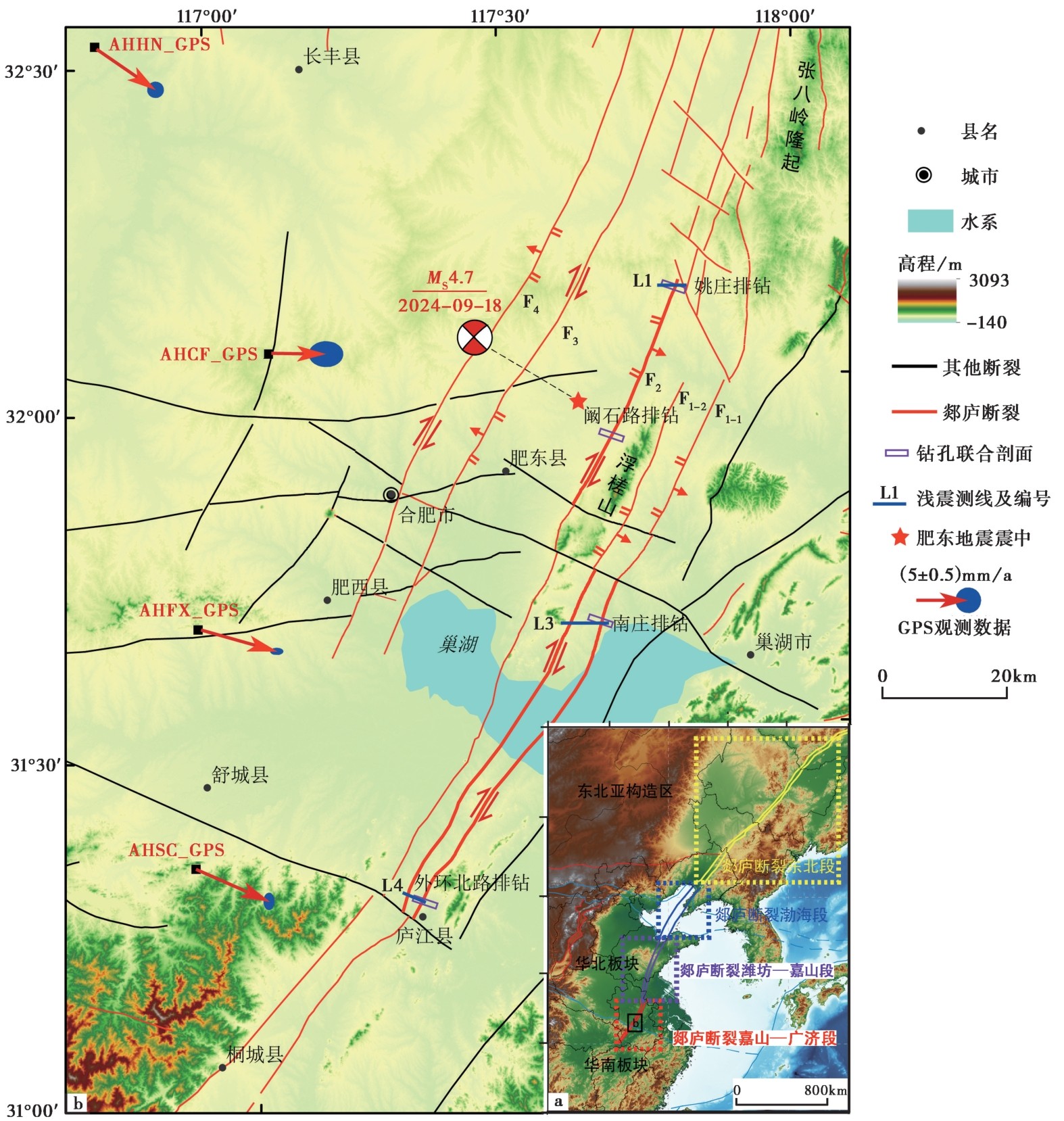
图1 研究区断层、浅震剖面与钻孔分布图 底图为数字高程模型。F1-1嘉山-庐江断裂; F1-2藕塘-清水涧断裂; F2池河-太湖断裂(或称池河-西山断裂); F3桑涧子-广寒桥断裂(或称石门山断裂); F4乌云山-合肥断裂(或称五河-合肥断裂)。GPS基准站水平速度场相对于欧亚大陆运动
Fig. 1 Distribution map of active faults and boreholes in the study region.
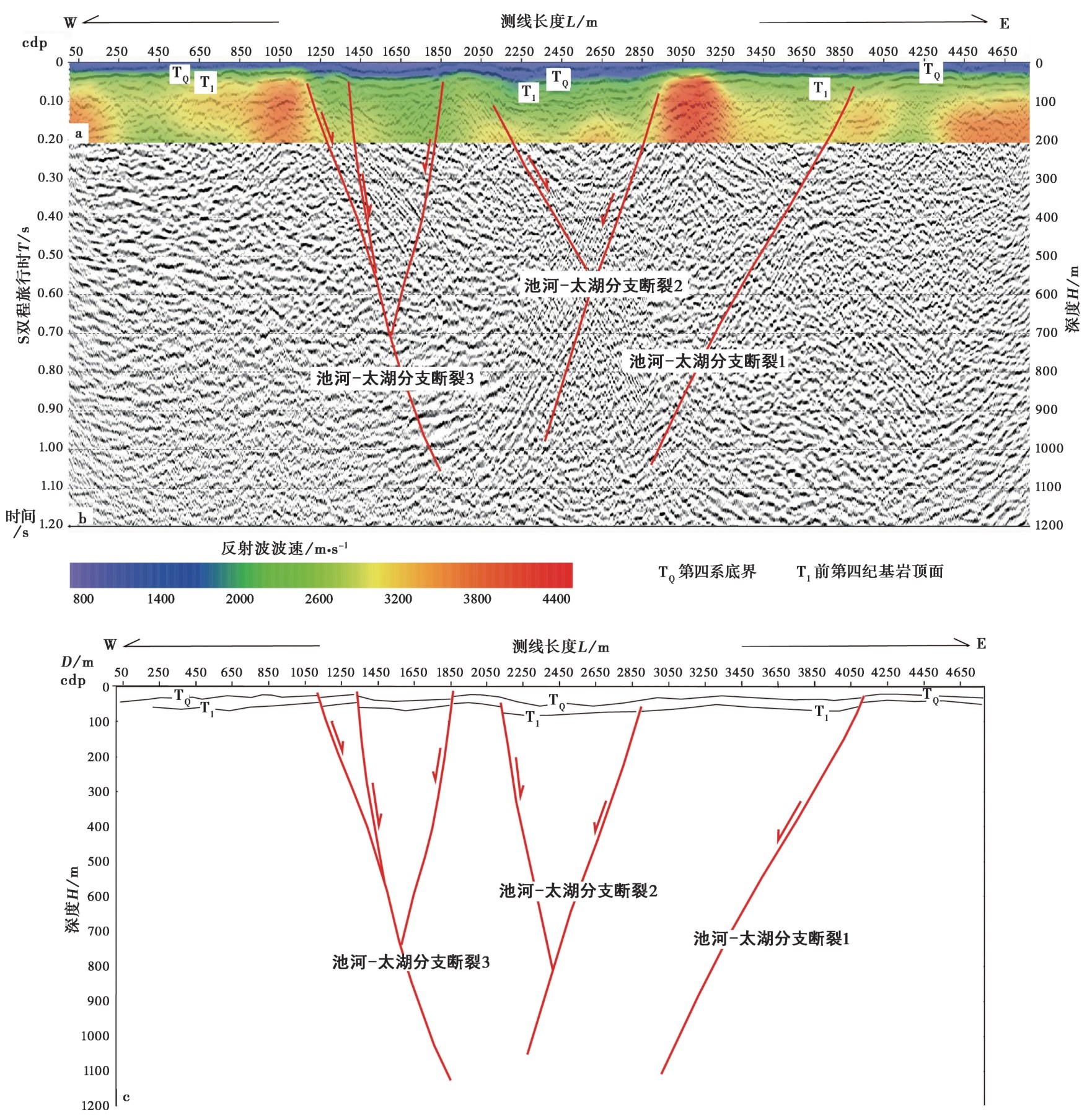
图2 a L1测线层析成像; b叠后偏移时间剖面; c地质层位解译剖面
Fig. 2 Plots showing tomographic imaging(a), post-stack migration time section(b), and stratigraphic interpretation section(c) of survey line 1.
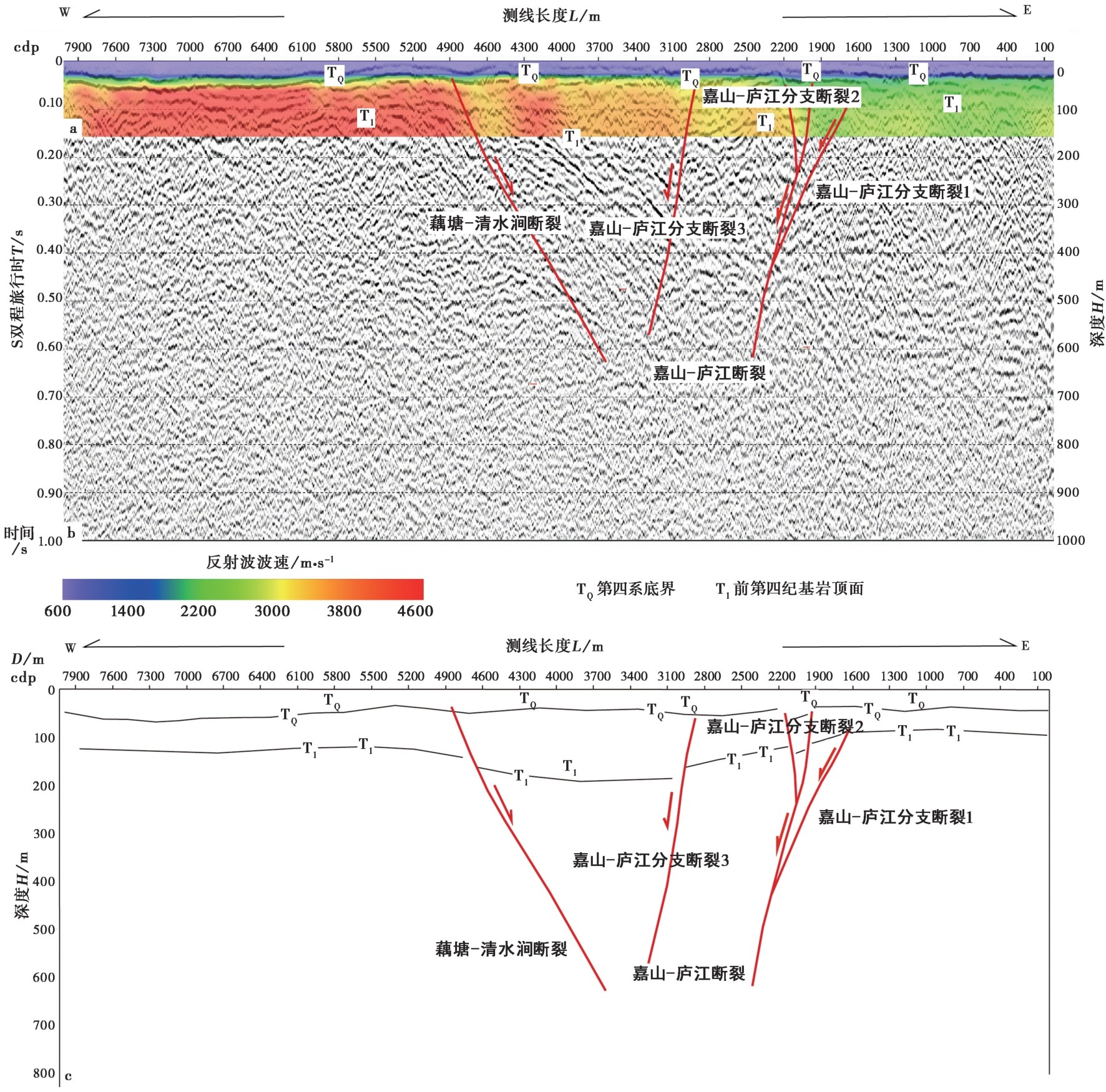
图3 a L3测线层析成像; b叠后偏移时间剖面; c地质层位解译剖面
Fig. 3 Plots showing tomographic imaging(a), post-stack migration time section(b), and stratigraphic interpretation section(c) of survey line 3.
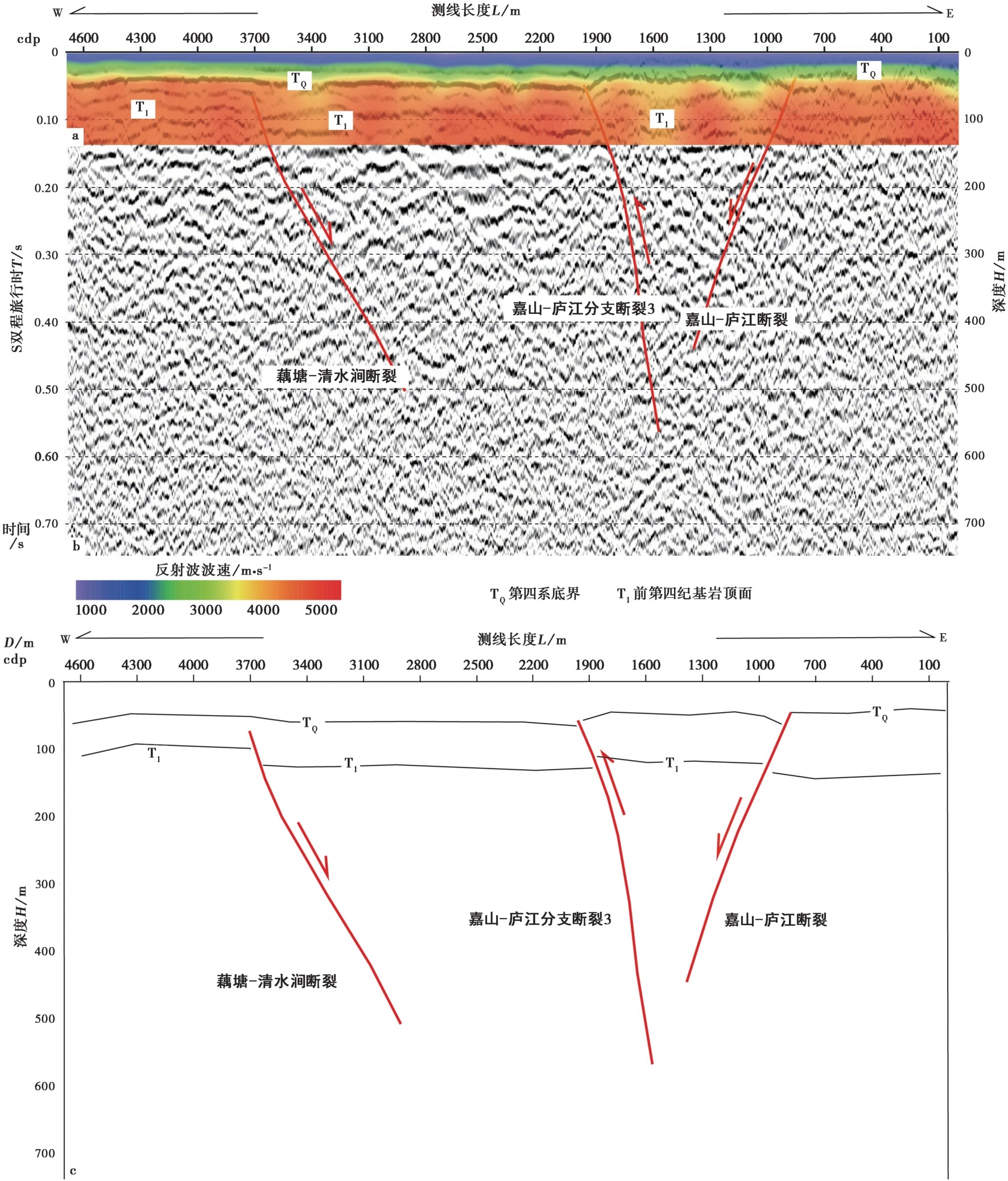
图4 a L4测线层析成像; b叠后偏移时间剖面; c地质层位解译剖面
Fig. 4 Plots showing tomographic imaging(a), post-stack migration time section(b), and stratigraphic interpretation section(c) of survey line 4.
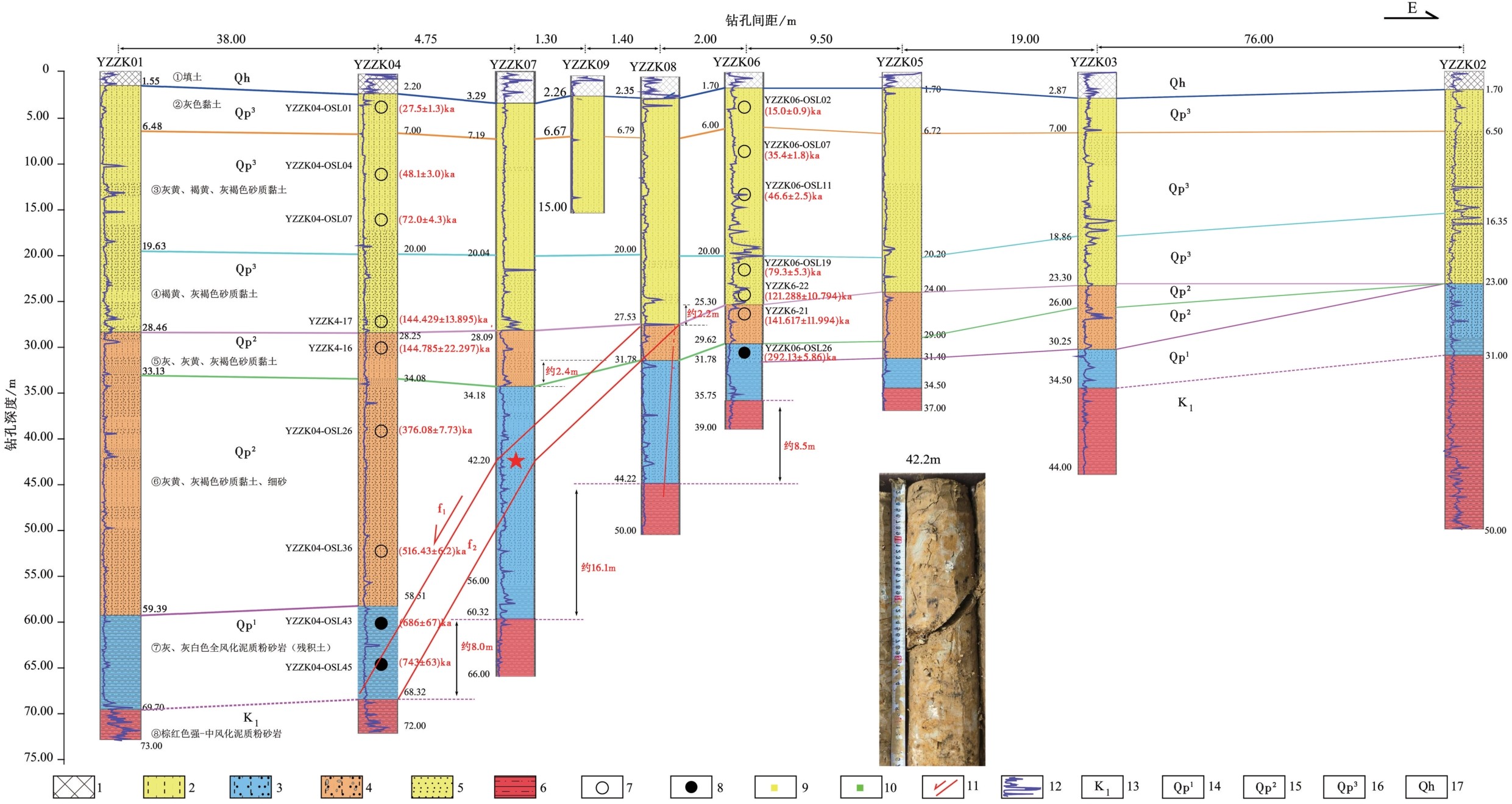
图5 姚庄钻孔联合地质剖面图 1. 填土; 2. 黏土; 3. 砂质黏土; 4. 含砾砂质黏土; 5. 细砂; 6. 泥质粉砂岩; 7. 光释光样品采样编号、位置及测试年龄(单位: ka); 8. 电子自旋共振测年样品采样编号、位置及测试年龄(单位: ka); 9. 粒度样品; 10. 孢粉样品; 11. 断层; 12. 磁化率测定曲线; 13. 下白垩统; 14. 下更新统; 5. 中更新统; 16. 上更新统; 17. 全新统
Fig. 5 Integrated geological profile of Yaozhuang borehole.
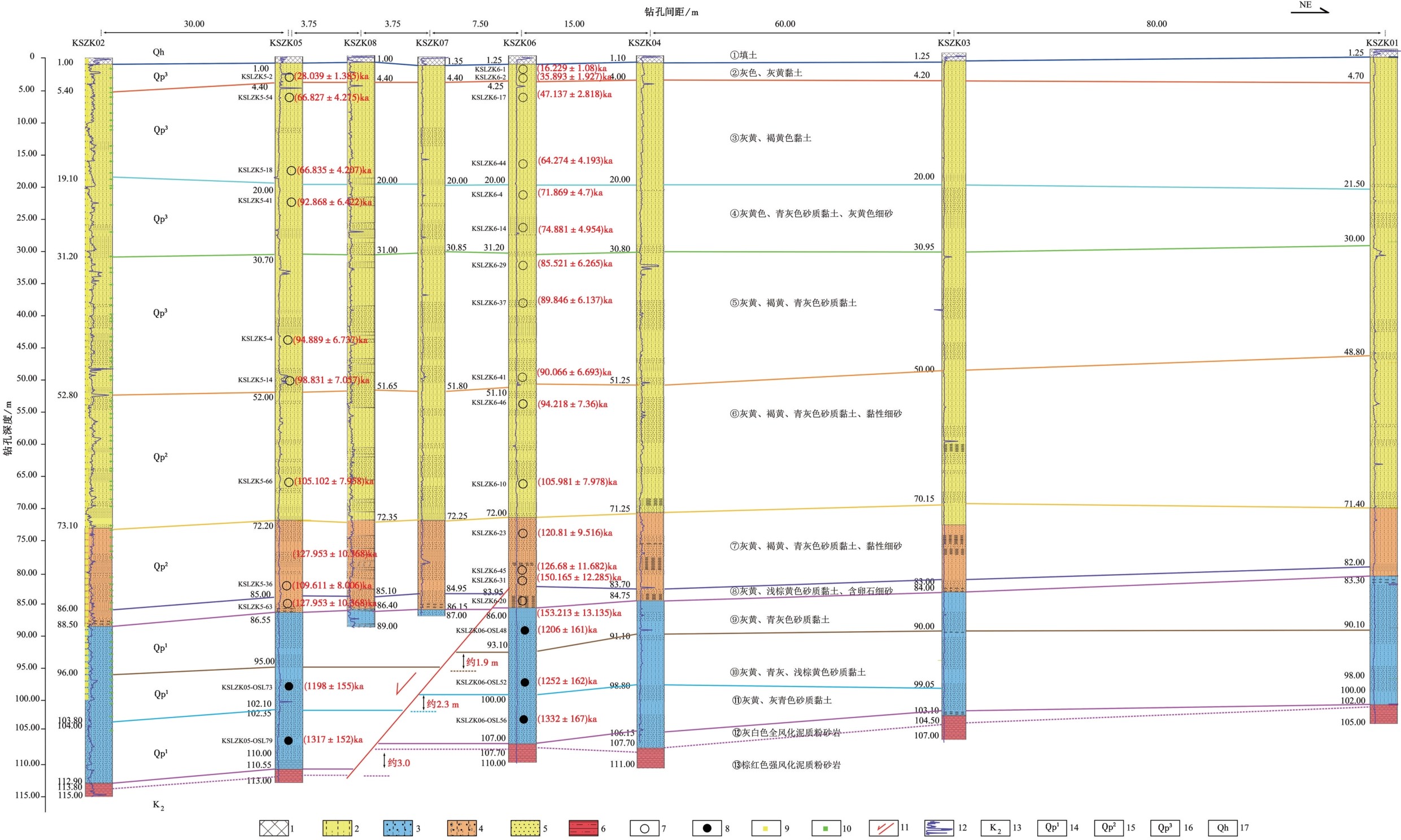
图6 阚石路钻孔联合地质剖面图 1. 填土; 2. 黏土; 3. 砂质黏土; 4. 含砾砂质黏土; 5. 细砂; 6. 泥质粉砂岩; 7. 光释光样品采样编号、位置及测试年龄(单位: ka); 8. 电子自旋共振测年样品采样编号、位置及测试年龄(单位: ka); 9. 粒度样品; 10. 孢粉样品; 11. 断层; 12. 磁化率测定曲线; 13. 下白垩统; 14. 下更新统; 15. 中更新统; 16. 上更新统; 17. 全新统
Fig. 6 Integrated geological profile of Kanshi-road borehole.
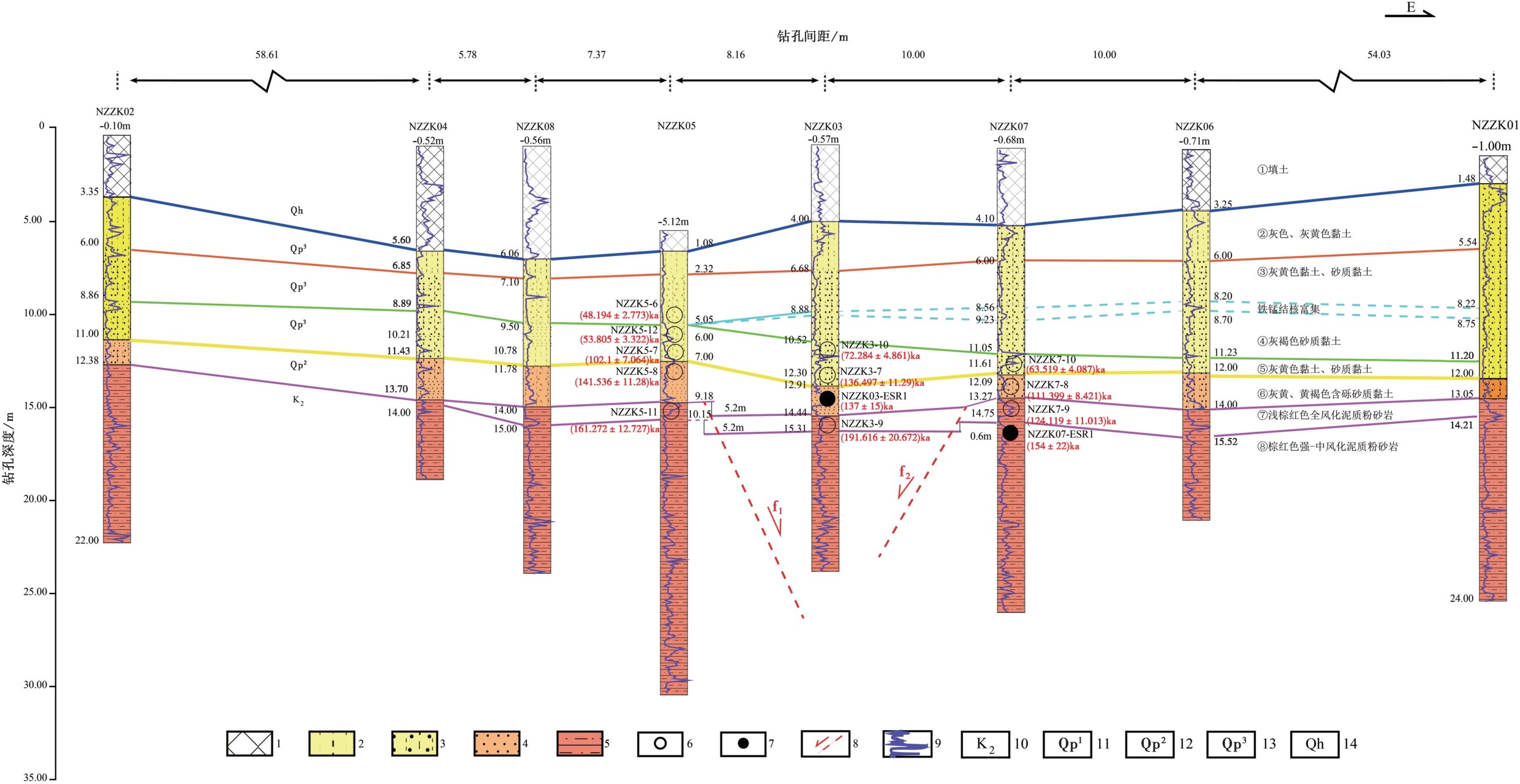
图7 南庄钻孔联合地质剖面图 1. 填土; 2. 黏土; 3. 砂质黏土; 4. 细砂; 5. 泥质粉砂岩; 6. 光释光样品采样编号、位置及测试年龄(单位: ka); 7. 电子自旋共振测年样品采样编号、位置及测试年龄(单位: ka); 8. 断层; 9. 磁化率测定曲线; 10. 上白垩统; 11. 下更新统; 12. 中更新统; 13. 上更新统; 14. 全新统
Fig. 7 Integrated geological profile of Nanzhuang borehole.
| 实验室 样品 编号 | 野外 样品编号 | 深度 /m | U /ug·g-1 | Th /ug·g-1 | K /% | 含水量 /% | 等效剂量 /Gy | 剂量率 /Gy·ka-1 | 年龄 /ka | 测年 方法 |
|---|---|---|---|---|---|---|---|---|---|---|
| 25361 | KSLZK05-OSL73 | 97.9 | 1.13±0.05 | 9.35±0.19 | 2.15±0.09 | 11±5 | 3164±409 | 2.64±0.13 | 1198±155 | ESR |
| 25362 | KSLZK05-OSL79 | 106.3 | 0.92±0.04 | 9.39±0.19 | 2.48±0.10 | 15±5 | 3587±413 | 2.72±0.14 | 1317±152 | ESR |
| 25363 | KSLZK06-OSL48 | 89.7 | 0.90±0.04 | 8.96±0.18 | 2.31±0.09 | 11±5 | 3257±436 | 2.70±0.14 | 1206±161 | ESR |
| 25364 | KSLZK06-OSL52 | 97.6 | 1.33±0.05 | 8.21±0.16 | 2.23±0.09 | 36±5 | 2293±297 | 1.83±0.09 | 1252±162 | ESR |
| 25365 | KSLZK06-OSL56 | 103.5 | 0.80±0.03 | 8.57±0.17 | 2.53±010 | 13±5 | 3684±462 | 2.77±0.14 | 1332±167 | ESR |
| 25366 | NZZK03-ESR1 | 15.1 | 3.88±0.16 | 17.10±0.34 | 3.09±0.12 | 13±5 | 599±64 | 4.39±0.22 | 137±15 | ESR |
| 25367 | NZZK07-ESR1 | 14.7 | 2.56±0.10 | 12.30±0.25 | 2.51±0.10 | 12±5 | 523±73 | 3.39±0.17 | 154±22 | ESR |
| 25368 | YZZK04-OSL43 | 49.7 | 1.19±0.05 | 7.48±0.15 | 1.65±0.07 | 12±5 | 1432±140 | 2.09±0.10 | 686±67 | ESR |
| 25369 | YZZK04-OSL45 | 64.7 | 1.34±0.05 | 10.50±0.21 | 1.80±0.07 | 9±5 | 1879±160 | 2.53±0.13 | 743±63 | ESR |
| 202526 | YZZK04-OSL01 | 3.3 | 1.9±0.3 | 11.1±0.7 | 1.9±0.04 | 6 | 87.6±1.4 | 3.2±0.1 | 27.5±1.3 | OSL |
| 202527 | YZZK04-OSL04 | 11.2 | 3.81±0.1 | 14.5±0.25 | 1.52±0.05 | 2 | 180.8±4.5 | 3.76±0.22 | 48.1±3.0 | OSL |
| 202528 | YZZK04-OSL07 | 16.4 | 2.0±0.3 | 10.1±0.7 | 1.2±0.04 | 6 | 178.4±6.8 | 2.5±0.1 | 72.0±4.3 | OSL |
| 202529 | YZZK04-OSL26 | 39.3 | 2.43±0.1 | 12.8±0.36 | 1.86±0.06 | 2 | 信号饱和 | 4.2±0.2 | >300 | OSL |
| 202530 | YZZK04-OSL36 | 52.8 | 2.5±0.3 | 15.3±0.8 | 2.0±0.04 | 5 | 信号饱和 | 3.8±0.2 | >500 | OSL |
| 202531 | YZZK06-OSL02 | 3.7 | 2.7±0.4 | 13.59±0.8 | 2.09±0.08 | 9 | 54.5±2.0 | 3.6±0.16 | 15.0±0.9 | OSL |
| 202532 | YZZK06-OSL07 | 8.6 | 2.1±0.3 | 11.2±0.7 | 2.0±0.04 | 6 | 114.7±3.0 | 3.2±0.1 | 35.4±1.8 | OSL |
| 202533 | YZZK06-OSL11 | 12.8 | 8.38±0.17 | 40.4±0.85 | 0.49±0.02 | 3 | 248.1±10.4 | 5.33±0.18 | 46.6±2.5 | OSL |
| 202534 | YZZK06-OSL19 | 21.5 | 3.54±0.1 | 16.00±0.5 | 3.19±0.04 | 2 | 426.5±21.7 | 5.4±0.2 | 79.3±5.3 | OSL |
| 202535 | YZZK06-OSL26 | 30.7 | 1.31±0.07 | 5.36±0.19 | 1.60±0.05 | 1 | 信号饱和 | 2.5±0.11 | >200 | OSL |
| 25-293 | NZZK5-7 | 5.30 | 2.61 | 11.92 | 1.37 | 12 | 332.887±17.798 | 3.26±0.143 | 102.1±7.064 | OSL |
| 25-294 | NZZK5-8 | 6.30 | 2.08 | 12.19 | 1.22 | 14 | 412.006±27.704 | 2.911±0.125 | 141.536±11.28 | OSL |
| 25-295 | NZZK3-7 | 10.80 | 2.82 | 12.18 | 1.31 | 15 | 429.7±30.455 | 3.148±0.134 | 136.497±11.29 | OSL |
| 25-296 | NZZK3-9 | 12.50 | 1.63 | 11.93 | 1.2 | 17 | 500±49.699 | 2.609±0.109 | 191.616±20.672 | OSL |
| 25-297 | FDZK5-9 | 22.10 | 2.02 | 10.28 | 1.16 | 11 | 500±50.127 | 2.683±0.126 | 186.355±20.626 | OSL |
| 25-298 | FDZK5-10 | 23.10 | 2.23 | 11.72 | 1.1 | 13 | 429.7±30.455 | 2.76±0.125 | 155.702±13.108 | OSL |
| 25-299 | FDZK6-8 | 21.00 | 1.78 | 10.60 | 1.31 | 12 | 500±43.272 | 2.747±0.12 | 182.02±17.661 | OSL |
| 25-300 | FDZK6-10 | 24.10 | 2.73 | 11.50 | 1.25 | 15 | 500±66.412 | 2.971±0.134 | 168.268±23.604 | OSL |
| 25-301 | YZZK4-16 | 27.80 | 2.22 | 14.29 | 1.49 | 10 | 500±52.1 | 3.453±0.392 | 144.785±22.297 | OSL |
| 25-302 | YZZK4-17 | 28.80 | 2.29 | 12.58 | 1.73 | 12 | 500±42.375 | 3.462±0.158 | 144.429±13.895 | OSL |
| 25-303 | YZZK6-21 | 24.80 | 1.79 | 11.77 | 1.96 | 10 | 500±36.818 | 3.531±0.148 | 141.617±11.994 | OSL |
| 25-304 | YZZK6-22 | 25.70 | 2.16 | 7.36 | 2.30 | 12 | 422.358±32.65 | 3.482±0.154 | 121.288±10.794 | OSL |
| 25-305 | KSLZK5-66 | 85.10 | 2.24 | 7.93 | 2.35 | 10 | 384.846±23.619 | 3.662±0.162 | 105.102±7.958 | OSL |
| 25-306 | KSLZK5-69 | 90.70 | 3.21 | 6.41 | 1.86 | 11 | 426.526±49.322 | 3.331±0.188 | 128.041±16.473 | OSL |
| 25-307 | KSLZK6-45 | 82.70 | 2.34 | 12.10 | 2.21 | 10 | 500±39.596 | 3.947±0.186 | 126.68±11.682 | OSL |
| 25-308 | KSLZK6-46 | 85.70 | 2.35 | 7.10 | 2.64 | 10 | 366.784±22.229 | 3.893±0.192 | 94.218±7.36 | OSL |
| 25-309 | LJZK7-2 | 6.30 | 2.73 | 12.86 | 1.25 | 19 | 37.509±0.695 | 3.037±0.133 | 12.352±0.586 | OSL |
| 25-310 | LJZK7-3 | 7.40 | 2.57 | 9.28 | 2.06 | 12 | 359.838±22.924 | 3.626±0.168 | 99.24±7.819 | OSL |
| 25-311 | LJZK8-2 | 7.70 | 2.05 | 12.86 | 1.10 | 15 | 451.534±29.871 | 2.804±0.145 | 161.05±13.521 | OSL |
| 25-360 | KSLZK5-2 | 3.70 | 2.38 | 14.30 | 1.80 | 16 | 102.809±2.779 | 3.667±0.152 | 28.039±1.385 | OSL |
| 25-361 | KSLZK5-4 | 6.40 | 2.24 | 13.69 | 1.71 | 14 | 334.829±19.451 | 3.529±0.144 | 94.889±6.737 | OSL |
| 25-362 | KSLZK5-14 | 17.70 | 2.44 | 13.07 | 1.79 | 15 | 347.333±20.145 | 3.514±0.146 | 98.831±7.057 | OSL |
| 25-363 | KSLZK5-18 | 22.70 | 1.79 | 9.61 | 2.08 | 15 | 218.125±9.725 | 3.264±0.145 | 66.835±4.207 | OSL |
| 25-364 | KSLZK5-36 | 44.20 | 1.32 | 10.30 | 2.09 | 10 | 366.784±21.535 | 3.346±0.145 | 109.611±8.006 | OSL |
| 25-365 | KSLZK5-41 | 51.70 | 1.32 | 10.22 | 1.85 | 9 | 292.536±13.879 | 3.15±0.158 | 92.868±6.422 | OSL |
| 25-366 | KSLZK5-54 | 66.60 | 1.43 | 7.82 | 2.22 | 9 | 221.348±8.671 | 3.312±0.168 | 66.827±4.275 | OSL |
| 25-367 | KSLZK5-63 | 82.60 | 1.15 | 9.99 | 2.41 | 11 | 450.145±29.871 | 3.518±0.164 | 127.953±10.368 | OSL |
| 25-368 | KSLZK6-1 | 1.70 | 2.39 | 12.68 | 1.39 | 17 | 51.403±1.389 | 3.167±0.131 | 16.229±0.801 | OSL |
| 25-369 | KSLZK6-2 | 3.60 | 1.12 | 10.31 | 1.76 | 15 | 105.588±3.473 | 2.942±0.125 | 35.893±1.927 | OSL |
| 25-370 | KSLZK6-4 | 6.40 | 2.37 | 13.94 | 1.82 | 14 | 265.362±13.199 | 3.692±0.157 | 71.869±4.7 | OSL |
| 25-371 | KSLZK6-10 | 16.80 | 2.65 | 11.62 | 1.39 | 14 | 332.051±19.451 | 3.133±0.148 | 105.981±7.978 | OSL |
| 25-372 | KSLZK6-14 | 21.60 | 1.25 | 9.45 | 2.19 | 11 | 248.69±11.809 | 3.321±0.153 | 74.881±4.954 | OSL |
| 25-373 | KSLZK6-17 | 27.40 | 1.08 | 9.75 | 2.12 | 14 | 147.268±5.557 | 3.124±0.145 | 47.137±2.818 | OSL |
| 25-374 | KSLZK6-20 | 32.70 | 2.19 | 12.52 | 1.52 | 11 | 500±36.123 | 3.263±0.151 | 153.213±13.135 | OSL |
| 25-375 | KSLZK6-23 | 38.40 | 0.94 | 7.68 | 2.20 | 10 | 373.731±22.229 | 3.094±0.16 | 120.81±9.516 | OSL |
| 25-376 | KSLZK6-29 | 50.60 | 2.01 | 13.31 | 2.44 | 9 | 361.227±21.535 | 4.224±0.18 | 85.521±6.265 | OSL |
| 25-377 | KSLZK6-31 | 54.60 | 1.50 | 11.45 | 1.87 | 11 | 490.436±33.344 | 3.266±0.149 | 150.165±12.285 | OSL |
| 25-378 | KSLZK6-37 | 66.70 | 1.20 | 10.32 | 1.73 | 11 | 263.745±11.596 | 2.936±0.153 | 89.846±6.137 | OSL |
| 25-379 | KSLZK6-41 | 74.70 | 1.86 | 12.32 | 2.29 | 9 | 354.818±20.38 | 3.94±0.186 | 90.066±6.693 | OSL |
| 25-380 | KSLZK6-44 | 80.80 | 2.38 | 12.05 | 2.28 | 11 | 255.637±12.504 | 3.977±0.172 | 64.274±4.193 | OSL |
| 25-381 | WHZK5-3 | 6.90 | 2.25 | 10.91 | 1.14 | 16 | 119.481±3.473 | 2.713±0.119 | 44.046±2.324 | OSL |
| 25-382 | WHZK5-4 | 7.40 | 1.93 | 9.77 | 0.98 | 15 | 154.215±5.557 | 2.398±0.123 | 64.312±4.022 | OSL |
| 25-383 | WHZK7-1 | 5.80 | 2.94 | 12.65 | 1.05 | 16 | 17.993±0.428 | 3.002±0.136 | 5.993±0.307 | OSL |
| 25-384 | WHZK8-1 | 6.10 | 2.90 | 13.30 | 1.19 | 18 | 18.058±0.695 | 3.101±0.133 | 5.823±0.335 | OSL |
| 25-385 | WHZK9-2 | 7.40 | 2.09 | 10.34 | 1.06 | 17 | 102.809±3.473 | 2.518±0.125 | 40.828±2.452 | OSL |
| 25-386 | NZZK3-10 | 13.50 | 1.72 | 10.91 | 2.03 | 10 | 254.247±11.809 | 3.517±0.171 | 72.284±4.861 | OSL |
| 25-387 | NZZK5-6 | 4.70 | 2.76 | 12.68 | 1.47 | 10 | 170.887±6.252 | 3.546±0.157 | 48.194±2.773 | OSL |
| 25-388 | NZZK5-11 | 7.80 | 2.34 | 12.57 | 1.08 | 13 | 469.596±31.26 | 2.912±0.123 | 161.272±12.727 | OSL |
| 25-389 | NZZK5-12 | 9.40 | 2.36 | 8.76 | 2.51 | 13 | 208.399±9.031 | 3.873±0.17 | 53.805±3.322 | OSL |
| 25-390 | NZZK7-8 | 11.70 | 2.24 | 11.2 | 1.46 | 12 | 347.333±20.84 | 3.118±0.143 | 111.399±8.421 | OSL |
| 25-391 | NZZK7-9 | 12.60 | 2.32 | 12.86 | 1.88 | 7 | 482.1±32.65 | 3.884±0.223 | 124.119±11.013 | OSL |
| 25-392 | NZZK7-10 | 13.60 | 2.41 | 7.18 | 2.07 | 13 | 211.178±9.031 | 3.325±0.16 | 63.519±4.087 | OSL |
表2 钻孔联合地质剖面光释光(OSL)和电子自旋共振(ESR)测年结果
Table 2 Dating results of samples from integrated borehole geological profiles with optically stimulated luminescence(OSL) and electron spin resonance(ESR).
| 实验室 样品 编号 | 野外 样品编号 | 深度 /m | U /ug·g-1 | Th /ug·g-1 | K /% | 含水量 /% | 等效剂量 /Gy | 剂量率 /Gy·ka-1 | 年龄 /ka | 测年 方法 |
|---|---|---|---|---|---|---|---|---|---|---|
| 25361 | KSLZK05-OSL73 | 97.9 | 1.13±0.05 | 9.35±0.19 | 2.15±0.09 | 11±5 | 3164±409 | 2.64±0.13 | 1198±155 | ESR |
| 25362 | KSLZK05-OSL79 | 106.3 | 0.92±0.04 | 9.39±0.19 | 2.48±0.10 | 15±5 | 3587±413 | 2.72±0.14 | 1317±152 | ESR |
| 25363 | KSLZK06-OSL48 | 89.7 | 0.90±0.04 | 8.96±0.18 | 2.31±0.09 | 11±5 | 3257±436 | 2.70±0.14 | 1206±161 | ESR |
| 25364 | KSLZK06-OSL52 | 97.6 | 1.33±0.05 | 8.21±0.16 | 2.23±0.09 | 36±5 | 2293±297 | 1.83±0.09 | 1252±162 | ESR |
| 25365 | KSLZK06-OSL56 | 103.5 | 0.80±0.03 | 8.57±0.17 | 2.53±010 | 13±5 | 3684±462 | 2.77±0.14 | 1332±167 | ESR |
| 25366 | NZZK03-ESR1 | 15.1 | 3.88±0.16 | 17.10±0.34 | 3.09±0.12 | 13±5 | 599±64 | 4.39±0.22 | 137±15 | ESR |
| 25367 | NZZK07-ESR1 | 14.7 | 2.56±0.10 | 12.30±0.25 | 2.51±0.10 | 12±5 | 523±73 | 3.39±0.17 | 154±22 | ESR |
| 25368 | YZZK04-OSL43 | 49.7 | 1.19±0.05 | 7.48±0.15 | 1.65±0.07 | 12±5 | 1432±140 | 2.09±0.10 | 686±67 | ESR |
| 25369 | YZZK04-OSL45 | 64.7 | 1.34±0.05 | 10.50±0.21 | 1.80±0.07 | 9±5 | 1879±160 | 2.53±0.13 | 743±63 | ESR |
| 202526 | YZZK04-OSL01 | 3.3 | 1.9±0.3 | 11.1±0.7 | 1.9±0.04 | 6 | 87.6±1.4 | 3.2±0.1 | 27.5±1.3 | OSL |
| 202527 | YZZK04-OSL04 | 11.2 | 3.81±0.1 | 14.5±0.25 | 1.52±0.05 | 2 | 180.8±4.5 | 3.76±0.22 | 48.1±3.0 | OSL |
| 202528 | YZZK04-OSL07 | 16.4 | 2.0±0.3 | 10.1±0.7 | 1.2±0.04 | 6 | 178.4±6.8 | 2.5±0.1 | 72.0±4.3 | OSL |
| 202529 | YZZK04-OSL26 | 39.3 | 2.43±0.1 | 12.8±0.36 | 1.86±0.06 | 2 | 信号饱和 | 4.2±0.2 | >300 | OSL |
| 202530 | YZZK04-OSL36 | 52.8 | 2.5±0.3 | 15.3±0.8 | 2.0±0.04 | 5 | 信号饱和 | 3.8±0.2 | >500 | OSL |
| 202531 | YZZK06-OSL02 | 3.7 | 2.7±0.4 | 13.59±0.8 | 2.09±0.08 | 9 | 54.5±2.0 | 3.6±0.16 | 15.0±0.9 | OSL |
| 202532 | YZZK06-OSL07 | 8.6 | 2.1±0.3 | 11.2±0.7 | 2.0±0.04 | 6 | 114.7±3.0 | 3.2±0.1 | 35.4±1.8 | OSL |
| 202533 | YZZK06-OSL11 | 12.8 | 8.38±0.17 | 40.4±0.85 | 0.49±0.02 | 3 | 248.1±10.4 | 5.33±0.18 | 46.6±2.5 | OSL |
| 202534 | YZZK06-OSL19 | 21.5 | 3.54±0.1 | 16.00±0.5 | 3.19±0.04 | 2 | 426.5±21.7 | 5.4±0.2 | 79.3±5.3 | OSL |
| 202535 | YZZK06-OSL26 | 30.7 | 1.31±0.07 | 5.36±0.19 | 1.60±0.05 | 1 | 信号饱和 | 2.5±0.11 | >200 | OSL |
| 25-293 | NZZK5-7 | 5.30 | 2.61 | 11.92 | 1.37 | 12 | 332.887±17.798 | 3.26±0.143 | 102.1±7.064 | OSL |
| 25-294 | NZZK5-8 | 6.30 | 2.08 | 12.19 | 1.22 | 14 | 412.006±27.704 | 2.911±0.125 | 141.536±11.28 | OSL |
| 25-295 | NZZK3-7 | 10.80 | 2.82 | 12.18 | 1.31 | 15 | 429.7±30.455 | 3.148±0.134 | 136.497±11.29 | OSL |
| 25-296 | NZZK3-9 | 12.50 | 1.63 | 11.93 | 1.2 | 17 | 500±49.699 | 2.609±0.109 | 191.616±20.672 | OSL |
| 25-297 | FDZK5-9 | 22.10 | 2.02 | 10.28 | 1.16 | 11 | 500±50.127 | 2.683±0.126 | 186.355±20.626 | OSL |
| 25-298 | FDZK5-10 | 23.10 | 2.23 | 11.72 | 1.1 | 13 | 429.7±30.455 | 2.76±0.125 | 155.702±13.108 | OSL |
| 25-299 | FDZK6-8 | 21.00 | 1.78 | 10.60 | 1.31 | 12 | 500±43.272 | 2.747±0.12 | 182.02±17.661 | OSL |
| 25-300 | FDZK6-10 | 24.10 | 2.73 | 11.50 | 1.25 | 15 | 500±66.412 | 2.971±0.134 | 168.268±23.604 | OSL |
| 25-301 | YZZK4-16 | 27.80 | 2.22 | 14.29 | 1.49 | 10 | 500±52.1 | 3.453±0.392 | 144.785±22.297 | OSL |
| 25-302 | YZZK4-17 | 28.80 | 2.29 | 12.58 | 1.73 | 12 | 500±42.375 | 3.462±0.158 | 144.429±13.895 | OSL |
| 25-303 | YZZK6-21 | 24.80 | 1.79 | 11.77 | 1.96 | 10 | 500±36.818 | 3.531±0.148 | 141.617±11.994 | OSL |
| 25-304 | YZZK6-22 | 25.70 | 2.16 | 7.36 | 2.30 | 12 | 422.358±32.65 | 3.482±0.154 | 121.288±10.794 | OSL |
| 25-305 | KSLZK5-66 | 85.10 | 2.24 | 7.93 | 2.35 | 10 | 384.846±23.619 | 3.662±0.162 | 105.102±7.958 | OSL |
| 25-306 | KSLZK5-69 | 90.70 | 3.21 | 6.41 | 1.86 | 11 | 426.526±49.322 | 3.331±0.188 | 128.041±16.473 | OSL |
| 25-307 | KSLZK6-45 | 82.70 | 2.34 | 12.10 | 2.21 | 10 | 500±39.596 | 3.947±0.186 | 126.68±11.682 | OSL |
| 25-308 | KSLZK6-46 | 85.70 | 2.35 | 7.10 | 2.64 | 10 | 366.784±22.229 | 3.893±0.192 | 94.218±7.36 | OSL |
| 25-309 | LJZK7-2 | 6.30 | 2.73 | 12.86 | 1.25 | 19 | 37.509±0.695 | 3.037±0.133 | 12.352±0.586 | OSL |
| 25-310 | LJZK7-3 | 7.40 | 2.57 | 9.28 | 2.06 | 12 | 359.838±22.924 | 3.626±0.168 | 99.24±7.819 | OSL |
| 25-311 | LJZK8-2 | 7.70 | 2.05 | 12.86 | 1.10 | 15 | 451.534±29.871 | 2.804±0.145 | 161.05±13.521 | OSL |
| 25-360 | KSLZK5-2 | 3.70 | 2.38 | 14.30 | 1.80 | 16 | 102.809±2.779 | 3.667±0.152 | 28.039±1.385 | OSL |
| 25-361 | KSLZK5-4 | 6.40 | 2.24 | 13.69 | 1.71 | 14 | 334.829±19.451 | 3.529±0.144 | 94.889±6.737 | OSL |
| 25-362 | KSLZK5-14 | 17.70 | 2.44 | 13.07 | 1.79 | 15 | 347.333±20.145 | 3.514±0.146 | 98.831±7.057 | OSL |
| 25-363 | KSLZK5-18 | 22.70 | 1.79 | 9.61 | 2.08 | 15 | 218.125±9.725 | 3.264±0.145 | 66.835±4.207 | OSL |
| 25-364 | KSLZK5-36 | 44.20 | 1.32 | 10.30 | 2.09 | 10 | 366.784±21.535 | 3.346±0.145 | 109.611±8.006 | OSL |
| 25-365 | KSLZK5-41 | 51.70 | 1.32 | 10.22 | 1.85 | 9 | 292.536±13.879 | 3.15±0.158 | 92.868±6.422 | OSL |
| 25-366 | KSLZK5-54 | 66.60 | 1.43 | 7.82 | 2.22 | 9 | 221.348±8.671 | 3.312±0.168 | 66.827±4.275 | OSL |
| 25-367 | KSLZK5-63 | 82.60 | 1.15 | 9.99 | 2.41 | 11 | 450.145±29.871 | 3.518±0.164 | 127.953±10.368 | OSL |
| 25-368 | KSLZK6-1 | 1.70 | 2.39 | 12.68 | 1.39 | 17 | 51.403±1.389 | 3.167±0.131 | 16.229±0.801 | OSL |
| 25-369 | KSLZK6-2 | 3.60 | 1.12 | 10.31 | 1.76 | 15 | 105.588±3.473 | 2.942±0.125 | 35.893±1.927 | OSL |
| 25-370 | KSLZK6-4 | 6.40 | 2.37 | 13.94 | 1.82 | 14 | 265.362±13.199 | 3.692±0.157 | 71.869±4.7 | OSL |
| 25-371 | KSLZK6-10 | 16.80 | 2.65 | 11.62 | 1.39 | 14 | 332.051±19.451 | 3.133±0.148 | 105.981±7.978 | OSL |
| 25-372 | KSLZK6-14 | 21.60 | 1.25 | 9.45 | 2.19 | 11 | 248.69±11.809 | 3.321±0.153 | 74.881±4.954 | OSL |
| 25-373 | KSLZK6-17 | 27.40 | 1.08 | 9.75 | 2.12 | 14 | 147.268±5.557 | 3.124±0.145 | 47.137±2.818 | OSL |
| 25-374 | KSLZK6-20 | 32.70 | 2.19 | 12.52 | 1.52 | 11 | 500±36.123 | 3.263±0.151 | 153.213±13.135 | OSL |
| 25-375 | KSLZK6-23 | 38.40 | 0.94 | 7.68 | 2.20 | 10 | 373.731±22.229 | 3.094±0.16 | 120.81±9.516 | OSL |
| 25-376 | KSLZK6-29 | 50.60 | 2.01 | 13.31 | 2.44 | 9 | 361.227±21.535 | 4.224±0.18 | 85.521±6.265 | OSL |
| 25-377 | KSLZK6-31 | 54.60 | 1.50 | 11.45 | 1.87 | 11 | 490.436±33.344 | 3.266±0.149 | 150.165±12.285 | OSL |
| 25-378 | KSLZK6-37 | 66.70 | 1.20 | 10.32 | 1.73 | 11 | 263.745±11.596 | 2.936±0.153 | 89.846±6.137 | OSL |
| 25-379 | KSLZK6-41 | 74.70 | 1.86 | 12.32 | 2.29 | 9 | 354.818±20.38 | 3.94±0.186 | 90.066±6.693 | OSL |
| 25-380 | KSLZK6-44 | 80.80 | 2.38 | 12.05 | 2.28 | 11 | 255.637±12.504 | 3.977±0.172 | 64.274±4.193 | OSL |
| 25-381 | WHZK5-3 | 6.90 | 2.25 | 10.91 | 1.14 | 16 | 119.481±3.473 | 2.713±0.119 | 44.046±2.324 | OSL |
| 25-382 | WHZK5-4 | 7.40 | 1.93 | 9.77 | 0.98 | 15 | 154.215±5.557 | 2.398±0.123 | 64.312±4.022 | OSL |
| 25-383 | WHZK7-1 | 5.80 | 2.94 | 12.65 | 1.05 | 16 | 17.993±0.428 | 3.002±0.136 | 5.993±0.307 | OSL |
| 25-384 | WHZK8-1 | 6.10 | 2.90 | 13.30 | 1.19 | 18 | 18.058±0.695 | 3.101±0.133 | 5.823±0.335 | OSL |
| 25-385 | WHZK9-2 | 7.40 | 2.09 | 10.34 | 1.06 | 17 | 102.809±3.473 | 2.518±0.125 | 40.828±2.452 | OSL |
| 25-386 | NZZK3-10 | 13.50 | 1.72 | 10.91 | 2.03 | 10 | 254.247±11.809 | 3.517±0.171 | 72.284±4.861 | OSL |
| 25-387 | NZZK5-6 | 4.70 | 2.76 | 12.68 | 1.47 | 10 | 170.887±6.252 | 3.546±0.157 | 48.194±2.773 | OSL |
| 25-388 | NZZK5-11 | 7.80 | 2.34 | 12.57 | 1.08 | 13 | 469.596±31.26 | 2.912±0.123 | 161.272±12.727 | OSL |
| 25-389 | NZZK5-12 | 9.40 | 2.36 | 8.76 | 2.51 | 13 | 208.399±9.031 | 3.873±0.17 | 53.805±3.322 | OSL |
| 25-390 | NZZK7-8 | 11.70 | 2.24 | 11.2 | 1.46 | 12 | 347.333±20.84 | 3.118±0.143 | 111.399±8.421 | OSL |
| 25-391 | NZZK7-9 | 12.60 | 2.32 | 12.86 | 1.88 | 7 | 482.1±32.65 | 3.884±0.223 | 124.119±11.013 | OSL |
| 25-392 | NZZK7-10 | 13.60 | 2.41 | 7.18 | 2.07 | 13 | 211.178±9.031 | 3.325±0.16 | 63.519±4.087 | OSL |
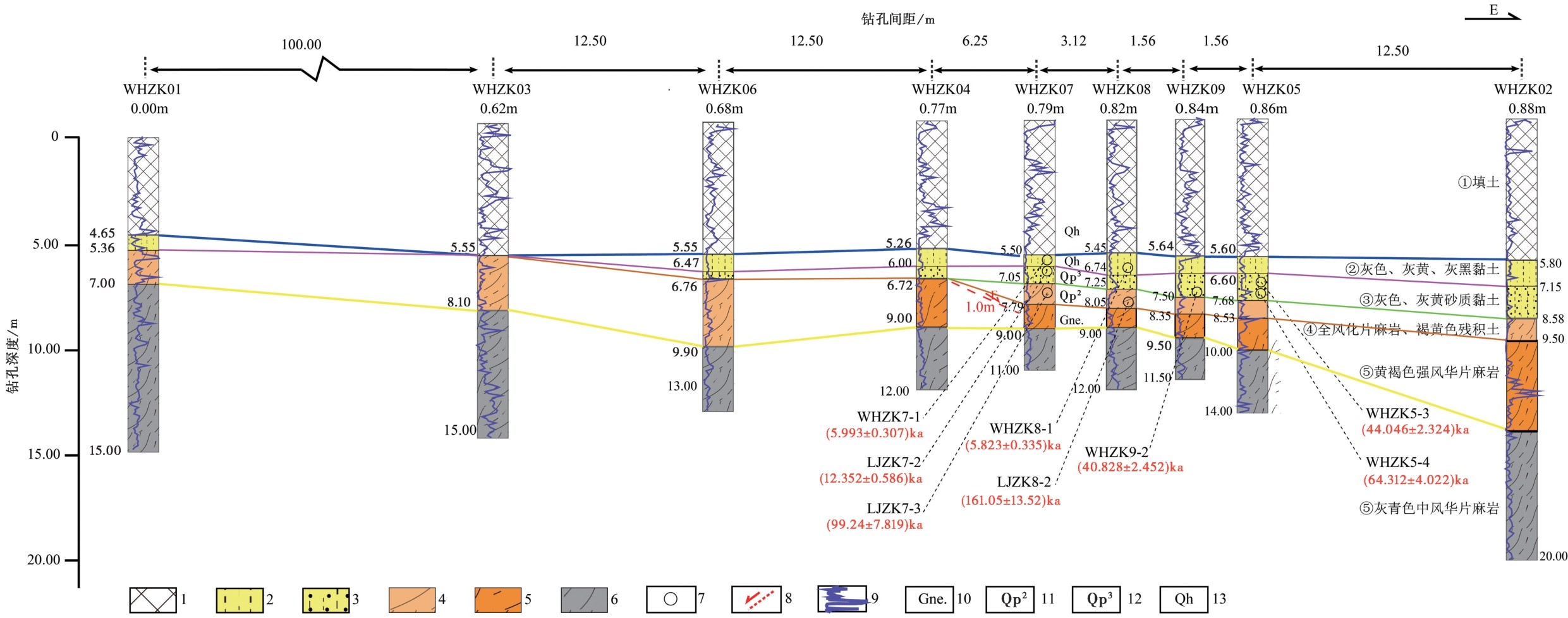
图8 庐江外环北路钻孔联合剖面图 1. 填土; 2. 黏土; 3. 砂质黏土; 4. 褐黄色全风化片麻岩; 5. 浅棕红色强风化片麻岩; 6. 灰黑色中风化片麻岩; 7. 光释光样品采样编号、位置及测试年龄; 8. 推测断层; 9. 磁化率测定曲线; 10. 片麻岩基底; 11. 中更新统; 12. 上更新统; 13. 全新统
Fig. 8 Integrated geological profile of Lujiang Outer Ring north road borehole.
| 断层名称 | 排钻 名称 | 上断点埋深 /m | 断距 | 倾向、 倾角 | 地层年代下限 | 上覆未错断地层及 年龄约束(上限) | 最新活动 时代判定 | 主要判定依据 |
|---|---|---|---|---|---|---|---|---|
| 池河-太湖 断裂 | 姚庄 排钻 | 25.4~30.5 | 松散沉积层,垂直断距约2.2m,基岩垂直断距约18m | W倾, 约80° | 中更新统下部,年龄为(141.6±12.0)~(144.4±13.9)ka | 中更新统上部, 年龄为(121.3± 10.8)ka | 中更新世 晚期 | 剖面显示断裂清晰切穿中更新统下部,被上覆中更新统上部稳定覆盖,区间约束严格。 |
| 池河-太湖 断裂 | 阚石路 排钻 | 83.0~84.0 | 垂直落差 1.0~1.8m | W倾, 约50° | 早更新统,年龄为(150.2±12.3)~(153.2±13.1)ka | 中更新统上部,年龄 为(105.1±8.0)~ (128.0±10.4)ka | 中更新世 晚期 | 结合年代学数据与地层接触关系,最新一次显著垂直错断发生在中更新世晚期(距今约150ka前后) |
| 嘉山-庐江 断裂 | 南庄 排钻 | 7.5~12.2 | 主断裂基底,垂直断距0.7~1.0m | E倾, 约60° | 早更新统,年龄为(137±15)~(154±22)ka | 中更新统,年龄 为(102.1±7.1)~ (191.6±20.7)ka | 早更新世及之前(垂直)、晚更新世-全新世(潜在走滑) | 1)宏观地质关系显示中、晚更新统未见显著垂直错断;2)断裂带内获取的年轻测年数据为11~67ka,指示潜在的水平走滑活动。 |
| 嘉山-庐江 断裂 | 外环北路 排钻 | 7.5~8.5 | 基岩顶面,垂直落差0.5~0.8m | E倾, 正断 | 基岩顶面残积层及中更新统下部,年龄为(64.312±4.022)ka | 上更新统底部,年龄 为(12.352±0.586)~ (44.046±2.324)ka | 中更新世或更早(垂直)、晚更新世-全新世(潜在走滑) | 上覆未受扰动的基底顶面残积层(64.3ka)约束了断裂垂直活动的上限,表明晚更新世以来无显著垂直位错;结合右旋走滑机制及断层带内部分年轻测年数据,判定晚期以水平运动为主。 |
表3 郯庐断裂肥东-庐江段钻孔联合地质剖面勘探断点特征一览表
Table 3 Characteristics of break point in integrated borehole geological profiles along the Feidong-Lujiang section of the Tan-Lu fault zone
| 断层名称 | 排钻 名称 | 上断点埋深 /m | 断距 | 倾向、 倾角 | 地层年代下限 | 上覆未错断地层及 年龄约束(上限) | 最新活动 时代判定 | 主要判定依据 |
|---|---|---|---|---|---|---|---|---|
| 池河-太湖 断裂 | 姚庄 排钻 | 25.4~30.5 | 松散沉积层,垂直断距约2.2m,基岩垂直断距约18m | W倾, 约80° | 中更新统下部,年龄为(141.6±12.0)~(144.4±13.9)ka | 中更新统上部, 年龄为(121.3± 10.8)ka | 中更新世 晚期 | 剖面显示断裂清晰切穿中更新统下部,被上覆中更新统上部稳定覆盖,区间约束严格。 |
| 池河-太湖 断裂 | 阚石路 排钻 | 83.0~84.0 | 垂直落差 1.0~1.8m | W倾, 约50° | 早更新统,年龄为(150.2±12.3)~(153.2±13.1)ka | 中更新统上部,年龄 为(105.1±8.0)~ (128.0±10.4)ka | 中更新世 晚期 | 结合年代学数据与地层接触关系,最新一次显著垂直错断发生在中更新世晚期(距今约150ka前后) |
| 嘉山-庐江 断裂 | 南庄 排钻 | 7.5~12.2 | 主断裂基底,垂直断距0.7~1.0m | E倾, 约60° | 早更新统,年龄为(137±15)~(154±22)ka | 中更新统,年龄 为(102.1±7.1)~ (191.6±20.7)ka | 早更新世及之前(垂直)、晚更新世-全新世(潜在走滑) | 1)宏观地质关系显示中、晚更新统未见显著垂直错断;2)断裂带内获取的年轻测年数据为11~67ka,指示潜在的水平走滑活动。 |
| 嘉山-庐江 断裂 | 外环北路 排钻 | 7.5~8.5 | 基岩顶面,垂直落差0.5~0.8m | E倾, 正断 | 基岩顶面残积层及中更新统下部,年龄为(64.312±4.022)ka | 上更新统底部,年龄 为(12.352±0.586)~ (44.046±2.324)ka | 中更新世或更早(垂直)、晚更新世-全新世(潜在走滑) | 上覆未受扰动的基底顶面残积层(64.3ka)约束了断裂垂直活动的上限,表明晚更新世以来无显著垂直位错;结合右旋走滑机制及断层带内部分年轻测年数据,判定晚期以水平运动为主。 |
| [46] |
张岳桥, 董树文. 2008. 郯庐断裂带中生代构造演化史: 进展与新认识[J]. 地质通报, 27(9): 1371-1390.
|
|
|
|
| [47] |
赵朋, 姚大全, 杨源源, 等. 2017. 郯庐断裂带安徽浮山段晚第四纪以来活动新发现[J]. 地震地质, 39(5): 889-903. doi: 10.3969/j.issn.0253-4967.2017.05.002.
|
|
DOI |
|
| [48] |
赵朋, 姚大全, 郑海刚, 等. 2018. 郯庐断裂带安徽明光段紫阳山探槽及其意义[J]. 中国地震, 34(4): 642-651.
|
|
|
|
| [49] |
赵朋, 李军辉, 陶月潮, 等. 2023. 郯庐断裂带女山湖北侧探槽的新活动现象及讨论[J]. 地震地质, 45(2): 338-354. doi: 10.3969/j.issn.0253-4967.2023.02.003.
|
|
DOI |
|
| [50] |
赵田, 朱光, 林少泽, 等. 2014. 郯庐断裂带张八岭隆起段变质岩的原岩时代与变形机制[J]. 中国科学(地球科学), 44(10): 2112-2129.
|
|
|
|
| [51] |
郑海刚, 姚大全, 赵朋, 等. 2023. 郯庐断裂带赤山段全新世新活动的特征[J]. 地震地质, 45(1): 127-138. doi: 10.3969/j.issn.0253-4967.2023.01.007.
|
|
DOI |
|
| [52] |
郑颖平, 方良好, 疏鹏, 等. 2020. 合肥市活断层探测与地震危险性评价[M]. 北京: 科学出版社.
|
|
|
|
| [53] |
朱光, 刘程, 顾承串, 等. 2018. 郯庐断裂带晚中生代演化对西太平洋俯冲历史的指示[J]. 中国科学(地球科学), 48(4): 415-435.
|
|
DOI |
|
| [54] |
朱光, 王薇, 顾承串, 等. 2016. 郯庐断裂带晚中生代演化历史及其对华北克拉通破坏过程的指示[J]. 岩石学报, 32(4): 935-949.
|
|
|
|
| [55] |
|
| [1] |
安徽省地质矿产局. 1987. 安徽省区域地质志[M]. 北京: 地质出版社.
|
|
Bureau of Geology and Mineral Resources of Anhui Province. 1987. Regional Geology of Anhui Province[M]. Geological Publishing House, Beijing (in Chinese).
|
|
| [2] |
曹筠, 冉勇康, 许汉刚, 等. 2015. 宿迁城市活动断层探测多方法技术运用的典型案例[J]. 地震地质, 37(2): 430-439. doi: 10.3969/j.issn.0253-4967.2015.02.007.
|
|
DOI |
|
| [3] |
曹筠, 许汉刚, 冉勇康, 等. 2017. 郯庐断裂带沂水-汤头断裂南段晚第四纪活动新证及构造意义[J]. 地震地质, 39(2): 287-303. doi: 10.3969/j.issn.0253-4967.2017.02.003.
|
|
DOI |
|
| [4] |
晁洪太, 李家灵, 崔昭文, 等. 1994. 郯庐断裂带中段全新世活断层的特征滑动行为与特征地震[J]. 内陆地震, 8(4): 297-304.
|
|
|
|
| [5] |
陈海云, 舒良树, 张云银, 等. 2004. 合肥盆地中新生代构造演化[J]. 高校地质学报, 10(2): 250-256.
|
|
|
|
| [6] |
陈书平, 田作基, 徐世东, 等. 2024. 2种结构类型的走滑相关剪断裂带[J]. 地质通报, 43(1): 13-19.
|
|
|
|
| [7] |
程捷, 万天丰. 1996. 郯庐断裂带在新生代的演化[J]. 地质科技情报, 15(3): 35-42.
|
|
|
|
| [8] |
邓起东, 冉勇康, 杨晓平, 等. 2007. 中国活动构造图(1︰400万)[CM]. 北京: 地震出版社.
|
|
|
|
| [9] |
邓宇涛, 方维萱, 柳玉龙, 等. 2009. 磁化率参数在地层中的特征及应用[J]. 矿物学报, 29(S1): 528-529.
|
|
|
|
| [10] |
丁国瑜, 中国地震学会地震地质专业委员会. 1982. 中国活动断裂[M]. 北京: 地震出版社: 1-9.
|
|
|
|
| [11] |
董雅竹, 谭颖, 张朋辉, 等. 2021. 利用PS-InSAR研究合肥地区活动构造变形[J]. 地球物理学进展, 36(5): 1822-1833.
|
|
|
|
| [12] |
方良好, 路硕, 疏鹏, 等. 2022. 郯庐断裂南段怀远-池河NW向断裂的第四纪活动性: 来自韭山东北缘的地质证据[J]. 地质论评, 68(6): 2248-2258.
|
|
|
|
| [13] |
方良好, 疏鹏, 路硕, 等. 2020. 郯庐断裂带庐江段嘉山-庐江断裂第四纪活动特征[J]. 防灾科技学院学报, 22(2): 33-38.
|
|
|
|
| [14] |
高级, 张海江, 黄宇奇, 等. 2025. 背景噪声成像揭示郯庐断裂带张八岭段上地壳广泛存在NW向隐伏断裂[J]. 中国科学(地球科学), 55(6): 1929-1941.
|
|
DOI URL |
|
| [15] |
顾勤平, 许汉刚, 晏云翔, 等. 2020. 郯庐断裂带新沂段地壳浅部结构和断裂活动性探测[J]. 地震地质, 42(4): 825-843. doi: 10.3969/j.issn.0253-4967.2020.04.004.
|
|
DOI |
|
| [16] |
国家地震局地质研究所. 1987. 郯庐断裂[M]. 北京: 地震出版社.
|
|
Institute of Geology, State Seismological Bureau. 1987. The Tanlu Fault Zone[M]. Seismological Press, Beijing (in Chinese).
|
|
| [17] |
花茜, 裴顺平, 李涛, 等. 2025. 喀什市浅层地壳高分辨率S波速度结构成像[J]. 地震地质, 47(2): 533-546. doi: 10.3969/j.issn.0253-4967.2025.02.20240160.
|
|
DOI |
|
| [18] |
雷启云, 柴炽章, 孟广魁, 等. 2011. 隐伏活断层钻孔联合剖面对折定位方法[J]. 地震地质, 33(1): 45-55. doi: 10.3969/j.issn.0253-4967.2011.01.005.
|
|
DOI |
|
| [19] |
李家灵, 晁洪太, 崔昭文, 等. 1994. 郯庐活断层的分段及其大震危险性分析[J]. 地震地质, 16(2): 121-126.
|
|
|
|
| [20] |
李玲利, 黄显良, 姚华建, 等. 2020. 合肥市地壳浅部三维速度结构及城市沉积环境初探[J]. 地球物理学报, 63(9): 3307-3323.
DOI |
|
|
|
| [21] |
李水平, 王建光, 程华, 等. 2013. 钻孔岩心岩(矿)石磁化率参数特征并用于地层岩性划分[J]. 物探与化探, 37(5): 775-778.
|
|
|
|
| [22] |
李忠, 李任伟, 孙枢, 等. 1999. 合肥盆地南部侏罗系砂岩碎屑组分及其物源构造属性[J]. 岩石学报, 15(3): 438-445.
|
|
|
|
| [23] |
李宗超, 纪志伟, 孙吉泽, 等. 2025. 基于安徽合肥MS4.7地震快速估计本地区MS6.0设定地震加速度时程及其破坏能力[J]. 地球与行星物理论评(中英文), 56(3): 338-351.
|
|
|
|
| [24] |
刘保金, 柴炽章, 酆少英, 等. 2008. 第四纪沉积区断层及其上断点探测的地震方法技术: 以银川隐伏活动断层为例[J]. 地球物理学报, 51(5): 1475-1483.
|
|
|
|
| [25] |
刘保金, 酆少英, 姬计法, 等. 2015. 郯庐断裂带中南段的岩石圈精细结构[J]. 地球物理学报, 58(5): 1610-1621.
DOI |
|
|
|
| [26] |
刘国生, 朱光, 牛漫兰, 等. 2006. 合肥盆地东部中-新生代的演化及其对郯庐断裂带活动的响应[J]. 地质科学, 41(2): 256-269.
|
|
|
|
| [27] |
秦晶晶, 石金虎, 张毅, 等. 2018. 郯庐断裂带合肥段五河-合肥断裂构造特征[J]. 地球物理学报, 61(11): 4475-4485.
DOI |
|
|
|
| [28] |
石光耀, 潘志龙, 李庆喆, 等. 2023. 大兴凸起北部D1钻孔岩心特征及第四纪地层划分[J]. 地质通报, 42(12): 2132-2141.
|
|
|
|
| [29] |
石光耀, 潘志龙, 张欢, 等. 2021. 河北平原三河S9孔岩心特征及第四纪地层划分研究[J]. 现代地质, 35(5): 1332-1342.
|
|
|
|
| [30] |
宋新初, 周本刚, 杨晓平, 等. 2014. 城市活动断层探测方法与实践[M]. 北京: 地震出版社: 83-103.
|
|
|
|
| [31] |
汤加富, 许卫. 2002. 郯庐断裂带南段并无巨大平移: 来自安徽境内的证据[J]. 地质论评, 48(5): 449-456.
|
|
|
|
| [32] |
汤有标, 姚大全. 1990. 郯庐断裂带赤山段晚更新世以来的活动性[J]. 中国地震, 6(2): 63-69.
|
|
|
|
| [33] |
魏雷鸣, 徐锡伟, 陈桂华, 等. 2025. 北京平原大厂凹陷XD04孔第四纪地层划分及其构造意义[J]. 地球物理学报, 68(10): 3726-3742.
|
|
|
|
| [34] |
肖坤泽, 童亨茂, 崔浩, 等. 2025. 郯庐断裂带新生代研究进展及右旋走滑成因机制探讨[J]. 地质论评, 71(3): 959-978.
|
|
|
|
| [35] |
徐嘉炜, 马国锋. 1992. 郯庐断裂带研究的十年回顾[J]. 地质论评, 38(4): 316-324.
|
|
|
|
| [36] |
许顺山, 彭华,
|
|
|
|
| [37] |
杨源源, 赵朋, 郑海刚, 等. 2017. 郯庐断裂带安徽紫阳山段发现全新世活动证据[J]. 地震地质, 39(4): 644-655. doi: 10.3969/j.issn.0253-4967.2017.04.002.
|
|
DOI |
|
| [38] |
杨源源, 李鹏飞, 路硕, 等. 2022. 郯庐断裂带中段F5断裂淮河-女山湖段的古地震与垂直滑动速率[J]. 地震地质, 44(6): 1365-1383. doi: 10.3969/j.issn.0253-4967.2022.06.002.
|
|
DOI |
|
| [39] |
杨源源, 李飞, 李鹏飞, 等. 2025. 嘉山-庐江断裂合肥盆地段第四纪活动特征初探[J]. 地震工程学报, 47(2): 426-436.
|
|
|
|
| [40] |
姚大全, 汤有标, 沈小七, 等. 2012. 郯庐断裂带赤山段中晚更新世之交的史前地震遗迹[J]. 地震地质, 34(1): 93-99. doi: 10.3969/j.issn.0253-4967.2012.01.009.
|
|
DOI |
|
| [41] |
姚大全, 郑海刚, 赵朋, 等. 2017. 郯庐断裂带淮河南到女山湖段晚第四纪以来的新活动[J]. 中国地震, 33(1): 38-45.
|
|
|
|
| [42] |
张交东, 杨长春, 刘成斋, 等. 2010. 郯庐断裂南段走滑和伸展断裂的深部结构及位置关系[J]. 地球物理学报, 53(4): 864-873.
|
|
|
|
| [43] |
张鹏, 李丽梅, 冉勇康, 等. 2015. 郯庐断裂带安丘-莒县断裂江苏段晚第四纪活动特征研究[J]. 地震地质, 37(4): 1162-1176. doi: 10.3969/j.issn.0253-4967.2015.04.018.
|
|
DOI |
|
| [56] |
|
| [57] |
|
| [58] |
|
| [59] |
|
| [60] |
|
| [61] |
|
| [62] |
DOI URL |
| [63] |
|
| [44] |
张鹏, 王良书, 钟锴, 等. 2007. 郯庐断裂带的分段性研究[J]. 地质论评, 53(5): 586-591.
|
|
|
|
| [45] |
张鹏, 张媛媛, 李丽梅, 等. 2019. 郯庐断裂带安丘-莒县断裂江苏段全新世活动的新证据[J]. 地震地质, 41(3): 576-586. doi: 10.3969/j.issn.0253-4967.2019.03.003.
|
|
DOI |
| [1] | 闫成国, 王志胜, 张文朋, 胥勤勉, 高武平, 杨菲, 安立强. 天津潮白河断裂深浅部构造特征及晚第四纪活动性[J]. 地震地质, 2026, 48(5): 1231-1252. |
| [2] | 王鑫, 高敏, 乔计花, 向健斌, 徐雨晨, 樊继迪. 郯庐断裂带中段重力均衡及深部孕震环境[J]. 地震地质, 2026, 48(3): 741-756. |
| [3] | 付俊东, 吴海英, 张建民, 鹿子林, 夏暖, 李志恒, 王雷, 邹奇峰. 郯庐断裂带安丘-莒县断裂南流段晚第四纪活动特征[J]. 地震地质, 2026, 48(3): 757-773. |
| [4] | 李细兵, 陶小三, 顾勤平, 彭小波, 王宇, 朱峰. 郯庐断裂带中南段地壳上地幔顶部P波速度结构及其构造意义[J]. 地震地质, 2026, 48(2): 423-441. |
| [5] | 钱婷, 陈昊, 何奕成, 江昊琳, 杜航, 倪昊琦. 郯庐断裂带中南段高分辨率地壳速度结构与地震活动空间差异特征分析[J]. 地震地质, 2026, 48(2): 442-459. |
| [6] | 陈艳文, 袁道阳, 姚赟胜, 于锦超, 文亚猛, 苏瑞欢, 孙浩. 祁连山东段玛雅雪山断裂晚第四纪活动特征及其构造意义[J]. 地震地质, 2025, 47(6): 1566-1585. |
| [7] | 赵雪锋, 沈军, 巨广宏, 马飞朋, 赵文刚, 宋旭. 哈密盆地北缘断裂东段晚第四纪活动性[J]. 地震地质, 2025, 47(5): 1477-1493. |
| [8] | 王度, 陈立春, 李彦宝, 王虎, 贾永顺, 高茵怡, 薛柯依. 藏南申扎-定结裂谷系谢通门-登么错段晚第四纪活动特征[J]. 地震地质, 2025, 47(3): 718-733. |
| [9] | 陈柏旭, 余中元, 肖鹏, 戴训也, 张世龙, 郑荣荧. 青藏高原东北缘榆木山东缘断裂地表破裂带的新发现及其地震地质意义[J]. 地震地质, 2024, 46(3): 589-607. |
| [10] | 赵朋, 李军辉, 陶月潮, 疏鹏, 方震. 郯庐断裂带女山湖北侧探槽的新活动现象及讨论[J]. 地震地质, 2023, 45(2): 338-354. |
| [11] | 郑海刚, 姚大全, 赵朋, 杨源源, 黄金水. 郯庐断裂带赤山段全新世新活动的特征[J]. 地震地质, 2023, 45(1): 127-138. |
| [12] | 田一鸣, 杨卓欣, 王志铄, 石金虎, 张扬, 谭雅丽, 张建志, 宋威, 季通宇. 新乡-商丘断裂封丘段浅部探测和第四纪活动性的初步研究[J]. 地震地质, 2023, 45(1): 139-152. |
| [13] | 杨源源, 李鹏飞, 路硕, 疏鹏, 潘浩波, 方良好, 郑海刚, 赵朋, 郑颖平, 姚大全. 郯庐断裂带中段F5断裂淮河-女山湖段的古地震与垂直滑动速率[J]. 地震地质, 2022, 44(6): 1365-1383. |
| [14] | 沈军, 戴训也, 肖淳, 焦轩凯, 白其乐格尔, 邓梅, 刘泽众, 夏方华, 刘玉, 刘明. 夏垫西断裂的晚第四纪活动性[J]. 地震地质, 2022, 44(4): 909-924. |
| [15] | 秦晶晶, 刘保金, 王志才, 酆少英, 邓小娟, 花鑫升, 李倩. 利用地震反射剖面探测研究安丘-莒县断裂板泉段的浅部构造特征[J]. 地震地质, 2022, 44(2): 349-362. |
| 阅读次数 | ||||||
|
全文 |
|
|||||
|
摘要 |
|
|||||